15 Amazing Facts About Hand Structure, Function, Bones, Nerves, Muscles & Anatomy
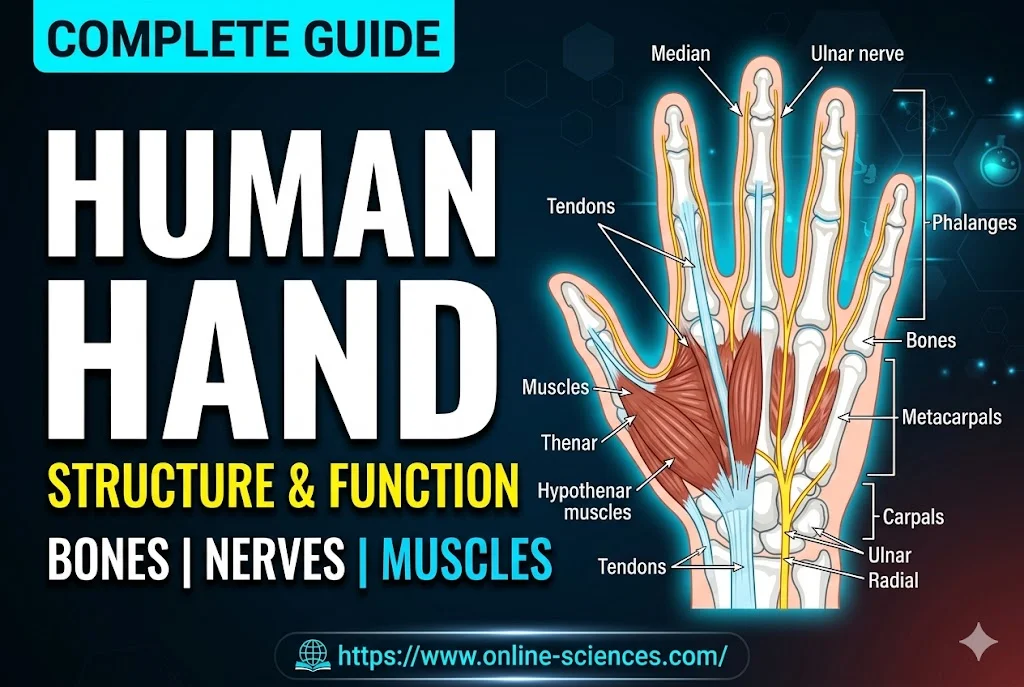
Hand structure is one of the most complex and remarkable designs in the human body. The human hand consists of bones, muscles, tendons, ligaments, nerves, blood vessels, and joints that work together to perform precise movements and powerful gripping actions. From writing and typing to lifting objects and feeling textures, the hands play a crucial role in everyday activities. Their unique anatomy allows both strength and dexterity, making them essential for communication, work, and survival.
Hand structure
Hand
The hand is a prehensile, multi-fingered appendage located at the end of the forearm or forelimb of primates such as humans, chimpanzees, monkeys, and lemurs. The human hand has five digits: four fingers plus one thumb; these are referred to collectively as five fingers, however, whereby the thumb is included as one of the fingers.
The hand has 27 bones, not including the sesamoid bone, the number of which varies among people, 14 of which are the phalanges (proximal, intermediate, and distal) of the fingers and thumb. Fingers contain some of the densest areas of nerve endings in the body and are the richest source of tactile feedback. The hand is responsible for the creative manifestations that characterize the human species and that distinguish it from all other known forms of life.
Cutaneous nerve supply
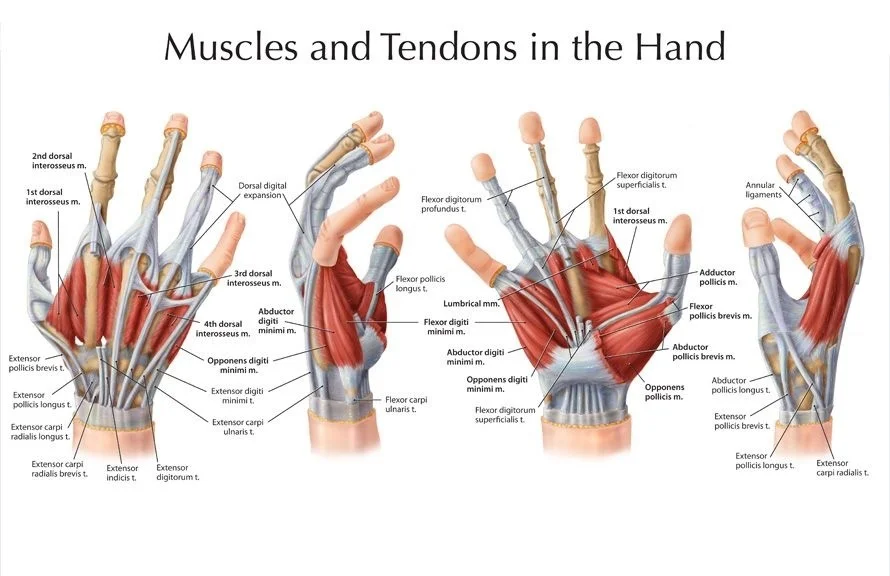
Hand muscles
Palm of the hand
- Cutaneous branches of the median nerve (lateral 2/3 and lateral 3 ½ fingers).
- Cutaneous branches of the ulnar nerve (medial 1/3 of palm and medial 1 ½ fingers).
Dorsum of the hand
- Cutaneous branches of the radial nerve (lateral 2/3 lateral and 3 ½ fingers except the nail bed and adjacent skin by the median nerve).
- Cutaneous branches of the ulnar nerve (medial 1/3 and medial 1 ½ fingers).
- Skin over the base of the thumb by the musculocutaneous nerve.
Deep fascia of the hand
1. Flexor Retinaculum
- It is a thick and strong fibrous band that bridges over the carpal groove (made by carpal bones). It converts the carpal groove into an osseo-fibrous tunnel (carpal tunnel).
- It keeps the long flexor tendons in position during movement of the wrist.
- The retinaculum is attached medially to the pisiform and hamate, while laterally it is attached to the scaphoid and trapezium.
Structures superficial to the flexor retinaculum
- Ulnar nerve.
- Ulnar vessels.
- Cutaneous branches of the ulnar nerve.
- Cutaneous branches of the median nerve.
- Tendon of the palmaris longus.
Structures deep to flexor retinaculum
- Median nerve.
- Flexor digitorum profundus and flexor digitorum superficialis tendons with a common synovial sheath.
- Flexor pollicis longus and its synovial sheath.
- Flexor carpi radialis in a separate tunnel.
2. Palmar aponeurosis
It is a triangular thickening of the deep fascia of the palm. Its apex is directed upwards while the base is divided into 4 slips; each for each of the median 4 fingers. Function: Protection of the underlying vessels and nerves of the palm of the hand.
3. Extensor retinaculum
It is a thickening of the deep fascia at the back of the wrist. It is attached laterally to the anterior border of the radius and medially to the triquetral and pisiform bones. It sends septa to the back of the lower and of the radius and ulna, forming 6 extensor compartments.
Structures superficial to the extensor retinaculum
- Basilic vein.
- Dorsal cutaneous branch of the ulnar nerve.
- Superficial radial nerve.
4. Extensor expansion
The tendons of the extensor digitorum muscle pass onto the dorsal aspect of the digits and expand over the proximal phalanges to form complex extensor expansions. Each extensor expansion is triangular in shape, with the apex attached to the distal phalanx. It divides into three bands:
The central (Middle) band is attached to the middle phalanx. The lateral bands are attached to the terminal phalanx. The tendons of the extensor digiti minimi, extensor indicis muscles join these expansions. It gives attachment to the lumbricals and interossei. Through this attachment, the writing position (Flexion of metacarpo-phalangeal joins and extension of interphalangeal joints of the medial four fingers) can be done.
Muscles of the hand
There are 4 groups:
- Thenar muscles.
- Hypothenar muscles.
- Lumbricals
- Interossel (palmar and dorsal).
And the palmaris brevis muscle. (small muscle lies in the superficial fascia of the palm).
Thenar muscles
4 muscles include:
- Muscles of the thenar eminence (abductor pollicis brevis, flexor pollicis brevis and opponens pollicis.
- Adductor pollicis.
Actions:
- Flexor pollicis brevis: helps in flexion of the thumb.
- Abductor pollicis brevis: helps in abduction of the thumb.
- Opponens pollicis: opposition of the thumb.
- Adductor pollicis: adduction of the thumb.
Hypothenar muscles
- Flexor digiti minimi.
- Abductor digiti minimi
- Opponens digiti minimi
Action:
- Flexor digiti minimi: helps in flexion of the little finger.
- Abductor digiti minimi: helps in abductor of the little finger.
- Opponens digiti minimi: opposition of the little finger.
Lumbrical muscle
4 muscles are attached to the lateral aspect of the tendons of the flexor digitorum profundus. Action: Helps in writing a position.
Interossei
They are small muscles that occupy the interosseous spaces. They are palmar and dorsal interossei.
Palmar interossei:
- They are 4 in number.
- They are much small than the dorsal ones.
- Their action is to adduct the fingers (move them towards the axis that pass through the middle finger).
- The first palmar interosseous is usually rudimentary or completely absent as its action is carried by adductor pollicis muscle.
Dorsal interossei:
- They are 4 in number.
- They are much larger than the palmar interossei.
- Their action is to abduct the fingers (move them away from the middle finger).
Nerve supply of the small muscles of the hand:
All muscles of the hand are supplied by the deep branch of the ulnar nerve EXCEPT.
- The first and second lumbrical (median nerve).
- The palmaris brevis (superficial branch of the ulnar nerve).
- Muscles of the thenar eminence (flexor pollicis brevis, abductor pollicis brevis & opponens pollicis) are supplied by the median nerve.
Anatomical Snuff Box:
- It is a triangular skin depression on the lateral side of the wrist.
- Boundaries: medially: the tendon of the extensor pollicis longus. Laterally: the tendons of the abductor pollicis longus and extensor pollicis brevis.
- Its clinical importance lies in the fact that the scaphoid bone is most easily palpated on the floor, where the pulsations of the radial artery can be felt.
Hands Anatomy
The human hand is composed of 27 bones, numerous muscles, and an intricate network of nerves and blood vessels. It is divided into three main regions:
- Wrist (Carpus): The wrist contains eight small carpal bones arranged in two rows that provide flexibility and stability.
- Palm (Metacarpus): The palm contains five metacarpal bones that connect the wrist to the fingers.
- Fingers (Phalanges): Each finger contains three phalanges (proximal, middle, and distal), while the thumb contains only two.
Bones of the Hand
The hand contains a total of 27 bones:
Carpal Bones (8)
- Scaphoid.
- Lunate.
- Triquetrum.
- Pisiform.
- Trapezium.
- Trapezoid.
- Capitate.
- Hamate.
Metacarpal Bones (5)
These bones form the framework of the palm.
Phalanges (14)
- Thumb: 2 phalanges.
- Each finger: 3 phalanges.
The arrangement of these bones allows a wide range of motion and precise control.
Muscles of the Hand
The hand contains both intrinsic and extrinsic muscles.
Intrinsic Muscles
Located within the hand itself, these muscles control fine motor movements such as writing and buttoning clothes.
Extrinsic Muscles
These muscles originate in the forearm and extend into the hand through tendons. They are responsible for stronger movements such as gripping and lifting.
Major Hand Muscle Groups
- Thenar muscles (thumb movements).
- Hypothenar muscles (little finger movements).
- Lumbricals.
- Interossei muscles.
Nerves of the Hand
Three major nerves supply the hand:
- Median Nerve: Controls most thumb movements and provides sensation to the thumb, index finger, middle finger, and part of the ring finger.
- Ulnar Nerve: Supplies many intrinsic hand muscles and sensation to the little finger and part of the ring finger.
- Radial Nerve: Controls extension movements of the wrist and fingers and supplies sensation to part of the back of the hand.
These nerves enable both movement and touch sensation.
Functions of the Hand
- Grasping: The hand can hold objects ranging from heavy tools to delicate items.
- Fine Motor Skills: Hands perform precise movements required for writing, drawing, sewing, and using electronic devices.
- Sensory Function: Thousands of sensory receptors allow the hand to detect temperature, pressure, pain, and texture.
- Communication: Gestures and sign language depend heavily on hand movements.
- Protection: Hands help protect the body from injury and maintain balance.
Common Hand Conditions
- Carpal Tunnel Syndrome.
- Arthritis.
- Tendonitis.
- Trigger Finger.
- Fractures.
- Nerve Compression Injuries.
Understanding hand anatomy helps healthcare professionals diagnose and treat these conditions effectively.
15 Amazing Facts About the Human Hand
- Each hand contains 27 bones.
- The hand has more than 30 muscles involved in movement.
- The thumb contributes nearly 40% of hand function.
- Hands contain thousands of sensory receptors.
- The hand can perform both powerful and delicate movements.
- Fingertips are among the most sensitive areas of the body.
- The median nerve is essential for thumb movement.
- The ulnar nerve controls many fine motor functions.
- Hand muscles work closely with forearm muscles.
- Bones of the hand account for over one-quarter of all bones in the body.
- The thumb has only two phalanges.
- Hand coordination relies on complex nerve signaling.
- Grip strength varies depending on muscle condition and age.
- The human hand is capable of highly precise movements.
- Hand anatomy plays a critical role in daily life and communication.
FAQ About Hands Structure, Function, Bones, Nerves, Muscles, and Anatomy
1. What is the structure of the human hand?
The human hand consists of 27 bones, multiple muscles, tendons, ligaments, nerves, blood vessels, and joints that work together to provide movement and sensation.
2. How many bones are in the hand?
Each hand contains 27 bones: 8 carpal bones, 5 metacarpal bones, and 14 phalanges.
3. What are the main functions of the hand?
The hand is responsible for grasping, fine motor control, sensation, communication through gestures, and protection.
4. Which nerves supply the hand?
The hand is supplied by the median nerve, ulnar nerve, and radial nerve.
5. What muscles control hand movements?
Both intrinsic muscles within the hand and extrinsic muscles from the forearm control hand movements.
6. Why is the thumb important?
The thumb provides opposition and contributes significantly to grip strength and hand dexterity.
7. What is the median nerve’s function?
The median nerve controls many thumb movements and provides sensation to several fingers.
8. What is carpal tunnel syndrome?
Carpal tunnel syndrome occurs when the median nerve becomes compressed at the wrist, causing pain, numbness, and weakness.
9. How do hand bones support movement?
Hand bones form joints that allow flexibility, stability, gripping, and precise finger movements.
10. Why are hands so sensitive?
Hands contain a high concentration of sensory receptors that detect touch, pressure, temperature, and pain.
You can subscribe to Science Online on YouTube from this link: Science Online
Blood vessels of forearm & hand, Veins and Lymphatics of the upper limb
Forearm bones, anatomy, function & Skeleton of the hand
Nerves of forearm and hand, Nerve injuries types & causes
Flexors of forearm, Forearm muscles, structure, function & anatomy
Arm structure, compartments, muscles, anatomy & Cubital Fossa contents
Bones of upper limb structure, function, types & anatomy
Bone (Osseous Tissue) types, structure, function & importance