Types and functions of the blood vessels in the circulatory system, What happens if blood vessels are damaged?
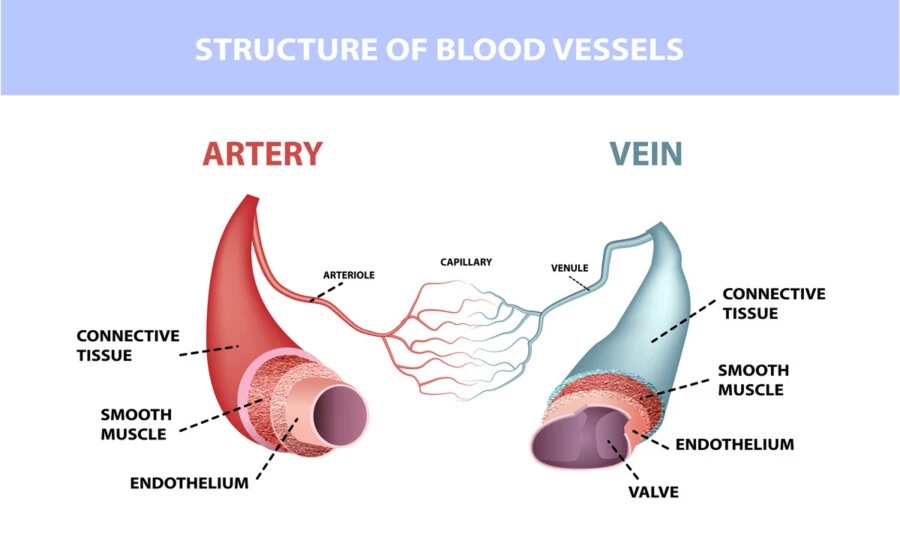
The blood flows inside the body through a network of blood vessels, So, they are the paths of the blood throughout the body. The types of blood vessels are the arteries, the veins, and the blood capillaries.
Arteries
The arteries are thick blood vessels that emerge from the heart exactly from the two ventricles. and they transport the blood from the heart to all the body parts.
The arteries are large and wide at the beginning (at the heart), then they become smaller till the end in a network of blood capillaries near the cells.
All the arteries carry blood rich in oxygen except the pulmonary artery, which carries blood rich in carbon dioxide. The Aorta, and the pulmonary artery are examples of the arteries.
Blood vessels
Veins
The veins are thin blood vessels that begin at the body cells and open in the heart exactly in the two atria, and they carry the blood from all the body parts to the heart at the two atria.
The veins begin in the form of the blood capillaries at the cells, then collect together to become larger till reaching the heart.
All the veins carry the blood rich in carbon dioxide except the pulmonary veins, which carry the blood rich in oxygen. The superior and inferior vena cava are examples of the veins.
The Atria receive the blood from the veins, while the ventricles pump the blood through the arteries. and the Arteries end with the blood capillaries, while the veins begin with the blood capillaries.
Blood vessels
Blood capillaries
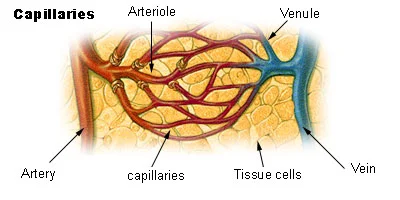
The blood capillaries are the network of tiny blood vessels with very thin walls, and they are located within the tissues and around the cells.
The blood capillaries connect the ends of the arteries and the beginnings of the veins. The thin walls of blood capillaries allow blood to deliver food and oxygen to cells and carry carbon dioxide and wastes.
(FAQ) about the types and functions of blood vessels in the circulatory system:
FAQ about Types and Functions of Blood Vessels
1. What are blood vessels?
Blood vessels are tube-like structures that carry blood throughout the body as part of the circulatory system. They transport oxygen, nutrients, hormones, and waste products.
2. What are the main types of blood vessels?
There are three main types:
- Arteries.
- Veins.
- Capillaries.
Each type has a unique structure and function.
3. What is the function of arteries?
Arteries carry oxygen-rich blood away from the heart to different parts of the body. They have thick, elastic walls to withstand high pressure.
4. What is the function of veins?
Veins carry oxygen-poor blood back to the heart. They contain valves that prevent blood from flowing backward.
5. What are capillaries and their function?
Capillaries are tiny, thin-walled vessels where the exchange of oxygen, nutrients, and wastes occurs between blood and body tissues.
6. What is the difference between arteries and veins?
- Arteries: Thick walls, high pressure, carry blood away from the heart.
- Veins: Thinner walls, low pressure, carry blood toward the heart, and contain valves.
7. Do all arteries carry oxygenated blood?
No. Most arteries carry oxygen-rich blood, except the pulmonary artery, which carries oxygen-poor blood from the heart to the lungs.
8. Do all veins carry deoxygenated blood?
No. Most veins carry oxygen-poor blood, except the pulmonary veins, which carry oxygen-rich blood from the lungs to the heart.
9. Why are capillaries so thin?
Capillaries have very thin walls (one cell thick) to allow easy exchange of gases, nutrients, and wastes through diffusion.
10. How do blood vessels help maintain body functions?
Blood vessels help:
- Deliver oxygen and nutrients.
- Remove carbon dioxide and wastes.
- Regulate body temperature.
- Maintain blood pressure and circulation.
11. What happens if blood vessels are damaged?
Damage can lead to bleeding, reduced oxygen supply, and diseases such as atherosclerosis or high blood pressure.
12. How are blood vessels adapted to their functions?
- Arteries: Thick, elastic walls for high pressure.
- Veins: Valves to prevent backflow.
- Capillaries: Thin walls for exchange.
You can follow science online on YouTube from this link: Science online
Human Transport System Structure of human circulatory system (heart, blood vessels and blood)
Blood pressure, structure, functions and Mechanism of blood clotting