E-Puck Mobile Robot: Definition, Applications, Features, Pros and Cons
The E-Puck mobile robot is a small, programmable educational robot designed for teaching and research in mobile robotics. Originally developed at the École Polytechnique Fédérale de Lausanne (EPFL), it features open-source hardware and software, multiple onboard sensors, and wireless communication, making it suitable for experiments in swarm robotics, artificial intelligence, autonomous navigation, and multi-robot coordination.
What is the E-puck Mobile Robot?
The E-puck mobile robot is a small, programmable, and fully open-source educational robot designed for research and teaching in mobile robotics. It was originally developed at the École Polytechnique Fédérale de Lausanne (EPFL) to offer a compact platform suitable for experiments in swarming, control systems, artificial intelligence, and autonomous navigation. Despite its small physical size, the E-puck is equipped with advanced sensors, communication modules, and processing capabilities.
Design Philosophy and Purpose
The E-puck was created to bridge the gap between theoretical robotics and real-world experimentation. It enables students, educators, and researchers to develop and test algorithms involving movement, interaction, coordination, learning, and multi-robot behavior.
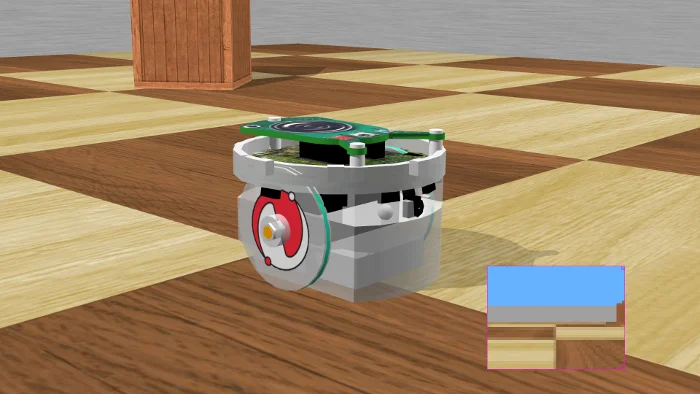
E-Puck Robot
Features of the E-puck Mobile Robot
The E-puck includes a rich set of hardware and software features, such as:
- Compact Size: roughly 70 mm in diameter, enabling easy handling and multi-robot experiments.
- Differential Drive System: two independent wheels for precise motion control.
- Integrated Sensors: including infrared proximity sensors, microphones, an accelerometer, and a camera.
- Onboard Camera: supports image processing and visual tracking.
- Wireless Communication: Bluetooth or other modules for multi-robot interaction.
- Open-Source Software: allowing researchers to customize and modify behavior.
- Modular Expansion: additional modules, such as range finders, RF communication, and Linux-based processors, can be added depending on the research purpose.
What Can the E-Puck Mobile Robot Do?
The E-puck robot is capable of performing multiple robotics tasks commonly needed in education and research environments:
- Obstacle Detection and Avoidance.
- Swarm Robotics Experiments.
- Path Following and Line Tracking.
- Multi-Robot Coordination.
- Mapping and Localization (with expansion modules).
- Machine Learning Experiments.
- Sound Localization.
- Vision-Based Navigation.
- Robot-to-Robot Communication.
- Teaching Advanced Robotics Programming.
These capabilities make it one of the most versatile mobile platforms in academic robotics laboratories worldwide.
Advantages of the E-Puck Robot
The E-puck mobile robot offers several strengths:
- Ideal for Education & Research — designed for hands-on robotics learning.
- Open-Source Architecture — users can modify hardware and software freely.
- Swarm-Ready — supports large multi-robot experiments.
- Rich Sensor Suite — enabling complex AI and control algorithms.
- Expandable Hardware — optional modules increase capabilities.
- Cost-Effective — more affordable than industrial robotics platforms.
- Strong Global Academic Community — extensive research, documentation, and examples available.
Disadvantages of E-puck mobile robot
Despite its benefits, the E-puck has some limitations:
- Not Designed for Industrial Deployment: The E-puck mobile robot is used mainly for labs and education.
- Limited Payload Capacity: due to its small size
- Processing Power Constraints: compared to larger research robots.
- Short Battery Life: The E-puck mobile robot can be limited during long experiments.
- Requires Robotics Programming Knowledge: The E-puck mobile robot is not suitable for total beginners without technical guidance.
Applications of the E-Puck Robot
The E-puck is widely used in:
- University robotics courses.
- Artificial intelligence research.
- Swarm robotics labs.
- Computer vision research.
- Control systems engineering.
- Machine learning and autonomous navigation research.
- It is recognized for its role in helping students and researchers test real-world implementations of robotics algorithms that are often simulated in software.
The E-puck mobile robot stands as an influential platform in robotics education and academic research. While not intended for industrial tasks, its open-source design, expandability, and sensor richness make it highly valuable for teaching core robotics skills, experimenting with artificial intelligence, and studying swarm coordination. As robotics education continues to grow, the E-puck remains an essential tool for bridging theory and practical robotics experimentation.
You can subscribe to Science Online on YouTube from this link: Science Online
Scara robot advantages and disadvantages and What is the structure of the SCARA robot?
Serial Robots review, advantages, disadvantages and what can serial robots do?
Collaborative robot arm (cobot robots) applications, uses, advantages and disadvantages
Automation in manufacturing uses, advantages and disadvantages
Industrial robot (Auto industry) uses, advantages and disadvantages
Robot welding advantages over manual welding