
Mars Colony Design: How Will a Mars Colony Look Like?, How will Mars colony get water and oxygen
The idea of building a colony on Mars is no longer just science fiction; it is becoming a serious scientific and technological goal. With rapid advances in space travel and ambitious plans led by private space companies, the vision of a self-sustaining city on the Red Planet is gaining momentum. From dome-shaped habitats and underground shelters to solar farms and advanced greenhouses, a future Mars colony could redefine how humans live beyond Earth.
How Will a Mars Colony Look Like?
A future Mars colony, as envisioned by Elon Musk and developed by SpaceX, would begin as a small industrial outpost and gradually evolve into a self-sustaining city. It would not look like a traditional Earth city at first — instead, it would resemble a high-tech research base combined with heavy industry and life-support systems.
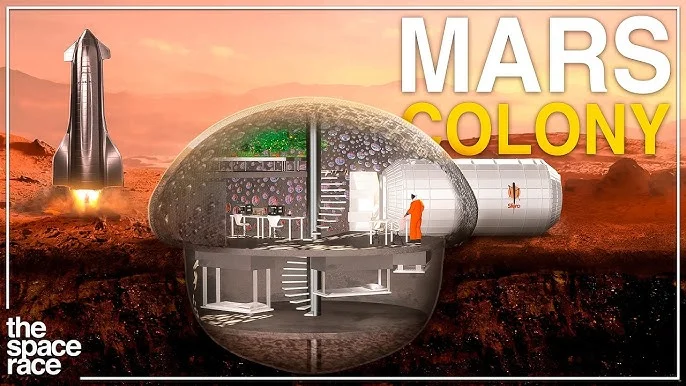
Mars Colony
Here’s what it would likely include:
1. Dome Habitats & Underground Living: Early settlers would live in:
- Pressurized dome structures made from strong composite materials.
- Inflatable habitats covered with Martian soil for radiation protection.
- Underground bases or lava tubes to shield against radiation and extreme temperatures.
Mars has no thick atmosphere or magnetic field, so radiation protection will be essential. Many experts believe long-term habitats may be built partially underground.
2. Power Systems: Large Solar Fields: The colony would likely rely on:
- Massive solar panel farms.
- Battery storage systems.
- Possibly small nuclear reactors in later phases.
Because Mars receives less sunlight than Earth, the solar arrays would need to cover large areas.
3. Greenhouses & Food Production: To become self-sustaining, the colony must grow food locally. Expected systems include:
- Hydroponic and aeroponic farms.
- Controlled-environment agriculture.
- Oxygen-producing plants.
- Water recycling systems.
- Greenhouses may be transparent domes or underground farms with artificial lighting.
4. Fuel Production Plants: A key part of the colony will be fuel production facilities using:
- The Sabatier reaction.
- Carbon dioxide from Mars’ atmosphere.
- Water ice mined from below the surface.
This allows Starship rockets to refuel for return trips to Earth.
5. Robots & Automation: Before large human populations arrive, robots such as Optimus from Tesla could:
- Assemble structures.
- Install solar panels.
- Operate mining equipment.
- Perform maintenance.
- Automation reduces risk and speeds construction.
6. Transportation & Landing Zones: The colony would include:
- Large landing pads for Starships.
- Storage hangars.
- Pressurized rover vehicles.
- Cargo unloading stations.
Over time, hundreds or even thousands of Starships could land during favorable Earth–Mars launch windows.
7. Long-Term Mars City Vision: If the colony succeeds, it could eventually feature:
- Residential districts.
- Research labs.
- Schools and medical centers.
- Manufacturing facilities.
- Underground transport tunnels.
Musk has suggested a long-term population goal of one million people.
FAQ About a Mars Colony
1. When could the first Mars colony begin?
Uncrewed missions may launch around 2026, with potential crewed landings targeted for 2029 or 2031, depending on technology readiness.
2. Where will the first colony likely be built?
One leading candidate is Arcadia Planitia, chosen for its flat terrain and accessible water ice.
3. How will people breathe on Mars?
Oxygen would be produced by:
4. How will colonists get water?
Water ice beneath the Martian surface would be mined, melted, purified, and recycled continuously.
5. How will colonists be protected from radiation?
Protection methods may include:
- Living underground.
- Covering habitats with Martian soil.
- Using specialized shielding materials.
6. What will people eat on Mars?
Initially, packaged food from Earth. Later:
- Hydroponic vegetables.
- Lab-grown protein.
- Controlled greenhouse crops.
7. How cold is Mars?
Mars temperatures can drop to –125°C (–195°F) at night, requiring insulated and heated habitats.
8. Will Mars colonies be independent from Earth?
The ultimate goal is a self-sustaining city capable of surviving without constant supply shipments from Earth.
9. How many people could live on Mars?
Long-term plans suggest up to one million people, but early missions may include only dozens of settlers.
10. Why build a Mars colony at all?
The main reasons include:
- Ensuring the long-term survival of humanity.
- Advancing science and technology.
- Expanding civilization beyond Earth.
You can follow Science Online on YouTube from this link: Science online
The importance and uses of solar cells (photovoltaic cells)