
Nanotechnology in Medicine: 7 Powerful Uses & Amazing Benefits for Modern Healthcare
Nanotechnology in medicine is an exciting field that uses extremely small materials and devices to improve the prevention, diagnosis, and treatment of diseases. By working at the nanoscale, scientists can develop advanced drug-delivery systems, medical imaging techniques, diagnostic tools, cancer therapies, tissue-engineering approaches, and other innovative healthcare technologies.
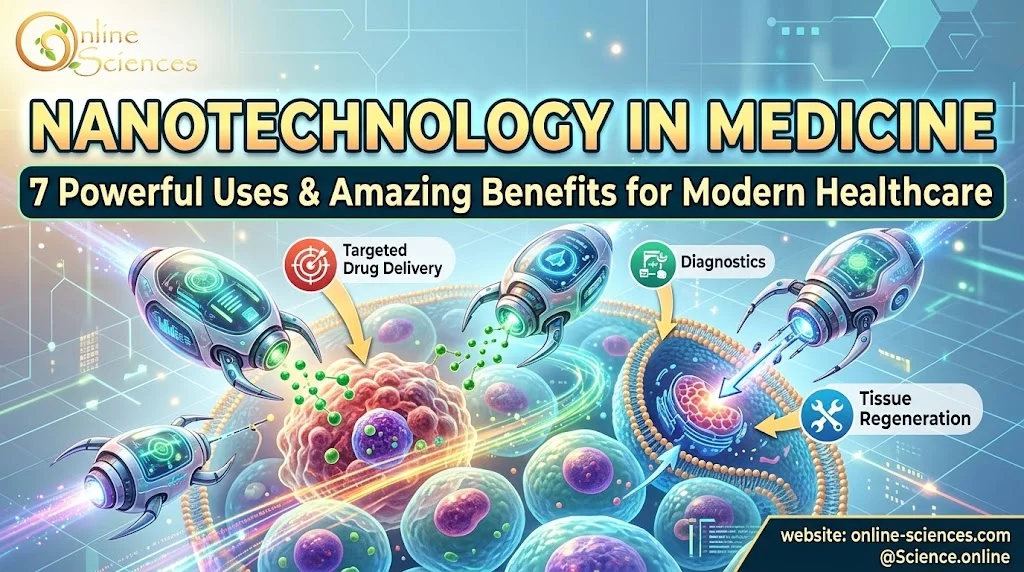
Nanotechnology in medicine
Nanomedicine
Nanomedicine is the medical application of nanotechnology. It ranges from the medical applications of nanomaterials to nanoelectronic biosensors and applications of molecular, It preserves and improves human health by using molecular tools and molecular knowledge of the human body.
Nanotechnology in medicine
Nanomedicine involves the use of nanoparticles in the surgical and medical treatment of patients, and it is used for the treatment of diseases in living organisms. Nanotechnology involves manipulating properties and structures at the nanoscale. It often involves dimensions that are just tiny fractions of the width of a human hair.
Nanotechnology is already used in products such as cosmetics and sunscreens; the nanoscale materials in cosmetic products provide greater clarity or coverage, cleansing, and absorption.
Nanoscale materials are used for antioxidant, antimicrobial, and other health properties in sunscreens, cleansers, complexion treatments, creams and lotions, shampoos, and specialized makeup.
Nanotechnology is used in cancer that can lead to breakthroughs in terms of detecting, diagnosing, and treating various forms of cancer. Medical nanotechnology tools are more personalized, portable, cheaper, safer, and easier to administer.
Nanotechnology will aid in the formation of molecular systems that may be strikingly similar to living systems. These molecular structures could be the basis for the regeneration or replacement of body parts that are currently lost to infection, accident, or disease.
Nanotechnology has been used in the early diagnosis of atherosclerosis, or the buildup of plaque in arteries and gold nanoparticles can be used to detect early-stage Alzheimer’s disease.
Quantum dots are semiconducting nanocrystals that can enhance biological imaging for medical diagnostics. When they are illuminated with ultraviolet light, they emit a wide spectrum of bright colors that can be used to locate and identify specific kinds of cells and biological activities.
These crystals offer optical detection up to 1,000 times better than conventional dyes used in many biological tests, such as MRIs, and render significantly more information.
Nanotechnology is used in multifunctional therapeutics where a nanoparticle serves as a platform to facilitate its specific targeting to the cancer cells and delivery of a potent treatment. They minimize the risk to normal tissues.
Research is underway to use nanotechnology to spur the growth of nerve cells, such as in damaged spinal cord or brain cells. Nanotechnology in medicine will benefit those who suffer from heart disease, respiratory problems, and diabetes in the future. Nanotechnology in medicine will be used to help with fertility issues, brain issues or malfunctions, and even the repair of senses.
Nanotechnology in Medicine 2026
Nanotechnology in medicine is an exciting field that uses extremely small materials, structures, and devices to improve healthcare. Nanotechnology works at the nanoscale, typically involving structures measured in nanometers—one billionth of a meter. At this scale, materials can have unique physical, chemical, and biological properties that differ from their larger forms.
Scientists and medical researchers are using these properties to develop more precise methods for diagnosing diseases, delivering medicines, treating cancer, creating medical implants, and supporting tissue repair. Nanomedicine could therefore contribute to more targeted and personalized healthcare while reducing some limitations of conventional medical technologies.
What is Nanotechnology in Medicine?
Nanotechnology in medicine, often called nanomedicine, involves applying nanoscale science and engineering to medical and biological problems. Nanoparticles, nanofibers, nanotubes, nanosheets, and other nanoscale structures can be engineered to interact with cells, tissues, proteins, and biological molecules.
One important advantage is the ability to design nanoparticles with specific properties. For example, some nanoparticles can carry therapeutic molecules and help deliver them to particular tissues. Other nanoscale materials can improve medical imaging or act as components of diagnostic devices.
However, nanomedicine is not a single treatment. It is a broad technological field that includes both established medical products and emerging research approaches.
7 Important Uses of Nanotechnology in Medicine
1. Targeted Drug Delivery
One of the most important uses of nanotechnology in medicine is drug delivery. Conventional medicines can circulate throughout the body, sometimes affecting healthy tissues as well as diseased tissues.
Nanoparticles can be engineered to transport drugs and release them under particular conditions. Researchers can design their size, surface properties, and chemical composition to influence how they interact with biological systems. This approach may help increase drug concentration at a desired site while potentially reducing exposure to other parts of the body.
2. Cancer Diagnosis and Treatment
Nanotechnology has attracted considerable attention in cancer medicine. Nanoparticles can be investigated as carriers for anticancer drugs, imaging agents, or combinations of diagnostic and therapeutic functions.
Some nanotechnology-based approaches aim to improve the delivery of cancer medicines to tumors. Other technologies are being studied for detecting cancer-related biological signals at an early stage. Researchers are also investigating nanoparticles for techniques such as photothermal therapy, in which certain nanoparticles can convert light energy into heat under controlled conditions.
3. Medical Imaging and Diagnosis
Nanomaterials can improve certain forms of medical imaging and diagnostics. Specially engineered nanoparticles may serve as contrast agents or help researchers detect biological molecules associated with disease.
Nanotechnology can also contribute to highly sensitive biosensors. These devices may detect proteins, genetic material, pathogens, or other biomarkers. The goal is to make some diagnostic processes more sensitive, specific, rapid, or convenient.
4. Tissue Engineering and Regenerative Medicine
Another promising application is tissue engineering. Scientists can create nanoscale structures that imitate aspects of the natural environment surrounding cells.
Nanofibers and nanostructured scaffolds may provide support for cells as tissues develop or repair themselves. Researchers are investigating these materials for applications involving bone, cartilage, skin, nerves, and other tissues. The interaction between cells and nanoscale surfaces can influence processes such as cell attachment, growth, and differentiation.
5. Antibacterial and Antimicrobial Applications
Certain nanomaterials have antimicrobial properties, making them interesting for medical applications. Researchers have investigated nanoparticles and nanostructured coatings that can reduce microbial growth on surfaces.
Potential applications include medical devices, wound dressings, implants, and hospital surfaces. For example, nanoscale coatings may be designed to limit bacterial attachment or activity. The safety and effectiveness of each material must be carefully evaluated because antimicrobial activity does not automatically mean that a nanomaterial is suitable for use in humans.
6. Personalized and Precision Medicine
Nanotechnology may also support personalized medicine, where treatment is adapted to the characteristics of an individual patient or disease. Nanoparticle-based systems can potentially be engineered to carry particular drugs or interact with specific biological targets. Researchers are studying how these technologies could help deliver treatments according to molecular characteristics of diseases.
Combining nanotechnology with genomics, molecular diagnostics, artificial intelligence, and biotechnology could create increasingly sophisticated approaches to precision healthcare.
7. Medical Implants and Devices
Nanotechnology can be used to modify the surfaces and properties of medical implants and devices. Nanoscale surface structures may influence how cells, proteins, and microorganisms interact with an implant.
Researchers are exploring nanostructured materials for applications such as orthopedic implants, dental devices, biosensors, and other medical technologies. Improving the interaction between an implant and surrounding tissue could potentially support better integration and long-term performance.
Importance of Nanotechnology in Medicine
Nanotechnology offers several potential advantages for healthcare. These include more targeted drug delivery, improved diagnostic sensitivity, enhanced imaging, controlled release of therapeutic substances, and the development of new biomaterials.
Another important benefit is its versatility. Nanomaterials can be engineered in many different ways, allowing researchers to investigate solutions for diseases and medical problems that may be difficult to address using conventional materials. Nanotechnology can also work together with other advanced fields, including biotechnology, robotics, artificial intelligence, and molecular medicine.
Challenges and Safety Considerations
Despite its potential, nanotechnology in medicine also presents important challenges. Nanomaterials can behave differently from conventional materials because of their very small size and large surface area. Researchers must carefully evaluate toxicity, distribution within the body, metabolism, long-term effects, immune responses, manufacturing quality, and environmental impact.
Regulatory approval is also essential before a nanotechnology-based medical product can be widely used. A promising laboratory result does not necessarily mean that a technology will become a safe and effective clinical treatment.
The Future of Nanotechnology in Medicine
The future of nanotechnology in medicine may involve increasingly precise systems that combine diagnosis, drug delivery, imaging, and therapy. Scientists are investigating multifunctional nanoparticles capable of performing several tasks within a single medical platform.
Advances in artificial intelligence, biotechnology, materials science, and molecular biology could accelerate the development of these technologies. Nevertheless, successful medical applications will depend on rigorous research, clinical testing, safety evaluation, manufacturing standards, and regulatory oversight.
Conclusion
Nanotechnology in medicine represents an important area of modern medical research and technology. Its applications include targeted drug delivery, cancer treatment and diagnosis, medical imaging, tissue engineering, antimicrobial technologies, personalized medicine, and advanced medical implants.
Although nanomedicine offers significant potential, its development must be accompanied by careful evaluation of safety, effectiveness, and long-term outcomes. As researchers continue to understand and control materials at the nanoscale, nanotechnology could contribute to new approaches for diagnosing and treating a wide range of medical conditions.
You can follow Science Online on YouTube from this link: Science Online
🔥 Tesla Bot Gen 4 UPDATE 5000 Tasks As HOMEMAKER & Surgeon! Elon Musk SHOCKED Inside Optimus! 🤯