
Type of Living organisms according to their feeding
Living organisms are classified according to their feeding into the producers, the consumers, and the decomposers. Living organisms obtain their food in different ways in order to survive, grow, and reproduce. The method by which an organism gets its nutrition is an important characteristic that helps scientists classify living things. Based on their feeding methods, organisms can be grouped into different types, each playing a specific role in the balance of nature.
Living organisms
In ecosystems, some organisms are able to produce their own food, while others depend on other living organisms for energy. This classification helps us understand how energy flows through food chains and how different organisms interact with each other in the environment. Studying the types of living organisms according to their feeding gives us a clearer picture of the relationships that maintain life on Earth.
Understanding the types of living organisms according to their feeding also helps explain the important roles that different organisms play in ecosystems. Producers, consumers, and decomposers work together to transfer energy and recycle nutrients in nature. This balance ensures the continuity of life and maintains the stability of the environment. By studying these feeding relationships, scientists can better understand biodiversity and how living organisms depend on one another for survival.
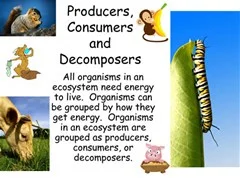
Living organisms
The producers
The producers are the living organisms that can make their own food through the photosynthesis process.
Examples of the producers
- The green plants
- Some types of bacteria
- The green algae
The consumers
Consumers are living organisms that depend on the producers directly or indirectly to get their food. They do not depend on themselves to make their food due to the absence of chloroplasts. Consumers are organisms that rely on other organisms for their source of energy.
There are many types of consumers, such as the herbivores that eat the plants, the carnivores that eat the meat, the omnivores that eat the plants and the meat, the detritivores that feed on the plant and the animal remains, decomposers that break down the organic matter.
Examples of consumers
-
Some consumers feed on the producers (The green plants) as the human and animals (the cows, the sheep, and the chickens).
-
Some consumers previously fed on the producers as the human and the animals (as the lion, the snake, the tiger, the hawk, and the wild cat).
The human is considered a consumer because he feeds on the producers or the consumers that previously fed on the producers.
The decomposers
The decomposers are living organisms that can not make their food by themselves due to the absence of chloroplasts in their cells, but they get their food through the decomposition of organic wastes, such as dead bodies, plant remains, and decayed food.
Examples of the decomposers
-
Some types of fungi as the yeast fungus and bread mold fungus.
-
Some types of bacteria as the yoghurt bacteria.
 |
| Types of living organisms according to their feeding. |
Importance of the decomposers
- They help us to get rid of the dead bodies of the organisms and the plant remains.
- They are used in a lot of industries.
- They increase soil fertility.
FAQ about Types of Living Organisms According to Their Feeding
1. What are the types of living organisms according to their feeding?
Living organisms can be classified according to how they obtain food into two main types: autotrophs and heterotrophs.
2. What are autotrophic organisms?
Autotrophs are organisms that can produce their own food from simple substances such as carbon dioxide and water using energy from sunlight or chemical reactions. Examples include green plants, algae, and some bacteria.
3. What is photosynthesis?
Photosynthesis is the process by which green plants and some microorganisms use sunlight, carbon dioxide, and water to produce food (glucose) and oxygen.
4. What are heterotrophic organisms?
Heterotrophs are organisms that cannot make their own food and depend on other organisms for nutrition. Examples include animals, fungi, and many bacteria.
5. What are the main types of heterotrophs?
Heterotrophic organisms are usually classified into:
- Herbivores – animals that eat plants (e.g., cows, rabbits).
- Carnivores – animals that eat other animals (e.g., lions, wolves).
- Omnivores – animals that eat both plants and animals (e.g., humans, bears).
6. What are decomposers?
Decomposers are organisms that obtain food by breaking down dead plants and animals. Examples include fungi and some bacteria, and they play an important role in recycling nutrients in ecosystems.
7. What is the role of producers in the ecosystem?
Producers (autotrophs) form the base of the food chain because they convert solar energy into food that other organisms depend on.
8. What is the role of consumers?
Consumers (heterotrophs) obtain energy by feeding on producers or other consumers, helping transfer energy through the food chain.
9. Can microorganisms have different feeding methods?
Yes. Some microorganisms may be autotrophic, producing their own food, while others are heterotrophic, feeding on organic matter.
10. Why is classification based on feeding important?
Classifying organisms by their feeding helps us understand food chains, energy flow in ecosystems, and the relationships between living organisms.
You can follow Science Online on YouTube from this link: Science Online
Classification of the ecosystem and Environmental balance
Food relationships among living organisms (Predation, Symbiosis & Saprophytism)

straightforward and thorough, Thanks
You are welcome