
Types of Pollination in Plants: 7 Amazing Facts About Self and Cross-Pollination!
Pollination is one of the most important processes in plant reproduction. It allows flowering plants to produce seeds and fruits by transferring pollen grains from the anther to the stigma of a flower. There are two main types of pollination in plants: self-pollination and cross-pollination. Each type plays an essential role in plant reproduction, genetic diversity, and the survival of different plant species.
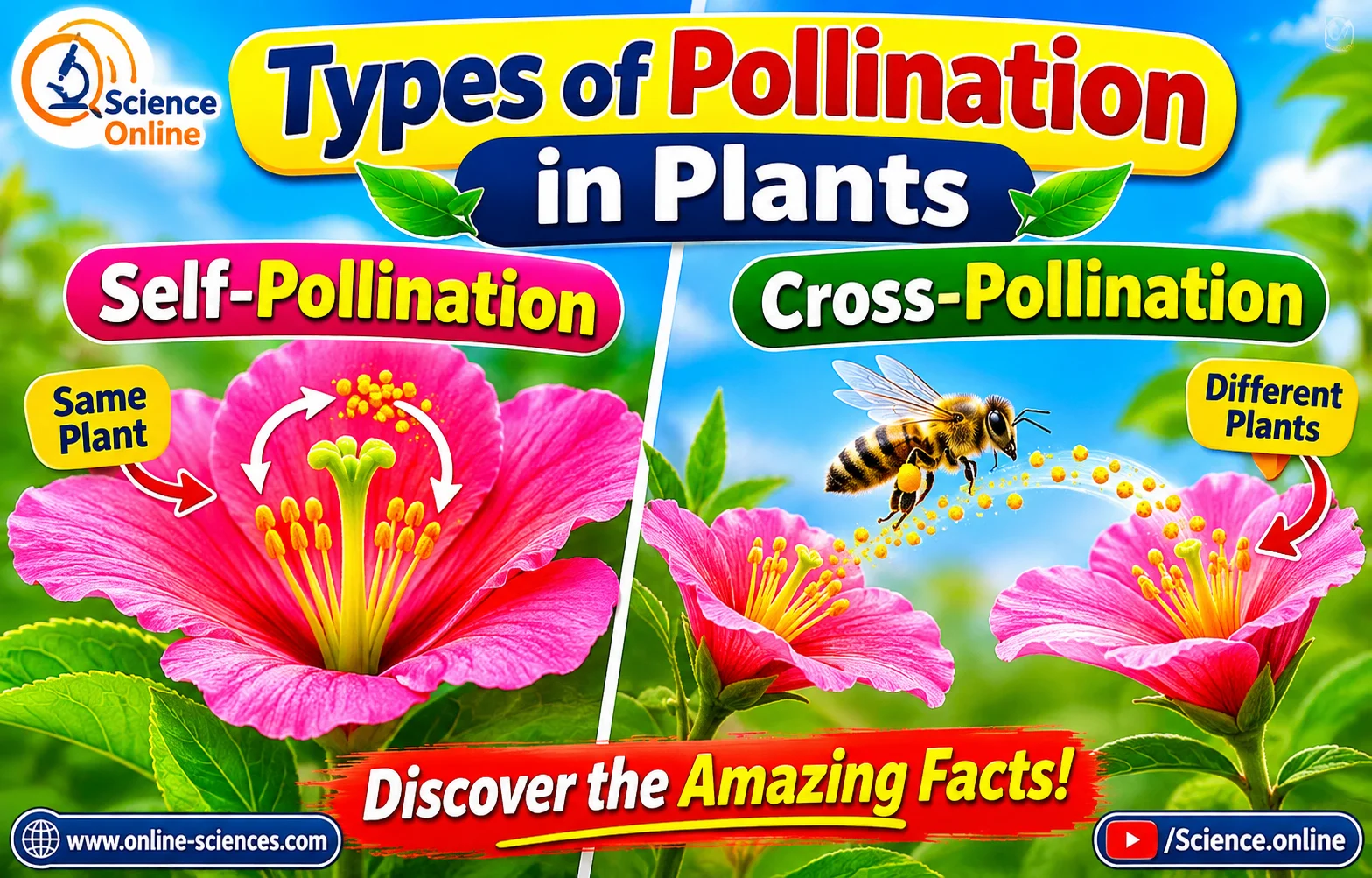
Types of Pollination in Plants: Self and Cross-Pollination!
Reproduction in plants
Plant reproduction is the process by which plants generate new individuals. There are two kinds of reproduction in plants, which are sexual reproduction and asexual reproduction. The flowers are classified according to sex into three types, which are the male flower, the female flower, and the bisexual (hermaphrodite) flower.
The male flowers contain only male reproductive organs (the androecium), and they are unisexual, such as in palms, maize, and pumpkin. The female flowers contain only female reproductive organs (the gynoecium), and they are unisexual, such as in palms, maize, and pumpkins. The bisexual (hermaphrodite) flowers contain both the male and female reproductive organs, such as the tulip, the petunia, and the wallflower.
Sexual reproduction in plants happens via the flowers; it takes place in two successive processes, which are pollination and fertilization. Fertilization is the formation of offspring by the fusion of gametes, while asexual reproduction is the formation of offspring without the fusion of gametes.
Pollination is the process of transfer of pollen grains from the flower anthers to the stigmas, the pollen grains are small cells that form in the anther inside the pollen chamber. When those grains become mature, the anther splits longitudinally and the pollen grains spread in the air like dust.
Pollination is essential for the survival of many plants, and it also plays an important role in the food chain. Many of the fruits and vegetables that we eat rely on animal pollinators for reproduction. If there were a decline in pollinator populations, it could have a significant impact on our food supply.
The decline of pollinators is a major threat to food security and biodiversity. Many factors are contributing to the decline of pollinators, including habitat loss, pesticide use, and climate change. We can all help to protect pollinators by planting pollinator-friendly gardens, avoiding pesticides, and supporting organizations that are working to conserve pollinators.

Types of pollination in plants
Types of pollination
There are two types of pollination, which are self (auto) pollination and mixed (cross) pollination. Self (auto) pollination is the transfer of pollen grains from the anthers of a flower to the stigmas of the same flower or to another flower in the same plant. Mixed (cross) pollination is the transfer of pollen grains from the anthers of a flower to the stigmas of another flower in other plants of the same kind.
Cross-pollination is more beneficial for plants, as it allows for greater genetic diversity. This diversity makes plants more resistant to diseases and pests and helps them to adapt to changing environmental conditions.
If the flowers are on two different individual plants, the flowers have been cross-pollinated, and if the flowers are on the same individual or if the anther and the stigma are in the same flower, the flowers have been self-pollinated.
The flowers that are self-pollinated and can produce viable seeds are self-compatible, and the flowers that are self-pollinated but the pollen grains do not function properly on the carpels of the same plant are termed self-incompatible.
Methods of mixed (cross) pollination
The pollen grains are transferred from one flower to another in different ways, which are pollination by wind, pollination by insects, and artificial pollination.
Pollination by air
The flowers that are pollinated by the air are characterized by their anthers being hanging to be easily opened by the air, and their stigmas are feathery-like and sticky to catch the pollen grains from the air.
The flowers produce huge numbers of pollen grains to compensate for what is lost in the air, and their pollen grains are light in weight and dry to be easily carried by air.
Pollination by insects
The flowers pollinated by insects are characterized by their petals that are colored and scented to attract the insects to feed on their nectar, and their pollen grains are sticky or have coarse surfaces to stick to the insect body.
Artificial pollination
The artificial pollination is carried out by man, man has to pollinate the palm trees to ensure the pollination process as the pollination is difficult to occur by the air or by insects, where the gardener spreads the palm tree’s pollen grains over their female flowers.
Importance of pollination in plants
Pollination is the transfer of pollen grains from the male part of a flowering plant (anther) to the female part (stigma). It is a vital part of plant reproduction, as it leads to fertilization and seed production. Without pollination, plants can’t reproduce sexually and create seeds, and they would die out. Seeds are essential for plants to spread and colonize new habitats.
Pollination can also help to increase genetic diversity within plant populations. Cross-pollination allows plants to mix their genes with other plants of the same species. When pollen is transferred between different plants, it can lead to the creation of new offspring with different traits. This genetic diversity helps plants adapt to changing environmental conditions, such as disease, pests, and climate change.
Many of the fruits and vegetables we eat rely on animal pollinators, like bees, butterflies, and birds, to transfer pollen. Pollinators help to ensure good crop yields and the variety of foods we enjoy.
Pollination is essential for healthy ecosystems. Plants are the base of the food chain, and many animals rely on fruits, seeds, and nuts for food. Plants provide food and habitat for animals, and they also help to regulate the climate. Pollination supports healthy populations of pollinators, which are themselves a vital part of the ecosystem.
What are the Types of Pollination in Plants?
There are two main types of pollination:
- Self-pollination: The transfer of pollen grains from the anther to the stigma of the same flower or another flower on the same plant.
- Cross-pollination: The transfer of pollen grains from the anther of one flower to the stigma of a flower on another plant of the same species.
What is Self-Pollination?
Self-pollination is the transfer of pollen grains from the anther to the stigma of the same flower or another flower on the same plant. It usually occurs in flowers that contain both male and female reproductive organs. Self-pollination does not require external pollinating agents such as insects, birds, or wind, although some flowers may still use them.
Examples of self-pollinated plants:
- Peas.
- Rice.
- Wheat.
- Tomatoes.
- Barley.
Advantages of self-pollination:
- It ensures seed production even when pollinators are absent.
- It requires less energy than cross-pollination.
- It preserves desirable parental characteristics.
- It reduces dependence on external pollinating agents.
Disadvantages:
- It produces less genetic variation.
- It may increase the risk of inbreeding.
- It can reduce plants’ ability to adapt to environmental changes.
What is Cross-Pollination?
Cross-pollination is the transfer of pollen grains from the anther of a flower on one plant to the stigma of a flower on another plant of the same species. This type of pollination usually occurs with the help of external agents, including wind, water, insects, birds, and other animals.
Examples of cross-pollinated plants:
- Apple.
- Mango.
- Papaya.
- Maize.
- Sunflower.
Advantages of cross-pollination:
- It increases genetic variation.
- It can produce healthier and stronger offspring through hybrid vigor.
- It improves plants’ ability to adapt to environmental changes.
- It may increase resistance to certain diseases.
Disadvantages:
– It depends on pollinating agents.
– It requires more energy to produce attractive flowers, nectar, and pollen.
– Successful pollination may be less predictable.
What is the Difference Between Self-Pollination and Cross-Pollination?
Self-pollination occurs when pollen grains are transferred from the anther to the stigma of the same flower or another flower on the same plant, while cross-pollination occurs when pollen grains are transferred from a flower on one plant to a flower on another plant of the same species.
Self-pollination usually does not require external pollinating agents and produces less genetic variation, helping preserve the characteristics of the parent plant. In contrast, cross-pollination often depends on agents such as wind, water, insects, and birds, and increases genetic diversity, which can produce stronger and more adaptable offspring. Examples of self-pollinated plants include peas, wheat, and rice, while apple, mango, and maize are common examples of cross-pollinated plants.
Frequently Asked Questions (FAQ)
1. What are the two main types of pollination in plants?
The two main types are self-pollination and cross-pollination.
2. What is self-pollination?
Self-pollination occurs when pollen grains are transferred from the anther to the stigma of the same flower or another flower on the same plant.
3. What is cross-pollination?
Cross-pollination occurs when pollen grains are transferred from a flower on one plant to a flower on another plant of the same species.
4. What is the main difference between self-pollination and cross-pollination?
Self-pollination involves pollen transfer within the same plant, while cross-pollination involves pollen transfer between two different plants of the same species.
5. Which type of pollination produces more genetic variation?
Cross-pollination produces more genetic variation because it combines genetic material from different plants.
6. What are the agents of cross-pollination?
The main agents include wind, water, insects, birds, bats, and other animals.
7. Give three examples of self-pollinated plants.
Peas, wheat, and rice are common examples of self-pollinated plants.
8. Why is cross-pollination important?
Cross-pollination increases genetic diversity, improves adaptability, and can produce plants with desirable characteristics.
Explore more AI innovations and emerging technologies on Science Online
and subscribe to the Science Online YouTube channel
Asexual and sexual reproduction in plants, Pollination and Stages of fertilization process in plants
Pollination, Fertilization, Seed and Fruit formation in flowering plants
Transportation in plant, Structure and role of the plant stem in the process of transportation
Autotrophic Nutrition in Green Plants, Mechanism of Water and Minerals Absorption
Reproduction in flowering plants, Structure and functions of the flower





Artificial pollination is done by purpose, right?
Artificial pollination is carried out by man, man has to pollinate the palm trees to ensure the pollination process as the pollination is difficult to occur by the air or by insects, where the gardener spread the palm tree’s pollen grains over their female flowers.