Structure of the Human Body Explained: Organs, Systems & Amazing Functions You Need to Know
The human body of the living organism consists of a group of systems. Each system consists of a group of organs. Each organ consists of a group of tissues. Each tissue consists of a group of similar cells. The cell is the smallest building unit of the body of living organism, which is made up of a group of systems.
Human Body
The structure of the human body is an incredible system made up of different levels of organization that work together in harmony. It begins with tiny cells, which are the building blocks of life. These cells form tissues, tissues create organs, and organs combine to form complex systems such as the digestive, respiratory, and nervous systems.
Each system in the human body has a specific role that keeps us alive and functioning properly. For example, the circulatory system transports oxygen and nutrients throughout the body, while the nervous system controls movement, thinking, and responses. These systems do not work independently but interact closely to maintain balance and health.
Understanding the structure of the human body helps us appreciate how complex and efficient it is. It also highlights the importance of maintaining a healthy lifestyle, as every organ and system depends on proper care to function effectively. Learning about body structure is essential for students, healthcare professionals, and anyone interested in human biology.
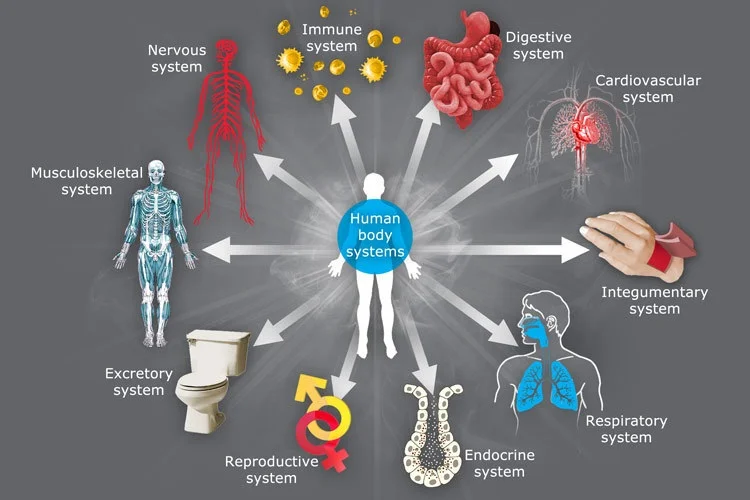
The systems of the human body
Structure of the human body
The human body is composed of a group of systems, which are the digestive system, the respiratory system, the urinary system, the circulatory system, the nervous system, and the reproductive system.
The digestive system digests and absorbs the food, while the respiratory system carries out the respiration process. There is the urinary system in the human body, which helps the body to get rid of harmful substances.
The circulatory system carries out the transport function in the human body, where it distributes the digested food and oxygen gas all over the body cells and carries the wastes away from the body.
The nervous system gives us the ability to feel, see, hear, smell, and taste, while the reproductive system produces new individuals who look like us. Living organisms are classified into animals (including humans) and plants.
All living organisms have common properties, such as nutrition, motion, respiration, excretion, sensation, and reproduction.
FAQ about the Structure of the Human Body
1. What are the main levels of organization in the human body?
The human body is organized into five main levels: cells, tissues, organs, organ systems, and the whole organism. Each level builds upon the previous one to create a fully functioning body.
2. How many organ systems are in the human body?
There are 11 major organ systems, including the circulatory, respiratory, digestive, nervous, skeletal, and muscular systems, each with specific functions.
3. What is the smallest unit of the human body?
The cell is the smallest structural and functional unit of the human body.
4. Why are organ systems important?
Organ systems are important because they perform essential life functions such as breathing, digestion, movement, and protection.
5. How do body systems work together?
Body systems work together by sharing information and resources. For example, the respiratory system provides oxygen, and the circulatory system delivers it to cells.
6. What is the largest organ in the human body?
The skin is the largest organ in the human body, protecting internal structures and regulating temperature.
7. What is the role of tissues in the body?
Tissues are groups of similar cells that perform a specific function, such as muscle tissue for movement or nerve tissue for communication.
You can follow science online on YouTube from this link: Science online
Role of the respiratory system in the excretion process in man & Respiration in plants
Important excretory organs in man’s body & Structure of the urinary system
Small intestine, Absorption of digested food, Metabolism, Large intestine, and defecation
Nervous system in man, Nerve cells types & Nature of nerve impulse