What are the importance and structure of chromosomes?
The chromosomes are threadlike bodies present in the cell’s nuclei, and they represent the genetic material of the living organisms, They are not visible in the cell’s nucleus not even under a microscope, When the cell is not dividing, However, the DNA that makes up the chromosomes becomes more tightly packed during the cell division and it is visible under a microscope.
Chromosomes structure
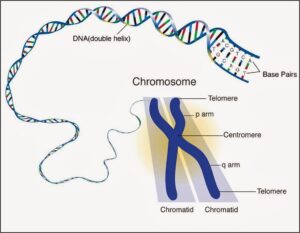
The chromosomes consist of two connected threads, each thread is called the chromatid, The two chromatids are connected at a point known as the centromere which is the point of connection of the two chromatids of the chromosome during the cell division.
The centromeres help to keep the chromosomes properly aligned during the complex process of the cell division, As the chromosomes are copied in the preparation for the production of a new cell, The centromere serves as an attachment site for the two halves of each replicated chromosome, known as sister chromatids.
The DNA molecule is packaged into thread-like structures called the chromosomes in the nucleus of each cell, Each chromosome is made up of DNA tightly coiled many times around the proteins called the histones that support its structure.
Chromosomes
Each chromosome has a constriction point called the centromere which divides the chromosome into two sections or “arms” The short arm of the chromosome is labeled the “p arm”, The long arm of the chromosome is labeled the “q arm”, The location of the centromere on each chromosome gives the chromosome its characteristic shape, and it can be used to help describe the location of the specific genes.
Each chromatid consists of protein and a nucleic acid called DNA which carries the genes that carry the genetic traits of the living organism, DNA is the nucleic acid that forms the chromosomes that present in the cell nucleus and it carries the genes.
The bodies of multicellular living organisms contain two kinds of cells which are the somatic cells and the reproductive cells, The somatic cells are all the body cells except the reproductive cells.
The somatic cells in the humans and the animals such as the cells of the liver, the cells of the kidney, And the somatic cells in the plants such as the cells of the roots, the cells of the stem, the cells of the leaves.
The cell nucleus is responsible for the cell division because it contains the genetic material of the living organisms which consists of a number of chromosomes that have the main role in the cell division.
The somatic cells contain two sets of chromosomes (one inherited from the father and the other from the mother), The number of chromosomes in the somatic cells is a diploid number (2 N), while in the gametes [the male gametes (the sperms) and the female gametes (ova)] is a haploid number (N).
All the somatic cells contain 23 chromosomes in the human, The humans have 23 pairs of chromosomes, and 46 chromosomes for a total, Each species of plants and the animals have a set number of chromosomes.
Genes, Chromosomes, Proteins, Bacteriophages & Quantity of DNA in the cells
Principles of Chromosomal Theory & Interpretation of Mendel’s Laws according to chromosomes theory
Human karyotype, Chromosomes, and Genetic information
Structure of Nucleic Acid (DNA), Enzymes, DNA replication and DNA repair mechanism
Packaging of DNA, Genome, chromosomal proteins, DNA in Prokaryotes & Eukaryotes