Human karyotype, Chromosomes and Genetic information
Scientists discovered that Genetic information which lead to the appearance of traits in all living organisms are carried on the chromosomes & Chromosomes are found inside the nucleus of each cell in all living organisms, At the beginning of the 20th century.
Genetically , there are two types of cells in all living organisms :
- Somatic ( body ) cells: They are produced by mitosis of body cells, which contain homologous pairs of chromosomes, such as cells of the skin, muscles, blood,…..and so on.
- Sex cells ( gametes ) : They are produced by meiosis of gonads cells ( tests in male and ovary in female ), They include: Male gametes ( pollens in the plants, sperms in the animals and the humans ) and the female gametes ( ovules in the plants and ova in the animals and the humans ) .
Karyotype
It is the arranging of chromosomes descendingly according to their size, then numerating them, To facilitate the arranging and numerating of chromosomes , they can be coloured with different colours.
We can classify chromosomes when they are in the clearest form , Chromosomes are classified into homologous pairs ( in somatic cells and gonads ) and arranged descendingly according to their size , then they are numerated , This is called the karyotype .
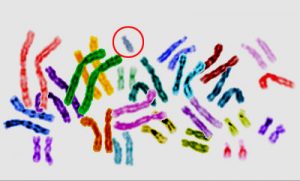
Human karyotype
The human karyotype :
There are 46 ( 23 pairs ) chromosomes in the human somatic cells , These chromosomes are descendingly arranged in homologous pairs according to their size from number ( 1 ) to number ( 23 ) , where :
The pairs from number ( 1 ) to ( 22 ) are called autosomes or somatic chromosomes, The pair number ( 23 ) represents the sex chromosomes , because it carries the genetic information of sex determination .
The pair of sex chromosomes is characterized by the following :
It does not subject to the arrangement of chromosomes in size because it comes after 7 th pair in size , but it is arranged at the end of chromosomes and given the number ( 23 ) .
It is heterozygous ( asymmetric ) in male ( XY ) and homozygous ( symmetric ) in female ( XX ) , So , the Karyotype of male differs from the karyotype of female .
Numbers of chromosomes
The number of chromosomes in living organisms differs from a species to another , but it is constant in individuals of the same species .
The constancy of chromosomes number in individuals of the same species indicates that chromosomes carry the genetic information that determine the characters of the living organism .
The number of chromosomes in the cells of the living organism does not express its advancement or its size .
Number of chromosomes in somatic and sex cells of living organisms :
Somatic cells
They contain two sets of homologous chromosomes ( one of them is inherited from father and the other from mother ) , They are diploid cells ( 2n ) .
They are produced from mitotic division of cells body, Such as the nucleus of the human somatic cell contain 46 ( 23 pairs ) chromosomes.
Sex cells ( gametes )
They contain half of the chromosomes number that found in the somatic cells , because they are produced by meiosis of gonads cells, they are haploid cells ( n ) .
Such as the nucleus of the human male gamete ( sperm ) and female gamete ( ovum ) contain 23 chromosomes.
Chromosomes and genes :
You already know that :
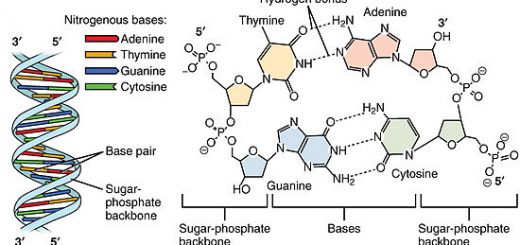
- Chromosomes are made up of nucleic acid DNA and protein .
- DNA is consisted of building units called nucleotides .
- DNA molecules carry the genes responsible for the traits of the living organism.
- Gene is a sequence of nucleotides on DNA molecule represents a code of a certain protein that is responsible for the appearance of a certain trait.
Scientists found that there are 60-80 thousand genes carried on 23 pairs of chromosomes in human, The complex set of genes in the cell is known as the human genome .
Chromosomal theory
You can read this article about Principles of Chromosomal theory & Interpretation of Mendel’s Laws according to chromosomes theory
Genes, Chromosomes, Proteins, Bacteriophages & Quantity of DNA in the cells
Importance of Nucleosides, Nucleotides, Purines, Pyrimidines & Sugars of nucleic acids
Regulation of the cell cycle, DNA synthesis phase, Interphase & Mitosis