
Echo in Locating Surfaces: 7 Powerful Facts About Finding Barriers
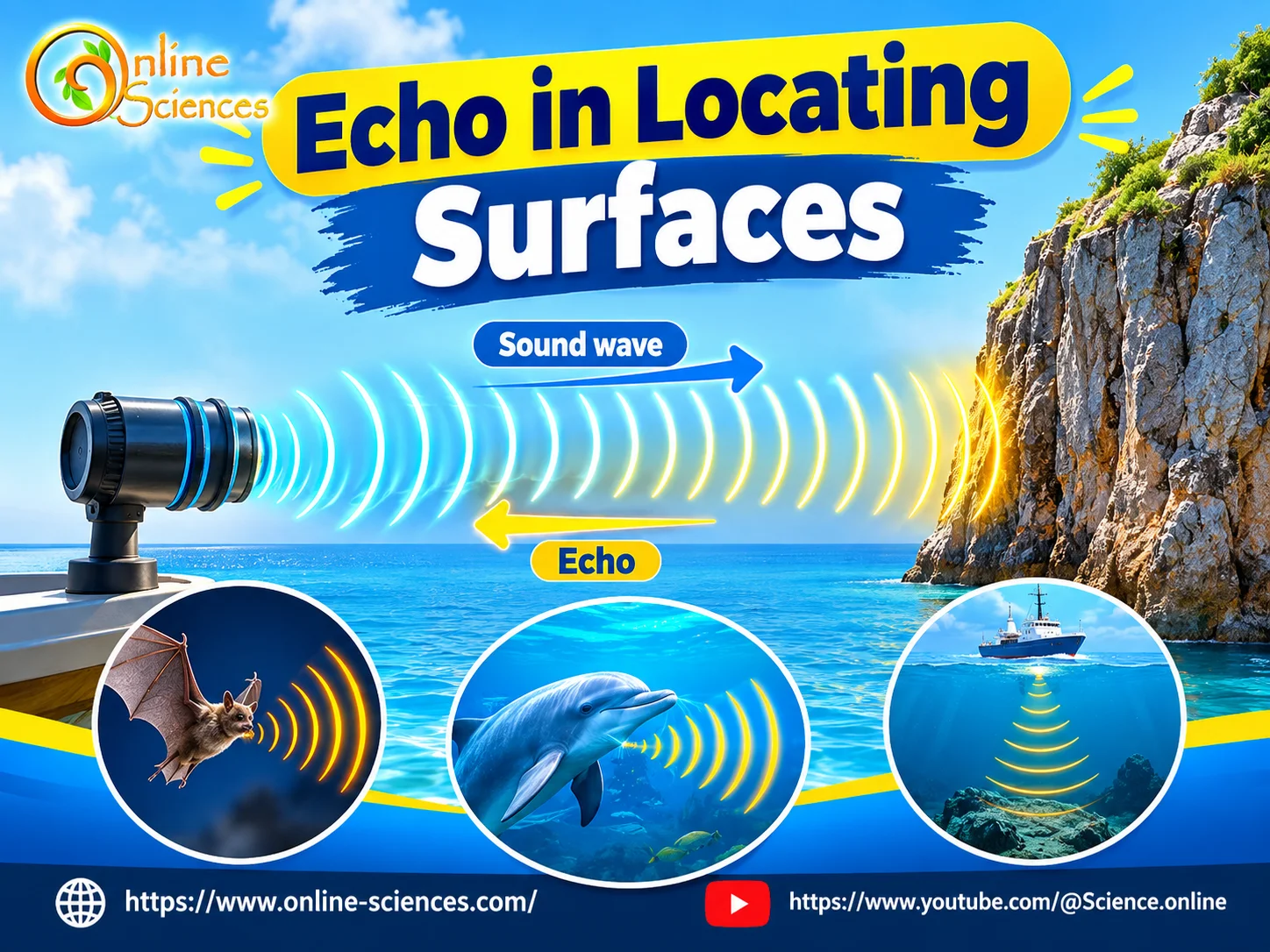
Echo in locating surfaces is an important application of the reflection of sound. When a sound wave reaches a surface or barrier, part of the sound energy can be reflected toward its source. By detecting this returning sound and measuring the time it takes to travel, it is possible to estimate the position and distance of the surface.
Echo in Locating Surfaces
Echo in Locating Surfaces
Sound does not always travel away from its source without changing direction. When a sound wave encounters a solid surface, wall, obstacle, or other barrier, it can be reflected. This reflected sound may return toward the source and can be heard as an echo.
The phenomenon of an echo provides a useful way to obtain information about objects and surfaces that may be difficult to see directly. The basic principle is simple: a sound pulse travels through a medium, reaches a surface, reflects from it, and returns. If the speed of sound and the time taken for the sound to return are known, the distance to the reflecting surface can be calculated.
How does an echo locate a surface?
When a sound source produces a short sound pulse, the sound waves travel outward. If the waves encounter a large enough surface, some of their energy is reflected. The reflected waves travel back toward the source or a detector. The time interval between producing the sound and receiving the reflected signal provides information about the distance. The distance can be approximately calculated using:
Distance = (speed of sound × time) ÷ 2
The division by two is important because the sound travels from the source to the surface and then back again. For example, if a sound pulse travels toward a wall and returns after a measurable time interval, the total distance traveled by the sound is the speed of sound multiplied by that time. Half of this total distance represents the distance between the source and the wall.
Why are echoes useful for locating barriers?
An echo can reveal the presence of a barrier even when the barrier cannot be seen directly. This makes reflected sound particularly useful in environments where visibility is poor or where direct measurement is difficult.
The strength and timing of the reflected sound can provide information about the reflecting object. A large, hard, smooth surface generally produces a clearer reflection than a soft, irregular surface that absorbs or scatters much of the sound energy.
This principle is used in several technologies, including sonar systems, distance-measuring devices, and medical ultrasound.
Echo and sonar
Sonar is one of the most important technological applications of sound reflection. It uses sound waves to detect objects and determine their distance, particularly underwater.
A sonar system sends a sound pulse through water. When the pulse encounters an underwater object or the seafloor, part of the sound is reflected. The system measures the time between transmitting the pulse and receiving the echo.
Because the speed of sound in water is known or can be estimated, the distance to the reflecting object can be calculated. Sonar can therefore help detect underwater obstacles, map the sea floor, locate objects, and determine water depth.
Echo and echolocation in animals
Some animals naturally use reflected sound to locate objects and navigate their surroundings. Bats, for example, produce high-frequency sounds and listen for the echoes that return from nearby objects. By analyzing the returning echoes, bats can obtain information about the location of obstacles and potential prey.
Dolphins also use echolocation. They produce clicks that travel through water and reflect from objects. The returning sound provides information about the surrounding environment. This natural ability demonstrates how reflected sound can provide spatial information without relying entirely on vision.
The bats
Some animals use echoes to locate and identify objects. Echolocation is used for navigation and for foraging (hunting) in various environments, The bats can use the phenomenon of sound reflection (echo) in their daily life to locate the position of their preys, and fly in the dark without colliding with anything.
The bats transmit ultrasonic waves of frequencies (50: 100 kHz) that reflect on the surfaces and barriers then receive them back after reflection, and locate their positions, so they avoid colliding them.
The bats generate ultrasonic waves via the larynx and emit the sound through the open mouth or the nose. The bats make high-pitched chirps which are too high for humans to hear; the bats identify the location of objects by echolocation.
The bats use echolocation to find their food and their way, so they can determine the direction of an object, how far it is, how fast it is, and how big the objects are by making sharp clicking and chirping sounds through their mouth and nose.
The dolphins
The dolphins can hear ultrasonic waves and use them to orient and capture prey; humans cannot hear sounds produced by the dolphins as the dolphins produce sounds up to 120 kilohertz, while man can hear sounds of frequencies up to 20 kilohertz only.
The dolphins can hear sounds up to 150 kilohertz, and they use a feature called echolocation to create acoustical pictures of their surroundings, The dolphins use the echolocation to find the walls, other big animals and other dolphins.
The dolphins are able to produce intense, short, broadband pulses of ultrasonic sound (clicks), they use short pulses and high frequencies using clicking and whistles, which are sent out of an opening below their blowhole.
Factors affecting the quality of an echo
The ability to locate a surface using an echo depends on several factors. Distance is important because the reflecting surface must be far enough away for the returning sound to be distinguishable from the original sound. In everyday environments, a distinct human-audible echo generally requires sufficient separation between the sound source and the reflecting surface.
Surface characteristics also matter. Hard surfaces such as concrete, rock, and large walls can reflect sound effectively. Soft materials such as carpets, curtains, and some types of insulation absorb more sound energy.
The shape and orientation of the surface can influence the direction of the reflected sound. A large flat surface can produce a strong reflection, while an irregular surface can scatter sound in different directions. Temperature and the properties of the medium can also affect the speed of sound, which is important when calculating distance from echo timing.
Using echo to measure distance
The timing of an echo provides a practical method for measuring distance. Suppose a sound pulse travels through air at approximately 343 meters per second under typical conditions. If the reflected sound returns after a known time, the distance can be estimated using the sound-speed equation.
For instance, if the round-trip travel time is 0.20 seconds: Distance = (343 × 0.20) ÷ 2
This gives approximately 34.3 meters. The calculation demonstrates the key idea: the echo provides a time measurement, and the known speed of sound converts that time into a distance.
Applications of echo-based detection
The principle of locating surfaces through reflected sound has many applications.
- Sonar uses echoes to detect underwater objects and measure depth.
- Ultrasound imaging uses high-frequency sound waves and their reflections to create images of structures inside the human body.
- Industrial sensors can use ultrasonic reflections to detect objects, measure distances, and monitor levels of liquids or materials.
- Robotic systems can use ultrasonic sensors to identify nearby obstacles and assist with navigation.
- Architectural acoustics also considers sound reflection when designing rooms, auditoriums, theaters, and recording studios.
Why echo is important in science and technology
Echo demonstrates how waves can carry information about their surroundings. The reflected wave does not simply represent returned sound; it can provide measurable information about the location and characteristics of the object that reflected it.
By measuring the time delay, researchers and engineers can estimate distance. By analyzing the strength and characteristics of the returned signal, more information about the reflecting surface may sometimes be obtained.
Therefore, the simple phenomenon of an echo forms the foundation of sophisticated technologies used in navigation, medicine, engineering, biology, and scientific research.
Conclusion
Echo in locating surfaces is based on the reflection of sound waves from barriers and other objects. When a sound pulse reaches a surface, part of the sound can return as an echo. Measuring the time between transmission and reception makes it possible to estimate the distance to the reflecting surface.
This principle has important applications in sonar, echolocation, ultrasound, robotics, industrial sensors, and distance measurement. What appears to be a simple everyday sound phenomenon is therefore an important scientific principle with powerful technological applications.
FAQ about Echo in Locating Surfaces
What is an echo?
An echo is a reflected sound wave that returns to the listener after sound has encountered a surface or barrier.
How does an echo help locate a surface?
The time taken for a sound pulse to travel to a surface and return as an echo can be used to calculate the distance to that surface.
What is the formula for finding distance using an echo?
The approximate formula is Distance = (speed of sound × echo time) ÷ 2.
Why is the echo time divided by two?
Because the measured time represents the complete journey of the sound: from the source to the surface and back again.
Can echoes detect underwater objects?
Yes. Sonar uses reflected sound waves to detect underwater objects and determine distances.
Do animals use echoes to locate objects?
Yes. Bats and dolphins are well-known examples of animals that use echolocation to detect objects and navigate.
Which surfaces reflect sound best?
Hard, large, and relatively smooth surfaces generally reflect sound more effectively than soft or highly absorbent surfaces.
Is ultrasound based on echoes?
Yes. Medical ultrasound sends high-frequency sound waves into the body and analyzes returning reflections to obtain information about internal structures.
Can robots use echoes to detect obstacles?
Yes. Ultrasonic sensors can send sound pulses and analyze their reflections to estimate the distance to nearby objects.
You can subscribe to Science Online on YouTube from this link: Science Online
🔥 Tiny Engineer: This Tiny Robot Works on My Desk! 🤖 Amazing AI Desktop Robot 🚀