
Echo (Sound Reflection): 7 Powerful Facts About Echo and Amazing Conditions Necessary for Hearing It
Echo (sound reflection) is one of the most fascinating phenomena in physics. It occurs when sound waves bounce off a large, hard surface and return to the listener after a short delay. From mountain valleys and caves to sonar technology and medical imaging, echoes play an important role in science and everyday life. Understanding the conditions required to hear an echo helps explain how sound travels, reflects, and interacts with different surfaces.
Echo (Sound Reflection)
The echo
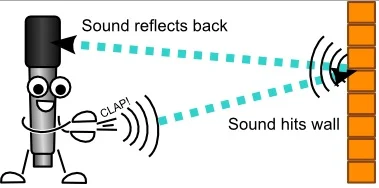
The echo is a repetition of sound produced due to its reflection. It can be used to tell how far away an object is, how fast the object is moving, and even its shape.
If you make a sound in a large empty room, you will hear a repetition of your sound, Also if you visit a large empty place containing hard flat surfaces and produce a sound, you will hear a repetition of your sound.
Echo (sound reflection)
The distance between the sound source and the reflecting surface must not be less than 17 metres, where the time period between hearing the original sound and its echo should not be less than 0.1 of a second.
The human ear can not distinguish between two successive sounds if the period between them is less than 0.1 second, Wide and big reflecting surface must be presented to hear the echo, such as the walls, the mountains, or the water bodies.
The velocity of sound through the air is 340 m/sec, so the distance travelled by the sound and its echo in 0.1 sec = 34 metres. The distance travelled by the sound is 17 metres from the sound source to the reflecting surface and 17 metres from the reflecting surface to the ear (echo).
The echo can not be heard if the distance between the sound source and the reflecting surface is less than 17 metres because the time between hearing the main sound and its echo will be less than 0.1 of a second, and the human ear can not distinguish between the two successive sounds.
When the distance between hearing the main sound and the reflecting surface is a multiple of 17 metres (twice or three times), the echo is heard in the form of the last two or three phrases of the whole produced sound.
Echo (Sound Reflection)
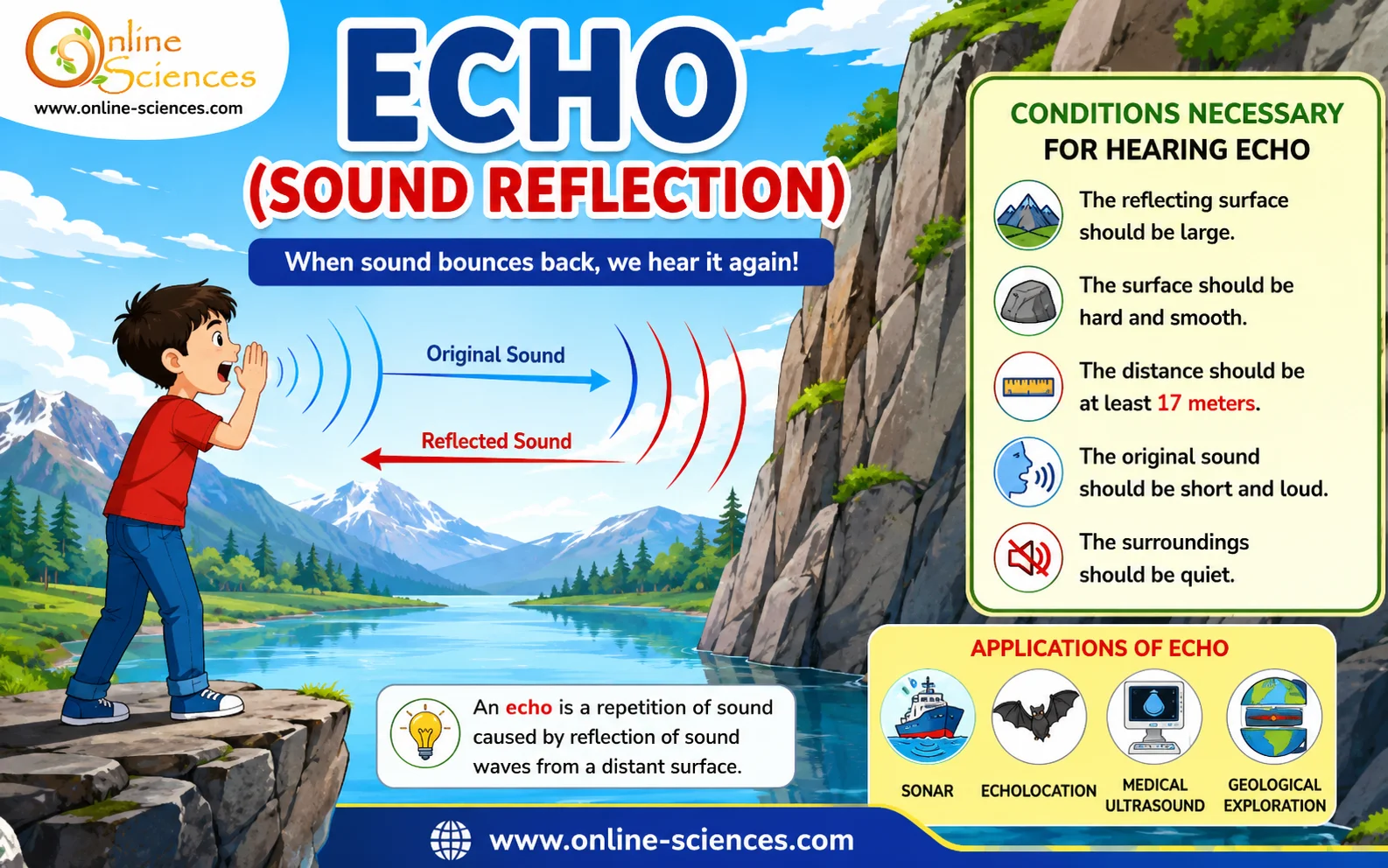
An echo is the repetition of a sound caused by the reflection of sound waves from a distant surface. Just as light reflects from mirrors, sound reflects from hard surfaces such as cliffs, mountains, walls, tunnels, or large buildings. When a sound wave strikes a hard obstacle, part of its energy is reflected back toward the source. If the reflected sound reaches the listener after a noticeable delay, it is heard as a separate sound called an echo.
What is Echo (Sound Reflection)?
An echo is the reflection of sound waves from a hard surface back to the listener after a sufficient time delay.
For example:
- Shouting across a canyon.
- Clapping inside a large empty hall.
- Calling inside a cave.
- Sonar signals reflected underwater.
The reflected sound travels back to the listener, creating the impression that the original sound has been repeated.
How is an Echo Produced?
The process occurs in several simple steps:
- A sound source produces sound waves.
- The waves travel through air or another medium.
- They strike a large, hard surface.
- The sound waves reflect from the surface.
- The reflected waves return to the listener.
- The listener hears the reflected sound as an echo.
Conditions Necessary for Hearing an Echo
Several conditions must be met before an echo can be heard clearly.
1. The Reflecting Surface Must Be Large
The obstacle should be much larger than the wavelength of the sound so that sufficient sound energy is reflected. Examples include:
- Mountains.
- Large buildings.
- Rock cliffs.
- Empty halls.
2. The Reflecting Surface Must Be Hard and Smooth
Soft materials absorb sound rather than reflect it. Good reflecting surfaces include:
- Concrete walls.
- Stone cliffs.
- Metal sheets.
- Brick buildings.
Poor reflecting surfaces include:
- Curtains.
- Foam.
- Carpets.
- Thick vegetation.
3. The Distance Must Be at Least About 17 Meters
The human ear can distinguish two sounds only if they arrive at least 0.1 seconds apart. Since the speed of sound in air is approximately 340 m/s, the reflected sound must travel about 34 meters (17 meters to the obstacle and 17 meters back). Therefore, the minimum distance to the reflecting surface ≈ 17 meters.
4. The Original Sound Should Be Short
A short, sharp sound such as:
- A clap.
- A shout.
- A gunshot.
produces a much clearer echo than a long continuous sound.
5. The Sound Must Be Loud Enough
Weak sounds may lose too much energy before returning. Louder sounds create stronger echoes.
6. The Surroundings Should Be Quiet
Background noise can mask the reflected sound, making the echo difficult to hear.
7. The Medium Must Allow Sound to Travel
Echoes require a material medium. They cannot occur in a vacuum because sound cannot travel without particles.
Why is 17 Meters Important?
The brain separates two sounds only if they are at least 0.1 seconds apart.
Using: Distance = Speed × Time
340 × 0.1 = 34 meters
Since the sound travels to the obstacle and back: 34 ÷ 2 = 17 meters, thus, the reflecting surface should be approximately 17 meters or more away.
Examples of Echoes
Common examples include:
- Shouting near mountains.
- Calling inside caves.
- Clapping in large empty buildings.
- Sonar systems on ships.
- Echolocation is used by bats.
- Dolphin communication.
Applications of Echo
Echoes have many scientific and practical applications.
Sonar
Ships use sonar to:
- Measure water depth.
- Locate submarines.
- Detect underwater obstacles.
- Find schools of fish.
Medical Ultrasound
Doctors use reflected ultrasonic waves to:
- Monitor pregnancy.
- Examine internal organs.
- Detect tumors.
- Diagnose heart diseases.
Animal Echolocation
Animals such as bats and dolphins produce ultrasonic sounds and detect reflected echoes to:
- Navigate.
- Hunt prey.
- Avoid obstacles.
Geological Exploration
Echo techniques help scientists:
- Study underground rock layers.
- Locate oil deposits.
- Investigate Earth’s interior.
Architectural Design
Engineers design:
- Auditoriums.
- Theaters.
- Concert halls.
to reduce unwanted echoes and improve sound quality.
Difference Between Echo and Reverberation
Echo
An echo is the repetition of a sound caused by the reflection of sound waves from a distant, hard surface. It is heard as a separate and distinct sound because the reflected sound reaches the listener at least 0.1 seconds after the original sound. To hear an echo clearly, the reflecting surface should generally be at least 17 meters away. Echoes are commonly experienced near mountains, cliffs, caves, and large buildings, and they are widely used in sonar, medical ultrasound, and animal echolocation.
Reverberation
Reverberation is the persistence of sound in an enclosed space due to multiple reflections from nearby surfaces such as walls, ceilings, and floors. Unlike an echo, the reflected sounds arrive less than 0.1 seconds after the original sound, so they overlap with it and are not heard as separate sounds. Reverberation is common in classrooms, auditoriums, churches, and large halls. While a slight amount of reverberation can improve sound quality in concert halls, excessive reverberation reduces speech clarity and is controlled using sound-absorbing materials such as carpets, curtains, and acoustic panels.
Factors Affecting Echo
Several factors influence echo quality:
- Surface material.
- Surface size.
- Distance from the obstacle.
- Loudness of the sound.
- Air temperature.
- Humidity.
- Wind direction.
- Background noise.
Advantages of Echo
- Helps measure distances.
- Used in underwater navigation.
- Essential in medical diagnosis.
- Helps animals navigate.
- Supports geological surveys.
- Improves scientific research.
Interesting Facts About Echo
- Lightning is seen before thunder is heard because light travels much faster than sound.
- Bats can navigate in complete darkness using echoes.
- Dolphins communicate using echolocation.
- Medical ultrasound depends entirely on reflected sound waves.
- Echoes cannot occur in outer space because there is no medium for sound.
Frequently Asked Questions (FAQ) about the echo
1. What is an echo?
An echo is the repetition of a sound caused by the reflection of sound waves from a distant hard surface.
2. What causes an echo?
An echo occurs when sound waves strike a hard surface and reflect back to the listener after a noticeable delay.
3. Why should the obstacle be at least 17 meters away?
Because the reflected sound must return at least 0.1 seconds after the original sound, allowing the human ear to distinguish the two sounds separately.
4. Why don’t curtains produce echoes?
Curtains absorb most of the sound energy instead of reflecting it.
5. Can echoes occur in space?
No. Sound requires a material medium, while outer space is essentially a vacuum.
6. What surfaces produce the best echoes?
Large, hard, smooth surfaces such as mountains, cliffs, concrete walls, and metal structures.
7. What is the difference between echo and reverberation?
An echo is heard as a separate repeated sound, while reverberation is the persistence of sound caused by multiple closely spaced reflections.
8. Where are echoes used in daily life?
Echoes are used in sonar, medical ultrasound, fish finding, geological exploration, animal navigation, and architectural acoustics.
9. Why is a loud sound better for producing an echo?
Louder sounds retain enough energy after reflection to be heard clearly when they return to the listener.
10. Does temperature affect echoes?
Yes. Temperature changes the speed of sound, which can slightly affect the timing and clarity of an echo.
Conclusion
Echo (sound reflection) is a fundamental concept in physics that demonstrates how sound waves interact with their surroundings. For an echo to be heard clearly, the reflecting surface must be large, hard, and at least 17 meters away, while the original sound should be loud, short, and produced in a quiet environment. Beyond being an interesting natural phenomenon, echoes have countless practical applications, from medical ultrasound and sonar systems to animal echolocation and architectural acoustics, making them an essential part of modern science and technology.
You can subscribe to Science Online on YouTube from this link: Science Online
The concentration of sound and importance of echo ( sound reflection ) in our life
Determination of sea depth and fish shoals by echo
The effect of echo in locating the position of surfaces and barriers
The importance of ultrasonic waves in medical diagnosis
The advantages and disadvantages of ultrasonic waves in detecting industrial defects





Thank you soo much you helped me alot cause I was suck with echo and stuff
You are welcome
thank you for your comment
what is the conditions to form echo?
The distance between the sound source and the reflecting surface must not be less than 17 metres where the time period between hearing the original sound and its echo should not be less than 0.1 of a second .
Thanks a.lot
You are welcome
Thank you very much for your comment
I wish you would elaborate on how you can hear it multiple times
You can read these articles about echo
The concentration of sound and importance of echo ( sound reflection ) in our life
Determination of sea depth and fish shoals by echo
The effect of echo in locating the position of surfaces and barriers
The importance of ultrasonic waves in medical diagnosis
The advantages and disadvantages of ultrasonic waves in detecting industrial defects