
Elon Musk’s Mars Plan: Building a Self-Sustaining City with Starship, How will people survive on Mars?
Elon Musk’s vision for Mars represents one of the most ambitious space exploration projects in modern history. Through SpaceX’s fully reusable Starship rocket, Musk aims to establish a self-sustaining city on the Red Planet, with uncrewed missions potentially launching as early as 2026 and crewed landings targeted for 2029 or 2031. By combining advanced rocket technology, in-situ fuel production, and robotic infrastructure development, the plan seeks to make humanity a multi-planetary species.
Elon Musk’s Mars Plan
Elon Musk has long articulated an ambitious vision: making humanity a multi-planetary species. At the heart of this plan is SpaceX and its fully reusable Starship rocket system, designed to transport massive amounts of cargo and people to Mars at dramatically lower costs than ever before. Musk’s ultimate goal is not just visiting Mars, but establishing a self-sustaining city capable of surviving independently from Earth.
The Core Vision: A Self-Sustaining Martian Civilization.
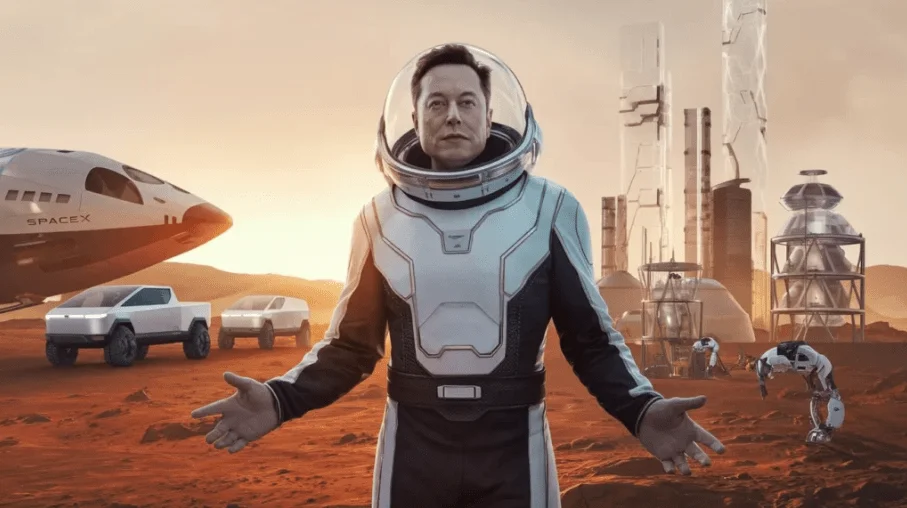
Elon Musk’s Mars Plan: Building a Self-Sustaining City with Starship on Mars.
The Mars plan centers on:
- Transporting millions of tons of cargo.
- Deploying thousands of reusable rockets.
- Producing fuel locally on Mars.
- Building infrastructure before humans arrive.
- Eventually supporting a city of over one million people.
Unlike past space missions focused on exploration, this plan is about permanent settlement.
Components of the Mars Plan
1. Starship Development: The Engine of the Mission: The backbone of the project is Starship V3, the most advanced iteration of SpaceX’s next-generation rocket.
Why Starship Is Critical
- Fully reusable (booster + spacecraft).
- Designed to carry 100–200+ tons per flight.
- Refueled in orbit before heading to Mars.
- Built for mass production.
- The reusability model is intended to reduce launch costs from billions to potentially under $10 million per flight in the long term, making large-scale colonization financially possible.
- SpaceX envisions building 1,000 to 2,000 Starships to support sustained Mars transport operations.
2. Launch Windows & Timeline: Travel to Mars depends on favorable orbital alignments between Earth and Mars, which occur roughly every 26 months.
Planned Timeline:
- 2026 – First uncrewed cargo missions
- Test atmospheric entry
- Validate landing systems
- Deliver initial infrastructure equipment
- 2029 or 2031 – Potential first crewed landings. If early missions succeed, Dependent on system reliability and safety milestones, these early missions will focus heavily on proving safe landing and fuel production capabilities.
3. Infrastructure & Colonization Strategy: The long-term goal is to create a self-sustaining Martian city.
Infrastructure Goals Include:
- Solar arrays for large-scale power generation.
- Energy storage systems.
- Food production facilities.
- Water extraction systems.
- Habitat modules.
- Industrial equipment.
Musk has estimated that transporting up to 100 million tons of cargo over decades would make a Mars civilization viable.
4. Fuel Production on Mars: A crucial part of the plan is enabling return trips to Earth.
The Sabatier Reaction: Starship is designed to use methane (CH₄) and liquid oxygen (LOX) as fuel. Mars provides the ingredients needed to make both:
- Carbon dioxide (CO₂) from the Martian atmosphere.
- Water ice mined from beneath the surface.
- Using a Sabatier reactor, CO₂ and hydrogen (extracted from water) are converted into methane and oxygen.
This process is called In-Situ Resource Utilization (ISRU) and is essential to making the colony self-reliant.
5. Location: Why Arcadia Planitia?
One leading candidate for initial landings is Arcadia Planitia.
Why It’s Promising:
- Relatively flat terrain (safer landings).
- Accessible subsurface water ice.
- Moderate latitude (better solar exposure).
The first missions will likely deliver:
- Mining robots.
- Power systems.
- Fuel production units.
- Habitat construction equipment.
6. Role of Robots & Automation: Before large numbers of humans arrive, robots will build the foundation.
Optimus Robots: Optimus, developed by Tesla, could assist in:
- Setting up solar farms.
- Assembling structures.
- Performing maintenance.
- Operating mining equipment.
Automation reduces early human risk and speeds infrastructure development.
7. Funding the Mars Project: The Mars initiative is partly funded through:
- Starlink satellite internet revenue.
- Commercial launch services.
- Government contracts (including NASA partnerships).
- Private investment.
SpaceX’s commercial success provides capital to reinvest in deep-space development.
The Moon First: A Stepping Stone
Although Mars is the ultimate destination, Musk has acknowledged that the Moon will take priority in the short term.
The Moon serves as:
- A testbed for life-support systems.
- A proving ground for Starship lunar landings.
- A location to validate refueling and habitat technologies.
This phased approach reduces technical risk before committing to interplanetary settlement.
Major Challenges Ahead
While ambitious, the Mars plan faces significant hurdles:
- Technical Challenges: Reliable interplanetary transport, Radiation protection, and Long-duration life support.
- Biological & Psychological Risks: Human adaptation to low gravity, Isolation and mental health concerns, Long-term food sustainability
Economic Feasibility
- Scaling production of thousands of rockets.
- Maintaining political and investor support.
- The Bigger Goal: Making Humanity Multi-Planetary.
Musk frequently frames Mars colonization as an existential safeguard. A self-sustaining Martian civilization could ensure humanity’s survival in case of:
- Global catastrophes.
- Climate collapse.
- Nuclear conflict.
- Asteroid impacts.
Rather than exploration alone, the mission represents a long-term insurance policy for civilization.
Conclusion
Elon Musk’s Mars plan is one of the most ambitious technological visions of the 21st century. Centered around the fully reusable Starship rocket, the strategy aims to:
- Launch uncrewed missions as early as 2026.
- Land humans by 2029 or 2031.
- Transport millions of tons of cargo.
- Build infrastructure using robotics.
- Produce fuel directly on Mars.
- Establish a self-sustaining city.
Whether timelines shift or challenges arise, the effort marks a fundamental shift from space exploration to space settlement.
FAQ About Elon Musk’s Mars Plan
1. What is Elon Musk’s main goal for Mars?
The ultimate goal is to make humanity multi-planetary by building a self-sustaining city on Mars that can survive independently from Earth.
2. What role does Starship play in the Mars plan?
Starship is the fully reusable rocket system designed to:
- Carry 100+ tons of cargo per mission.
- Transport large numbers of passengers.
- Be refueled in orbit.
- Land on Mars and return to Earth.
- Its reusability is key to reducing launch costs dramatically.
3. When will missions to Mars begin?
- Uncrewed missions could launch as early as 2026, depending on development progress.
- Crewed landings are tentatively targeted for 2029 or 2031.
- Launch timing depends on Earth–Mars alignment, which occurs roughly every 26 months.
4. Where will the first Mars colony likely be built?
A leading candidate is Arcadia Planitia, selected for:
- Flat landing terrain.
- Accessible subsurface water ice.
- Favorable solar conditions.
5. How will the colony produce rocket fuel on Mars?
Fuel will be created using the Sabatier reaction, which converts:
- Carbon dioxide from Mars’ atmosphere.
- Water ice mined from underground.
- Into methane and oxygen, the propellants used by Starship.
6. How will people survive on Mars?
The colony will rely on:
- Pressurized habitats.
- Oxygen production systems.
- Water recycling.
- Hydroponic farming.
- Radiation shielding.
The long-term goal is complete self-sufficiency.
7. How many Starships are needed to build the city?
Musk has suggested that 1,000 to 2,000 Starships may be required to transport up to 100 million tons of cargo over decades.
8. Will robots help build the Mars city?
Yes. Robots, including Optimus from Tesla, may help:
- Construct habitats.
- Install solar panels.
- Operate mining equipment
- Maintain infrastructure.
- Automation reduces early risks to humans.
9. Why is the Moon important before Mars?
Musk has indicated that lunar missions will serve as:
- A testing ground for Starship.
- A place to validate life-support systems.
- A lower-risk environment to refine technologies.
The Moon acts as a stepping stone before deeper space settlement.
10. How many people could eventually live on Mars?
The long-term vision includes up to one million residents, though early missions may carry only small crews.
11. How will the Mars project be funded?
Funding sources include:
- Commercial launch services.
- Government contracts.
- Private investment.
- Revenue from Starlink satellite internet.
12. What are the biggest challenges?
Major challenges include:
- Radiation exposure.
- Long-term life support reliability.
- Psychological effects of isolation.
- Massive infrastructure costs.
- Technical complexity of interplanetary travel.
You can follow Science Online on YouTube from this link: Science Online
Mars Colony Design: How Will a Mars Colony Look Like?, How will Mars colony get water and oxygen
Boston Dynamics Atlas review, advantages and features, How does Atlas robot work?
Tesla robots (Optimus) review, use, advantages and disadvantages
Emo robot review, advantages, disadvantages, features and what can Emo do?
Advantages and disadvantages of using robots in our life
Artificial intelligence (AI) definition, advantages, disadvantages, features and applications
Robot teachers use, advantages and disadvantages
Sophia robot review, features, use, advantages and disadvantages
Vector robot review, advantages, disadvantages and specifications