
Incredible Camel Adaptation in the Desert: How Camels Survive Extreme Heat (2026)
Camel adaptation in desert ecosystems demonstrates how animals evolve specialized features to survive extreme heat and water scarcity, making camels among the most efficient desert animals in the world.
Camel Habitat and Adaptation
Camels are among the most fascinating animals on Earth, perfectly adapted to survive in extreme desert environments such as the Sahara Desert and Arabian Desert. These regions are known for intense heat, limited water, and scarce vegetation. Despite these harsh conditions, camels thrive thanks to a powerful combination of structural, physiological, and behavioral adaptations.
Camel habitat and adaptation are closely connected. Every feature of a camel’s body—from its hump to its eyelashes—plays a role in helping it survive. Studying these adaptations reveals how life can exist and even flourish under extreme environmental stress.
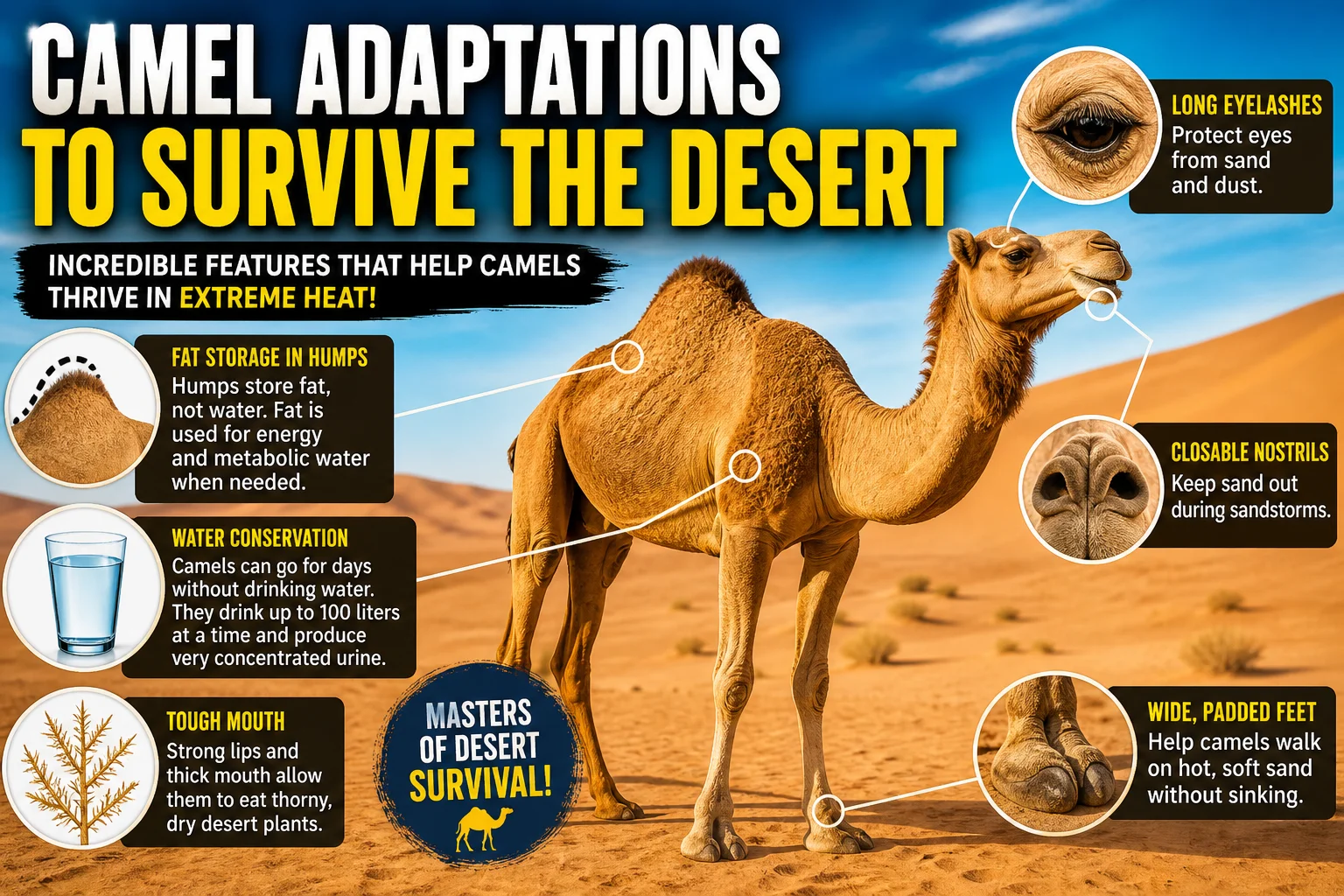
Camel Adaptation in the Desert
How Do Camels Survive in Deserts?
Camels survive in deserts through a range of specialized adaptations:
- Water Conservation: Camels can survive without water for up to two weeks. When water becomes available, they can drink up to 100 liters in a short time. Their kidneys and intestines are highly efficient, producing concentrated urine and very dry feces to minimize water loss.
- Heat Tolerance: Camels can tolerate body temperature changes from 34°C to 41°C. This reduces sweating and helps conserve water, making them highly heat-resistant.
- Fat Storage (Hump): A camel’s hump stores fat, not water. This fat can be converted into energy and metabolic water when food is scarce.
- Protection from Sandstorms: Long, double eyelashes and closable nostrils protect camels from blowing sand and dust.
- Movement on Hot Sand: Their wide, padded feet prevent sinking into soft sand and protect them from the heat of the desert ground.
What Adaptations Do Camels Have in the Desert?
Camels have many unique adaptations, including:
- Thick fur that reflects sunlight and insulates the body.
- Long legs that keep the body away from the hot ground.
- Tough lips that allow them to eat thorny plants.
- Oval-shaped red blood cells that continue flowing during dehydration
- Ability to survive extreme dehydration levels.
Types of Camel Adaptations Explained
Camels show three main types of adaptation:
Structural Adaptations: Physical features like humps, long legs, and wide feet. Camels have a body specially designed for desert survival. Their humps store fat, their long legs lift the body off the hot sand, and their feet are adapted for walking on loose surfaces.
Physiological Adaptations: Internal processes such as water conservation and temperature regulation. Camels have highly efficient internal systems. They conserve water, regulate body temperature, and tolerate dehydration better than most animals.
Behavioral Adaptations: Actions such as resting during the hottest part of the day and traveling during cooler periods. Camels adjust their behavior to avoid extreme heat. They often rest during the hottest hours and are more active in the early morning or evening.
20 Adaptations of Camels in the Desert
Water & Survival Adaptations
- It can survive without water for up to 10–14 days.
- It drinks large amounts quickly (up to 100 liters at once).
- It produces highly concentrated urine to reduce water loss.
- It produces very dry feces to conserve moisture.
- Minimal sweating even in extreme heat.
- It can tolerate up to 25–30% body water loss (fatal for most animals).
Heat & Temperature Adaptations
- Body temperature fluctuates (34°C–41°C) to reduce sweating.
- Thick fur reflects sunlight and insulates against heat.
- A light-colored coat helps reflect solar radiation.
- Long legs keep the body away from the hot sand.
Structural (Body) Adaptations
- Hump stores fat (not water) for energy and metabolic water.
- Wide, padded feet prevent sinking in soft sand.
- Long eyelashes protect eyes from sandstorms.
- Closable nostrils keep out sand and dust.
- Thick lips allow eating thorny desert plants.
- Calloused pads on knees and chest for sitting on hot sand.
Internal (Physiological) Adaptations
- Oval-shaped red blood cells continue flowing during dehydration.
- Efficient kidneys and intestines conserve water.
- Ability to convert fat into water and energy.
Behavioral Adaptations
Rest during the hottest part of the day and move during cooler times.
Camel Habitat Around the World
Camels are commonly found in:
- North Africa (e.g., the Sahara Desert).
- The Middle East (e.g., Arabian Desert).
- Central Asia (home of the Bactrian camel).
Low rainfall, high temperatures, and limited plant life characterize these habitats.
FAQ about Camel Adaptation in the Desert
1. How do camels survive in deserts?
Camels survive in deserts through a combination of water conservation, heat tolerance, and specialized body features. They can go long periods without drinking, regulate their body temperature efficiently, and use stored fat in their humps as an energy source.
2. What is the most important adaptation of a camel?
One of the most important adaptations is the camel’s ability to conserve water. Its kidneys produce highly concentrated urine, and it loses very little water through sweating, allowing it to survive in extremely dry environments.
3. Do camels store water in their humps?
No, camels do not store water in their humps. The humps store fat, which can be converted into energy and a small amount of metabolic water when food is scarce.
4. How do camels protect themselves from sandstorms?
Camels have long double eyelashes, bushy eyebrows, and nostrils that can close tightly. These features prevent sand from entering their eyes and respiratory system during storms.
5. Why do camels have long legs?
Camels have long legs to keep their bodies elevated above the hot desert ground, reducing heat absorption and helping them stay cooler.
6. How do camels walk on sand easily?
Camels have wide, padded feet that spread their weight evenly. This prevents them from sinking into soft sand and makes walking across deserts easier.
7. Can camels survive without food for long periods?
Yes, camels can survive for weeks without food by using the fat stored in their humps as an energy source.
8. What do camels eat in the desert?
Camels eat dry grasses, thorny plants, and salty vegetation that many other animals cannot consume, thanks to their tough lips and strong mouths.
9. What types of adaptation do camels show?
Camels show three main types of adaptation:
- Structural (body features like humps and feet).
- Physiological (internal processes like water conservation).
- Behavioral (actions like resting during extreme heat).
10. How do camels regulate their body temperature?
Camels allow their body temperature to fluctuate throughout the day, reducing the need to sweat and helping conserve water.
11. Where do camels live?
Camels mainly live in desert regions such as the Sahara Desert and the Arabian Desert, where conditions are hot and dry.
12. Why are camels called “ships of the desert”?
Camels are called “ships of the desert” because they can travel long distances across sand carrying heavy loads, similar to how ships move across the sea.
13. How long can a camel live?
Camels typically live between 40 and 50 years, depending on their environment and care.
14. What makes camel blood special?
Camel red blood cells are oval-shaped, which allows them to continue flowing smoothly even when the animal is dehydrated.
15. Are camels the only animals adapted to deserts?
No, many animals are adapted to desert life, but camels are among the best examples due to their unique combination of survival features.
These adaptations make the camel one of the most perfectly designed animals for desert life, allowing it to survive in extreme environments like the Sahara Desert and the Arabian Desert.
You can follow Science online on YouTube from this link: Science online
Adaptation in insectivorous & birds, Hibernation, Aestivation, Birds migration and Camouflage
Adaptation reasons, types, diversity of living organisms & motion in mammals
Types and reasons of adaptation of living organisms
Adaptation and continuity of life by hibernation and aestivation