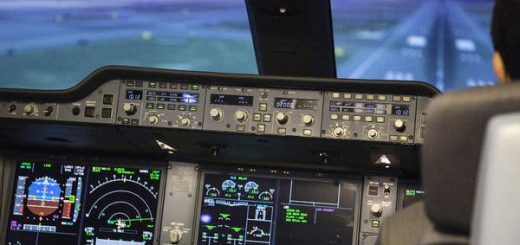
Robotic sensing (Robot Sensors) uses, types and importance
Robotic sensing is the subarea of robotics science intended to give robots sensing capabilities so that the robots are more human-like. Robotic sensing mainly gives robots the ability to see, touch, hear, and move, and it uses algorithms that require environmental feedback.
Robot Sensors
Robotic sensors are used to estimate the robot’s condition and environment. These signals are passed to the controller to enable the appropriate behavior. The sensors in robots are based on the functions of the human sensory organs. The robots require extensive information about their environment to function effectively.
Robots need Robot Sensors to know the world around them. There are many Robot Sensors, including ultrasonic, temperature and humidity, force, and a lot more, to increase robot awareness.
The sensor is a sophisticated device that measures physical quantities such as speed or pressure, and it converts them into a signal that can be measured electrically. The sensors are based on several working principles and types of measurements. Almost all types of sensors emit signals and measure the reflection to make measurements.
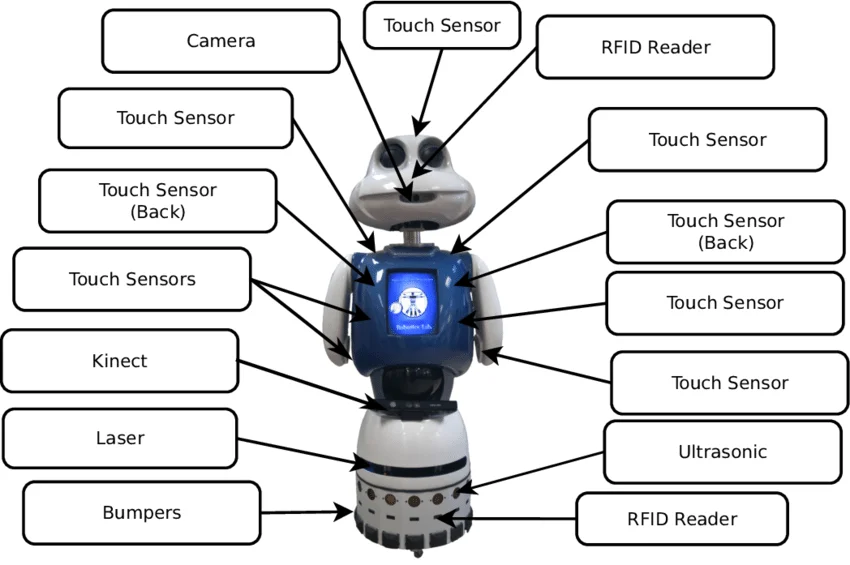
Robotic sensing
The sensors provide analogs to the human senses. They can monitor other phenomena for which humans lack explicit sensors, and they can measure physical properties such as the distance between objects.
The sensors can measure the presence of light and the frequency of sound. They can measure the object proximity, They can measure the presence or the absence of the object, bearing, the color, and the distance between the objects.
The sensors can measure the physical orientation and the coordinates of the object in the space, they can measure the heat, the wavelength of infrared or ultraviolet rays, the temperature, the magnitude, and the direction.
The sensors can measure the presence and concentration of chemicals or reactants. They can measure the presence, color, and intensity of light. They can measure the presence, frequency, and intensity of sound.
The accuracy is very important in detecting and tracking objects. Environmental conditions affect the sensors, such as the temperature and the humidity; you can select the sensors that can be used to build the robot.
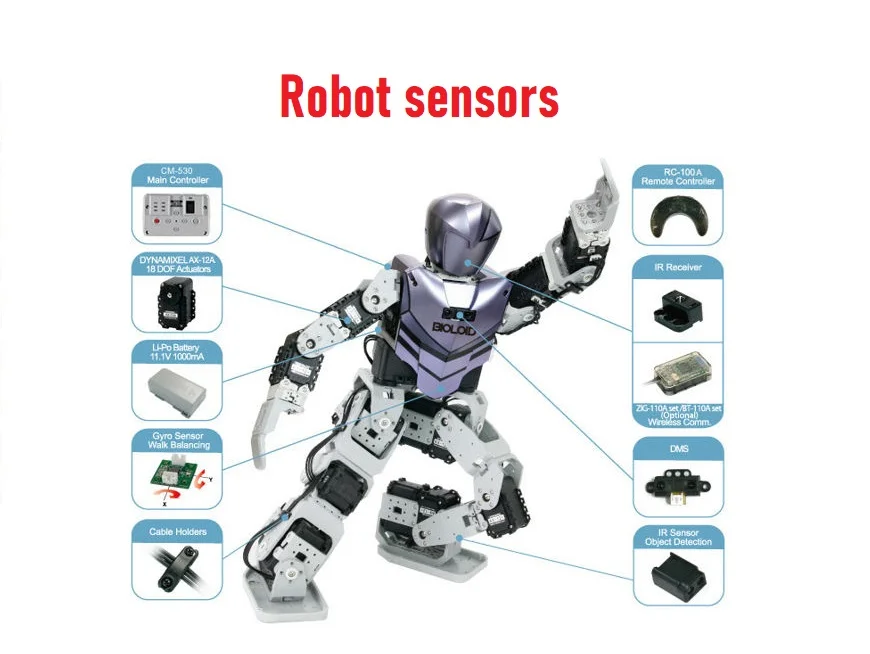
Robot Sensors
Robot sensors types
The internal sensors measure the robot’s internal state, and they are used to measure its position, velocity, and acceleration. The position sensors measure the position of the joint (the degree to which the joint is extended). The velocity or speed sensor measures the consecutive position measurements at known intervals, and it computes the time rate of change in the position values.
The presence of the object can be detected with the proximity sensors, There are many sensors such as the ultrasonic sensors, the capacitive, the photoelectric, the inductive or the magnetic, Tracking the objects can work using the proximity sensors (ultrasonic sensors), for the advanced applications generally it is used the image sensors (webcams) and the vision software like OpenCV.
Many sensor technologies are used to build the proximity sensors, ultrasonic sensors, capacitive, photoelectric, inductive, or magnetic. Motion detectors are based on infrared light, ultrasound, or microwave/radar technology. Image sensors are digital cameras, camera modules, and other imaging devices based on CCD or CMOS technology.
Uses of Sensors in Robotics
The sensors are one of the useful technologies that play a vital role in the robotics field. They are highly required in robotics in Safety monitoring, interlocking in work cell control, quality control in work part inspection, and data collection of the objects in the robot work cell.
The sensors are used in industrial robotics for monitoring the dangerous and safety conditions in the robot cell layout. They help in avoiding physical injuries and other damages caused to the human workers.
In the robot work cell, the series of activities of various equipments are controlled by using the interlocks. The sensors are used to verify the conclusion of the current work cycle before progressing to the next cycle.
The quality control was performed with the manual inspection system. Nowadays, the sensors are used in the inspection process to determine the quality features of the work part automatically. The sensors provide highly accurate results, but they are only able to examine a limited variety of work part features and faults.
The sensors are used in data collection of objects in the robot work cell to determine the position or other related data about the fixtures, the work parts, the equipment, the human workers and so on, Apart from sensing the position, It is implemented to find out the other information like the work part’s color, the orientation, the size, the shape, etc.
The image quality is important in applications that require excellent robotic vision. An algorithm based on the wavelet transform for fusing the images of different spectra and different foci improves the image quality. The robots can collect more accurate information from the resulting improved image.
The visual sensors help the robots to identify the surroundings, and they take appropriate action. The touch sensory signal is useful to identify the external tactile signals for accurate operations. Touch patterns enable the robots to interpret human emotions in interactive applications.
The robots use touch signals to map the profile of the surface in a hostile environment, such as the water pipe. The predetermined path was programmed into the robot, with the integration of touch sensors. The robot first acquires the random data point.
The accurate audio sensor requires low internal noise contribution; audio sensors combine the acoustical arrays and the microphones to reduce the internal noise level.
The automated robots require a guidance system to determine the path to perform their task; the only way to achieve motion in such an environment is to replace the sensors with chemical reactions.
FAQ About Robotic Sensing (Robot Sensors)
What is Robotic Sensing?
Robotic sensing refers to the use of sensors in robots to detect, measure, and interpret information from their environment. Sensors act as the “eyes, ears, and skin” of a robot, allowing it to interact intelligently with its surroundings. Without sensors, robots cannot adapt, navigate, or make decisions effectively.
Why are sensors essential in robotics?
Sensors are important because they:
- Enable environmental awareness.
- Improve safety and collision avoidance.
- Provide feedback for precise movement.
- Allow autonomous navigation.
- Help robots make intelligent decisions.
- They transform robots from simple automated machines into intelligent systems.
What Are the Main Types of Robot Sensors?
- Proprioceptive Sensors (Internal Sensors): These measure the robot’s internal state. Examples: Position sensors (encoders), Velocity sensors, Acceleration sensors, Battery level sensors, and Temperature sensors. Purpose: Monitor robot performance and control motion accuracy.
- Exteroceptive Sensors (External Sensors): These detect information from the external environment. Examples: Cameras (Vision sensors), LIDAR, Ultrasonic sensors, Infrared sensors, and Proximity sensors. Purpose: Help robots detect objects, obstacles, and surroundings.
What are tactile sensors?
Tactile sensors detect touch, pressure, or force. Used in robotic hands and grippers.
What are force and torque sensors?
Measure applied force and rotation. Used in industrial robotic arms for precision tasks.
What are environmental sensors?
Measure temperature, humidity, gas levels, or light. Used in monitoring robots and smart systems.
What Are the Uses of Robot Sensors?
- Navigation: Autonomous vehicles, Delivery robots, and Drones.
- Obstacle Detection: Prevent collisions, ensure workplace safety.
- Object Recognition: Used in robotic vision systems, Essential in AI-powered robots.
- Motion Control: Ensures precise movement in industrial robots.
- Human-Robot Interaction: Detect gestures, voice, or touch.
- Medical Robotics: Used in surgical robots for high precision.
What Is the Importance of Robotic Sensing?
- Increases automation efficiency.
- Improves task accuracy.
- Enhances adaptability.
- Enables AI integration.
- Supports autonomous systems.
- In modern robotics, sensors are the foundation of intelligent behavior.
Can a robot work without sensors?
Yes, but it will perform only pre-programmed tasks without adapting to changes.
What is the most important sensor in robotics?
There is no single most important sensor. It depends on the robot’s function (e.g., vision sensors for navigation robots, force sensors for industrial arms).
What is LIDAR used for?
LIDAR is used for mapping, navigation, and distance measurement in autonomous robots.
What is the difference between active and passive sensors?
- Active sensors emit signals (e.g., ultrasonic, LIDAR).
- Passive sensors detect existing signals (e.g., cameras, temperature sensors).
How do sensors improve robot safety?
They detect obstacles, monitor conditions, and prevent dangerous movements.
You can follow science online on YouTube from this link: Science online
Advantages and disadvantages of using robots in our life