From Swallowing to Digestion: How the Pharynx, Esophagus and Stomach Really Work!
Ever wondered what really happens to your food after you swallow it? The journey through the pharynx, esophagus, and stomach is more fascinating than you think! From smooth swallowing to powerful muscle movements and acid digestion, these organs work together in perfect harmony—discover the hidden process that keeps your digestive system running efficiently!
Functions in the Digestive System
The pharynx (throat) acts as a passageway that directs food from the mouth to the esophagus while preventing it from entering the airway. The esophagus is a muscular tube that moves food to the stomach through rhythmic contractions known as Peristalsis, ensuring smooth and controlled movement. Once food reaches the stomach, it is mixed with digestive juices and acids that break it down into a semi-liquid substance, preparing it for further digestion and nutrient absorption in the intestines.
What if one of these organs doesn’t work properly? Even a small issue can lead to swallowing difficulties, acid reflux, or poor digestion. Understanding how the pharynx, esophagus, and stomach function together can help you recognize early signs of digestive problems and keep your system healthy!
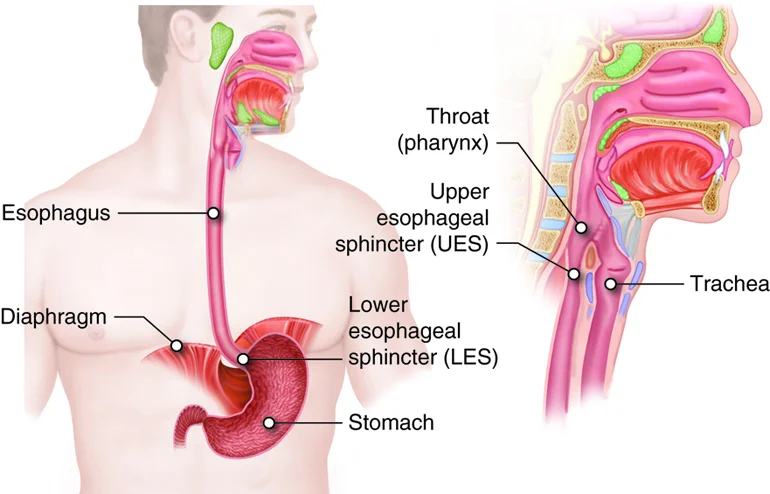
Pharynx, Esophagus, and Stomach
The pharynx
The pharynx is a cavity extending from the mouth to the esophagus. It is a common cavity between the esophagus and the trachea, and the pharynx is a common cavity between the digestive system and the conducting zone of the respiratory system.
The conducting zone includes the nose, the larynx, the trachea, the bronchi, and the bronchioles, and their function is to filter, warm, and moisten the air and conduct it into the lungs. The human pharynx is divided into three sections, which are the nasopharynx, the oropharynx, and the laryngopharynx.
The esophagus
The esophagus is a muscular tube connecting the mouth to the stomach, and it allows food to pass from the mouth to the stomach. The esophagus is usually from 18 to 25 centimetres (cm) long, and it is behind the trachea and the heart. It passes through the diaphragm.
The esophagus empties into the cardia of the stomach, and during swallowing, the epiglottis prevents the food from going down the larynx.
The stomach
The stomach is a sac-like muscular organ, and it is a hollow, dilated part of the digestive system which located on the left side of the upper abdomen, The stomach is located between the esophagus and the small intestine, and it has a relaxed near empty volume of about 45 to 75 millilitres, and it normally expands to hold about one litre of food.
The stomach secretes the gastric juice that causes the incomplete digestion of proteins. The stomach receives the food from the esophagus, and it enters the stomach through a muscular valve called the lower esophageal sphincter.
The stomach mixes the food with its gastric (digestive) juice to form a semi-liquid substance after a few hours that can be digested easily. The stomach is divided into four sections beginning at the cardia, and each of them has different cells and functions.
The cardia is where the contents of the esophagus empty into the stomach, and the cardia is defined as the region following the z-line of the gastroesophageal junction.
The fundus is formed by the upper curvature of the stomach, the body is the main central region, and the pylorus is the lower section of the stomach that facilitates emptying the contents into the small intestine.
FAQ about Digestive System
1. What is the function of the pharynx in digestion?
The pharynx helps guide food from the mouth to the esophagus and ensures it does not enter the respiratory tract.
2. How does the esophagus move food?
It uses Peristalsis to push food downward toward the stomach.
3. What is the main role of the stomach?
The stomach digests food by mixing it with acids and enzymes, turning it into a semi-liquid substance.
4. What is peristalsis?
It is a series of wave-like muscle contractions that move food through the digestive tract.
5. Why is the stomach important?
It breaks down food chemically and mechanically, making nutrients easier to absorb later.
You can subscribe to Science Online on YouTube from this link: Science Online
Digestion in man, Buccal digestion and Gastric digestion (digestion in stomach)
Small intestine, Absorption of digested food, Metabolism, Large intestine and defecation
Human Transport System, Structure of human circulatory system (Heart, blood vessels and blood)