7 Powerful Types of Covalent Bonds Explained: Amazing Chemistry Guide 2026
Types of covalent bonds play a fundamental role in chemistry because they determine how atoms share electrons to form stable molecules. Covalent bonds are commonly found in substances such as water, oxygen, carbon dioxide, and organic compounds. Understanding the different types of covalent bonds helps explain molecular structure, chemical properties, and the behavior of matter in both living organisms and industrial applications.
Types of covalent bonds
Covalent bond
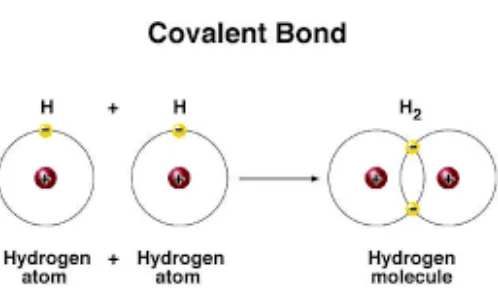
The covalent bond is a bond occurred among the atoms of nonmetals through the participation of each atom with the same number of electrons to complete the outer electron shell. The covalent bond is a type of bond that occurs between two nonmetals, when two nonmetal atoms interact with each other, neither of them loses or even gains any electrons.
Each atom shares the other, with a number of electrons (from its outermost shell) equal to the number of electrons it needs to complete its outermost shell. There is an interference occurred among both atoms, resulting in a bond known as the covalent bond.
Covalent bonds
The covalent bond is formed by sharing one pair of electrons or more, and it may be formed between 2 atoms of the same element. The covalent bond is formed due to the sharing of electrons between the atoms, and it produces the element and the compound molecules.
The covalent bonds produce element molecules between two similar nonmetal atoms, they produce compound molecules between two different nonmetallic atoms, and the covalent bonds produce the covalent compounds.
Types of covalent bonds
Types of covalent bonds
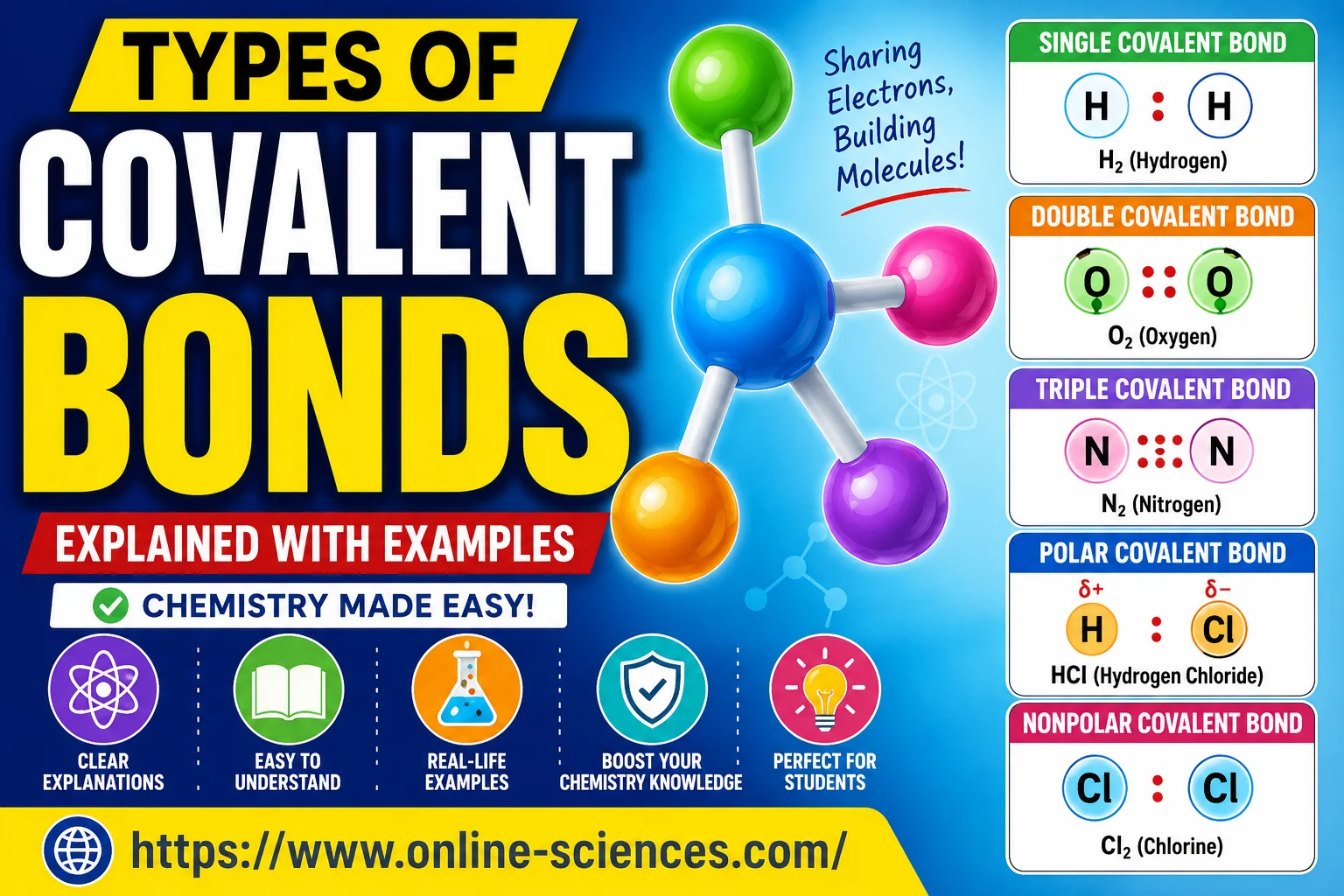
Covalent bonds form when two atoms share one or more pairs of electrons to achieve stability. Depending on the number of shared electron pairs and the distribution of electrons, covalent bonds can be classified into several types.
1. Single Covalent Bond
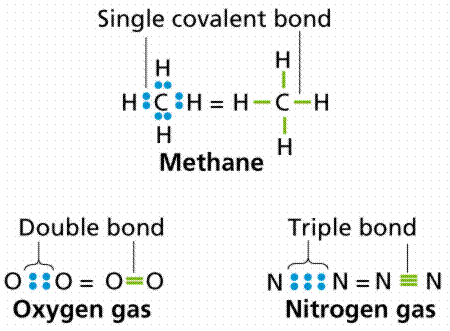
A single covalent bond is formed when two atoms share one pair of electrons. It is represented by a single line between atoms. A single covalent bond is the bond that arises between two nonmetal atoms, where each atom shares the other atom with one electron to complete its outermost shell, and becomes more stable. A single covalent bond is represented by one line ( – ) joining the two atoms.
Examples:
- Hydrogen (H₂).
- Chlorine (Cl₂).
- Methane (CH₄).
Single bonds are generally the longest and weakest among covalent bonds.
2. Double Covalent Bond
A double covalent bond occurs when two atoms share two pairs of electrons. A double covalent bond is the bond that arises between two nonmetal atoms, where each atom shares the other atom with two electrons to complete its outermost shell with 8 electrons and becomes more stable. A double covalent bond is represented by two lines ( = ) joining the two atoms.
Examples:
- Oxygen (O₂).
- Carbon dioxide (CO₂).
Double bonds are shorter and stronger than single bonds.
3. Triple Covalent Bond
A triple covalent bond forms when two atoms share three pairs of electrons. A triple covalent bond is the bond that arises between two nonmetal atoms, where each atom shares the other atom with three electrons to complete its outermost shell with 8 electrons and becomes more stable.
Examples:
- Nitrogen (N₂).
- Ethyne (C₂H₂).
Triple bonds are the strongest and shortest type of covalent bond.
4. Polar Covalent Bond
In a polar covalent bond, electrons are shared unequally because one atom attracts electrons more strongly than the other.
Examples:
- Water (H₂O).
- Hydrogen chloride (HCl).
These bonds create partial positive and negative charges within molecules.
5. Nonpolar Covalent Bond
In a nonpolar covalent bond, electrons are shared equally between atoms with similar electronegativities.
Examples:
- Hydrogen gas (H₂).
- Oxygen gas (O₂).
Nonpolar molecules generally have no permanent electrical charge.
6. Coordinate (Dative) Covalent Bond
A coordinate covalent bond forms when both shared electrons are provided by the same atom.
Examples:
- Ammonium ion (NH₄⁺).
- Carbon monoxide (CO).
Although formed differently, coordinate bonds function like ordinary covalent bonds once established.
7. Network Covalent Bond
Network covalent bonding occurs when atoms are connected through an extensive three-dimensional network of covalent bonds.
Examples:
- Diamond.
- Silicon dioxide (SiO₂).
These substances are usually very hard and have high melting points.
Frequently Asked Questions (FAQ) about covalent bonds
1. What is a covalent bond?
A covalent bond is a chemical bond formed when atoms share electrons to achieve a stable electron configuration.
2. What are the main types of covalent bonds?
The main types are single, double, triple, polar, nonpolar, coordinate, and network covalent bonds.
3. Which covalent bond is the strongest?
Triple covalent bonds are generally the strongest because they involve three shared pairs of electrons.
4. What is the difference between polar and nonpolar covalent bonds?
Polar bonds share electrons unequally, while nonpolar bonds share electrons equally.
5. Why do atoms form covalent bonds?
Atoms form covalent bonds to achieve a more stable electron arrangement and a lower energy state.
6. What is an example of a single covalent bond?
The bond between two hydrogen atoms in H₂ is a single covalent bond.
7. What is a coordinate covalent bond?
It is a covalent bond in which both shared electrons originate from the same atom.
8. Are covalent bonds stronger than ionic bonds?
The strength depends on the specific compounds involved, but many covalent bonds are extremely strong, especially network covalent bonds.
9. What substances contain network covalent bonds?
Diamond, graphite, and silicon dioxide are common examples.
10. Why are covalent bonds important?
Covalent bonds are essential for forming molecules, biological compounds, and many materials used in everyday life.
Conclusion
The types of covalent bonds determine how atoms share electrons and influence the physical and chemical properties of substances. From single and double bonds to complex network structures, covalent bonding is fundamental to understanding chemistry, molecular behavior, and the composition of matter.
You can subscribe to Science Online on YouTube from this link: Science Online
The quantum numbers and principles of distributing electrons
Chemical combination, Types of bonds (Chemical bonds & Physical bonds)
Theories explaining the covalent bond, Octet rule & Overlapped orbitals concept
Chemical bonds, Ionic bonds, Properties & types of covalent bonds