General properties of alkali metals in the modern periodic table, Why are alkali metals highly reactive?
The alkali metals are located on the left side of the modern periodic table in group (1) or (1 A). They are the first group of s-block, the alkali metals are monovalent elements as they have only one electron in their outermost energy levels.
Alkali metals
The alkali metals are all metals that have one electron in the outer shell. They are highly reactive, and they are the most reactive metals. They are located in group 1; the alkali metals are good conductors of heat and electricity.
Most alkali metals have low density. Lithium (Li). Sodium (Na) and potassium (K) elements float on the water surface as their densities are smaller than the water density. Rubidium (Rb) and cesium (Cs) elements sink in the water as their densities are greater than the water density.
The alkali metals tend to lose their valency (outermost) electrons during chemical reactions, forming positive ions. Each of them carries one positive charge.
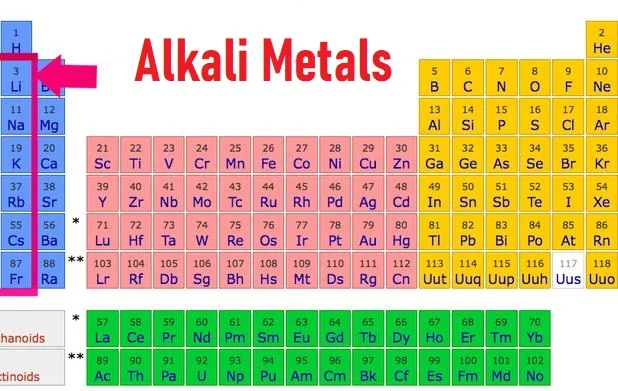
Alkali metals are located on the left side of the modern periodic table.
The elements of the alkali metals react with water, forming alkaline solutions. So, they named the alkali metals.
The alkali metals react by losing electrons. These metals are very reactive, with reactivity increasing down the group. They are active elements, so they are kept submerged in kerosene or paraffin oil.
Lithium is not kept under the surface of kerosene as it floats on its surface and burns at once, so it is kept in paraffin oil. Sodium and potassium are kept under the surface of kerosene to prevent them from reacting with the moist air, as they are active metals.
If you would like to know why Cesium is the most active metal, look at the modern periodic table. You will know that the chemical activity of the alkali metals increases as the atomic size increases; therefore, Cesium (Cs) is considered the most active metal (in the periodic table) as it has the largest atomic size.
FAQ about General Properties of Alkali Metals
1. What are alkali metals?
Alkali metals are elements found in Group 1 of the modern periodic table (except hydrogen). They include elements like lithium, sodium, and potassium.
2. Why are they called alkali metals?
They are called alkali metals because they form alkaline (basic) solutions when they react with water.
3. What elements belong to the alkali metals group?
The main alkali metals are:
- Lithium (Li).
- Sodium (Na).
- Potassium (K).
- Rubidium (Rb).
- Cesium (Cs).
- Francium (Fr).
4. What is the electronic configuration of alkali metals?
All alkali metals have one electron in their outermost shell, which makes them highly reactive.
5. What are the general physical properties of alkali metals?
- Soft and can be cut easily.
- Low density (some float on water).
- Shiny when freshly cut.
- Low melting and boiling points compared to other metals.
6. What are the general chemical properties of alkali metals?
- Highly reactive, especially with water.
- Form alkaline hydroxides.
- React quickly with oxygen.
- Lose one electron to form +1 ions.
7. How do alkali metals react with water?
They react vigorously with water to produce:
- Metal hydroxide (alkaline solution).
- Hydrogen gas.
Example: Sodium + Water → Sodium hydroxide + Hydrogen
8. Why are alkali metals highly reactive?
Because they have one valence electron that is easily lost to achieve a stable electron configuration.
9. How does reactivity change down the group?
Reactivity increases down the group (from lithium to cesium) because the outer electron becomes farther from the nucleus and easier to remove.
10. How are alkali metals stored?
They are stored under oil or kerosene to prevent reaction with air and moisture.
11. What type of compounds do alkali metals form?
They mainly form:
- Ionic compounds.
- Oxides.
- Hydroxides.
- Halides.
12. What is the flame test for alkali metals?
Each alkali metal gives a characteristic flame color:
- Lithium → Red.
- Sodium → Yellow.
- Potassium → Lilac.
13. Why do alkali metals form positive ions?
They lose their single outer electron easily, forming +1 cations.
14. Are alkali metals found freely in nature?
No, due to their high reactivity, they are found only in compounds, not in their free state.
15. What are the common uses of alkali metals?
Lithium → Batteries.
Sodium → Street lamps and chemical industry.
Potassium → Fertilizers.
You can subscribe to Science Online on YouTube from this link: Science Online
Elements of s-block, Properties of the first group elements 1A (Alkali metals) in the periodic table
Alkali metals compounds properties and uses (Sodium hydroxide & Sodium carbonate)
Metallic & nonmetallic property, Acidic & basic properties in the periodic table
Elements of s-block, Properties of the first group elements 1A (Alkali metals) in the periodic table