
10 Amazing Kinds of Molecules: A Complete and Easy Guide with Examples
Kinds of molecules are one of the most important concepts in chemistry because they explain how atoms combine to form the substances around us. From the oxygen we breathe to the water we drink and the DNA that carries our genetic information, molecules play a vital role in everyday life.
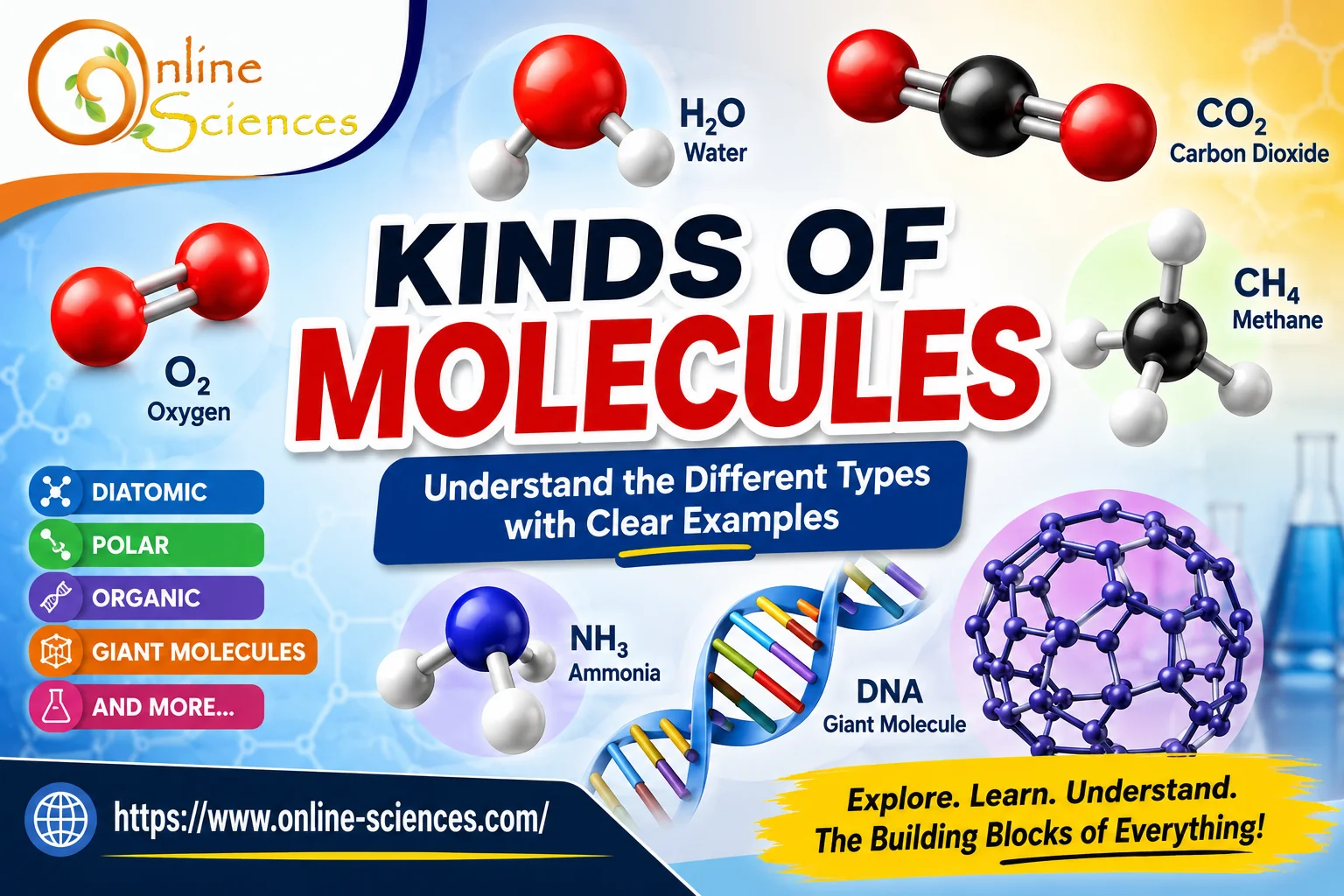
Kinds of Molecules
Molecules
The molecules of one substance are alike in properties, but they differ from other substance molecules. The molecule is composed of tiny structural units called atoms. A molecule is a group of two or more atoms that stick together, and they are very small that nobody can see them except with an electron microscope.
The difference in the molecules of various substances is found as a result of the difference in the atoms that are involved in the structure of the molecule through the number of atoms, the kind of atoms, and the way of combination together.
Understanding the different kinds of molecules helps students, researchers, and science enthusiasts recognize how materials behave, react, and contribute to biological, industrial, and environmental processes.
Kinds of molecules
Kinds of molecules
1. Based on Composition
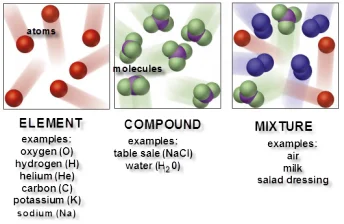
There are three types of molecules: the element molecule, the compound molecule, and the mixture.
Element molecule
The element molecule is formed of similar atoms (one or more atoms) that combine together, The element is the simplest pure form of matter, which can not be analyzed chemically into a simpler form. The elements molecules formed of only one atom (monoatomic) as solid (copper, iron, aluminum, sulphur, magnesium, carbon), liquid ( mercury), and Nobel gases (helium, neon, krypton, xenon, and radon).
The element molecules formed of two atoms (diatomic), such as liquid (bromine), and active gases (oxygen, hydrogen, chlorine, nitrogen, and fluorine). The molecules of active gases are diatomic, such as oxygen molecules, while the molecules of inert gases are monoatomic, Mercury is the liquid element that is composed of one atom, while bromine is the liquid element that is composed of two atoms.
The elements molecules consist of only one kind of atom; they can’t be broken down into a simpler type of matter by either physical or chemical means, and they can exist as either atoms (e.g. argon) or molecules (e.g. nitrogen).
Elements made of only one kind of atom, such as O₂ (oxygen), N₂ (nitrogen), H₂ (hydrogen).
Compound molecule
The compound molecule is formed of different atoms. A compound is a substance that is formed from the combination of atoms of two or more different elements with constant weight ratios. Some known compounds as sodium chloride molecule (table salt), water molecule, and ammonia molecule.
The compound molecule can be broken down into a simpler type of matter (the elements) by chemical means, but not by physical means. It has properties that are different from its component elements, and it always contains the same ratio of its component atoms.
Compounds are made of two or more different elements bonded together, such as H₂O (water), CO₂ (carbon dioxide), and NaCl (salt).
Mixture molecule
The mixture molecule consists of two or more different elements or compounds physically intermingled. It can be separated into its components by physical means, and it often retains many of the properties of its components.
2. Based on the Bonding Type
- Covalent Molecules: Atoms share electrons, Usually formed between nonmetals, Example: CH₄ (methane), H₂O, O₂.
- Ionic Compounds (not always called “molecules,” but still worth noting), Atoms transfer electrons (creating ions). Typically between metals and nonmetals. Example: NaCl, MgO.
3. Based on the Number of Atoms
- Diatomic Molecules: Made of two atoms (same or different). Example: O₂, H₂, CO.
- Polyatomic Molecules: Made of three or more atoms. Example: H₂O (3 atoms), C₆H₁₂O₆ (glucose — 24 atoms!).
4. Based on Origin
- Organic Molecules: Contain carbon (usually with hydrogen, oxygen, and nitrogen). Found in living things. Examples: Glucose, proteins, DNA.
- Inorganic Molecules: Often don’t contain carbon (or it’s not central). Example: H₂O, NaCl, CO₂ (yes, CO₂ is an exception — inorganic but carbon-containing).
5. Biological Molecules (Biomolecules)
These are crucial for life:
- Carbohydrates – sugars and starches
- Lipids – fats, oils
- Proteins – made of amino acids
- Nucleic Acids – DNA and RNA
FAQ: Types of Molecules
What is a molecule?
A molecule is a group of two or more atoms chemically bonded together. The atoms can be the same or different elements.
What are the main types of molecules?
Molecules are commonly grouped by composition and function:
- Elemental molecules.
- Compound molecules.
- Organic molecules.
- Inorganic molecules.
- Biomolecules.
What is an elemental molecule?
An elemental molecule is made of only one type of element.
Examples:
- O₂ (oxygen).
- N₂ (nitrogen).
- O₃ (ozone).
What is a compound molecule?
A compound molecule contains two or more different elements bonded together.
Examples:
- H₂O (water).
- CO₂ (carbon dioxide).
- NH₃ (ammonia).
What are organic molecules?
Organic molecules are compounds that contain carbon bonded to hydrogen.
Examples:
- CH₄ (methane).
- C₆H₁₂O₆ (glucose).
- Proteins, fats, and DNA.
What are inorganic molecules?
Inorganic molecules do not have carbon–hydrogen bonds (with a few special exceptions).
Examples:
- H₂O (water).
- NaCl (salt — technically a compound, not a molecule in solid form).
- CO₂ (carbon dioxide).
What are biomolecules?
Biomolecules are molecules found in living organisms.
Main types:
- Carbohydrates (sugars, starches).
- Proteins (enzymes, muscles).
- Lipids (fats, oils).
- Nucleic acids (DNA, RNA).
What is the difference between polar and nonpolar molecules?
- Polar molecules have uneven charge distribution. Example: H₂O.
- Nonpolar molecules have an even charge distribution. Example: O₂, CO₂
Are all compounds molecules?
No, some compounds (like ionic compounds such as NaCl) form crystal lattices, not discrete molecules.
Why are molecules important?
Molecules make up everything — air, water, food, cells, medicines, and materials. Understanding them explains how matter behaves and reacts.
What Are Molecules?
A molecule is the smallest unit of a substance that retains all of its chemical properties. It consists of two or more atoms held together by chemical bonds.
Examples include:
- Water (H₂O).
- Oxygen (O₂).
- Carbon dioxide (CO₂).
- Methane (CH₄).
10 Kinds of Molecules with Examples
1. Diatomic Molecules
These molecules contain two atoms.
Examples:
Uses:
- Respiration.
- Fuel production.
- Industrial chemistry.
2. Triatomic Molecules
Contain three atoms.
Examples:
- Water (H₂O).
- Carbon dioxide (CO₂).
- Ozone (O₃).
Importance:
- Supports life.
- Photosynthesis.
- Climate regulation.
3. Polyatomic Molecules
Contain more than three atoms.
Examples:
Applications:
- Agriculture.
- Medicine.
- Food industry.
4. Homonuclear Molecules
Made entirely from the same element.
Examples:
- O₂.
- N₂.
- Cl₂.
- O₃.
Characteristics:
- Symmetrical.
- Often stable.
- Important in atmospheric chemistry.
5. Heteronuclear Molecules
Contain atoms from different elements.
Examples:
- H₂O.
- CO₂.
- NH₃.
- CH₄.
Most compounds found in nature belong to this category.
6. Organic Molecules
Contain carbon bonded to hydrogen.
Examples:
Applications:
- Biology.
- Pharmaceuticals.
- Fuels.
- Plastics.
7. Inorganic Molecules
Generally do not contain carbon-hydrogen bonds.
Examples:
- Water.
- Carbon dioxide.
- Sodium chloride.
- Ammonia.
Applications:
- Construction.
- Agriculture.
- Chemical manufacturing.
8. Polar Molecules
Have an uneven distribution of electrical charge.
Examples:
Properties:
- Dissolve in water.
- Strong intermolecular forces.
- Higher boiling points.
9. Nonpolar Molecules
Share electrons equally.
Examples:
- Oxygen.
- Nitrogen.
- Carbon dioxide (overall nonpolar).
- Methane.
Properties:
- Poor water solubility.
- Good solvents for oils and fats.
10. Giant Molecules (Macromolecules)
Large networks containing thousands or millions of atoms.
Examples:
Applications:
- Electronics.
- Construction.
- Biology.
- Nanotechnology.
Why is it important to Learn the Kinds of Molecules?
Studying molecular classifications helps us:
- Understand chemical reactions.
- Predict physical properties.
- Design new medicines.
- Develop advanced materials.
- Improve industrial manufacturing.
- Explain biological functions.
- Support environmental research.
Frequently Asked Questions (FAQ)
1. What are molecules?
Molecules are groups of two or more atoms chemically bonded together, representing the smallest unit of a substance that retains its chemical properties.
2. What are the main kinds of molecules?
The major kinds include diatomic, triatomic, polyatomic, homonuclear, heteronuclear, organic, inorganic, polar, nonpolar, and giant molecules.
3. What is the difference between polar and nonpolar molecules?
Polar molecules have uneven charge distribution, while nonpolar molecules share electrons equally and have no permanent electrical poles.
4. What are organic molecules?
Organic molecules are compounds primarily made of carbon and hydrogen. Examples include proteins, carbohydrates, lipids, and DNA.
5. Is water a polar molecule?
Yes. Water is a polar molecule because oxygen attracts electrons more strongly than hydrogen, creating positive and negative ends.
6. Is oxygen a molecule?
Yes. Oxygen naturally exists as O₂, a diatomic molecule composed of two oxygen atoms.
7. Why are molecules important?
Molecules make up every living organism and almost every material around us. They determine chemical behavior, biological processes, and physical properties.
8. Which is the largest molecule?
Some DNA molecules are among the largest naturally occurring molecules, containing billions of atoms arranged in long chains.
Conclusion
The kinds of molecules form the foundation of chemistry and explain the structure of everything from the air we breathe to the cells in our bodies. By understanding classifications such as polar, nonpolar, organic, inorganic, diatomic, and giant molecules, you can better appreciate how matter behaves and interacts. Whether you’re a student, educator, or science enthusiast, mastering these molecular types provides a powerful foundation for exploring chemistry, biology, medicine, and materials science.
Comparison of the Different Kinds of Molecules
The different kinds of molecules can be compared based on their structure, composition, and properties. Diatomic molecules contain two atoms, such as oxygen (O₂), while triatomic molecules consist of three atoms, such as water (H₂O) and carbon dioxide (CO₂).
Polyatomic molecules have four or more atoms, with methane (CH₄) and glucose (C₆H₁₂O₆) being common examples. Homonuclear molecules are made of atoms of the same element, like nitrogen (N₂), whereas heteronuclear molecules contain atoms of different elements, such as ammonia (NH₃).
Molecules can also be classified by their chemical behavior: organic molecules contain carbon-hydrogen bonds and include proteins, DNA, and carbohydrates, while inorganic molecules include water, ammonia, and many mineral compounds.
In addition, polar molecules like water have an uneven distribution of electrical charge, making them highly soluble in water, whereas nonpolar molecules like oxygen and methane have a more even charge distribution and dissolve better in nonpolar substances. Finally, giant molecules such as diamond, graphite, and DNA are extremely large structures with unique mechanical, electrical, or biological properties.
Everyday Examples of Molecules
Molecules are present in nearly every aspect of daily life and are essential for living organisms and modern technology. The water (H₂O) we drink is a polar molecule that supports all forms of life, while oxygen (O₂) is a diatomic molecule required for respiration.
Carbon dioxide (CO₂) is released during breathing and is used by plants during photosynthesis to produce food. Methane (CH₄) is widely used as a natural gas fuel for heating and cooking. Ammonia (NH₃) plays a vital role in the production of fertilizers that increase crop yields.
Glucose (C₆H₁₂O₆) provides energy for the body’s cells, and DNA stores the genetic instructions that determine the growth and function of every living organism. Even diamond, a giant molecular structure made entirely of carbon atoms, is used in jewelry and industrial cutting tools because of its exceptional hardness. These examples demonstrate how different kinds of molecules influence our health, environment, industry, and everyday activities.
You can follow Science Online on YouTube from this link: Science online
Matter, Properties and Kinds of molecules, Melting process, and Vaporization process
Theories explaining the covalent bond, Octet rule and Overlapped orbitals concept
Chemical combination, Types of bonds (Chemical bonds and Physical bonds)
The coordinate bond, Physical bonds (hydrogen bond and the metallic bond)