Galileo E1 Robot 2026: Powerful Intelligent Quadruped Robot with Perception-Driven Decisions & Smart Movement🤖
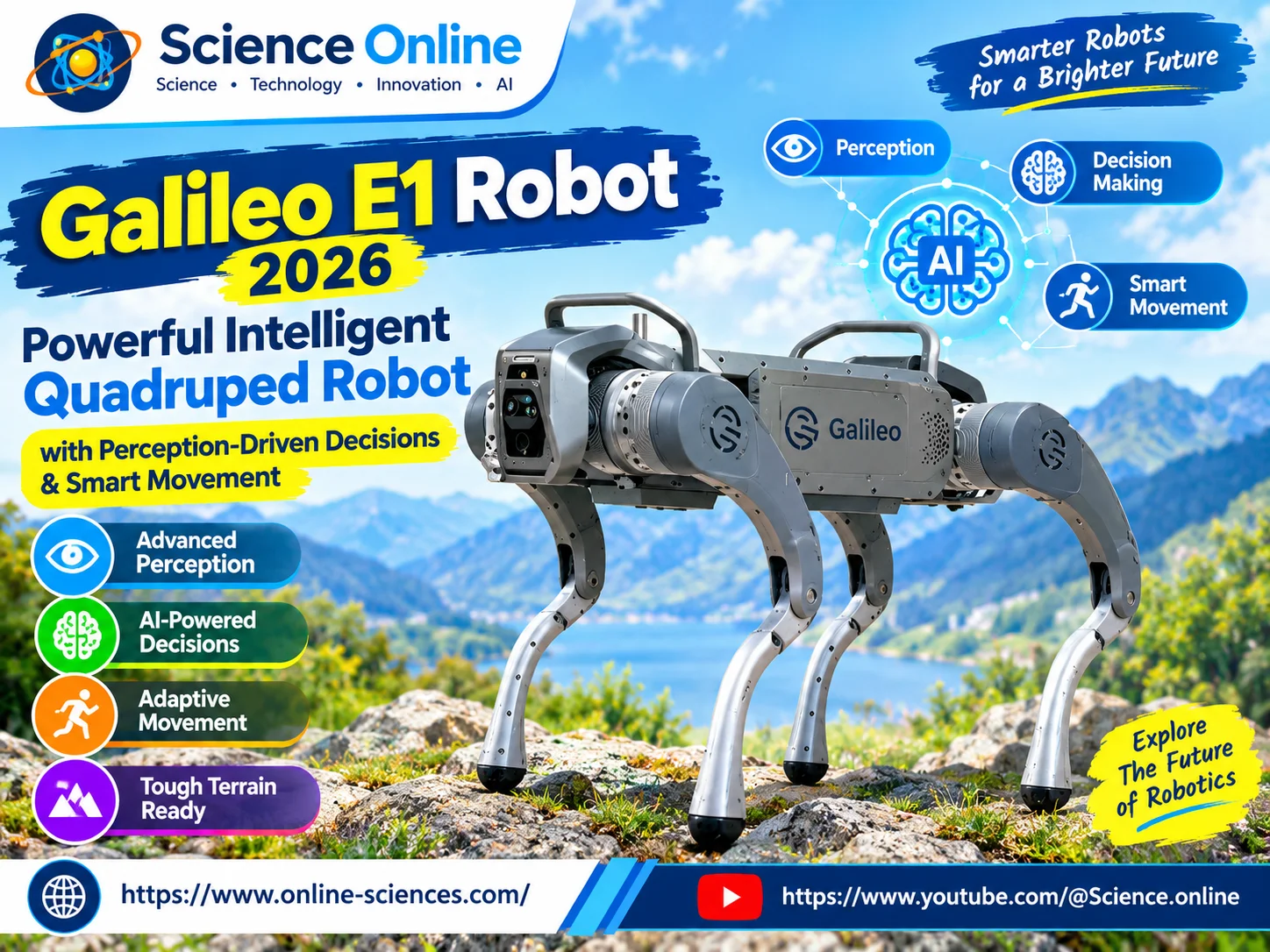
Galileo E1 Robot represents a new generation of intelligent quadruped robots designed to combine advanced perception with dynamic movement and autonomous decision-making. By connecting what the robot sees with how it moves and responds, Galileo E1 demonstrates how AI-powered four-legged robots could operate more intelligently in complex real-world environments.
Galileo E1 Robot 2026
Galileo E1 Robot 2026
Robotics is moving beyond simple programmed movements toward machines that can perceive their surroundings, understand changing conditions, make decisions, and adapt their movements in real time. The Galileo E1 Intelligent Bionic Quadruped Robot is an example of this approach, combining four-legged robotic mobility with intelligent perception and decision-making.
Instead of treating movement and perception as completely separate functions, Galileo E1 is designed around the idea that a robot should use environmental information to determine how it moves. This perception-driven approach can help quadruped robots navigate challenging environments while maintaining balance, stability, and responsiveness.
What is Galileo E1?
The Galileo E1 is an intelligent bionic quadruped robot designed around a four-legged robotic architecture. Its bionic-inspired structure gives it walking and movement capabilities that differ from traditional wheeled robots.
Four-legged robots can potentially travel across surfaces that are difficult for conventional wheeled machines, including uneven terrain, obstacles, slopes, and areas where maintaining continuous contact with the ground is challenging.
The Galileo E1 concept focuses not only on mechanical mobility but also on intelligent robotic perception and decision-making. This combination is important because a robot operating outside a controlled laboratory environment needs to continuously understand what is happening around it.
Perception-Driven Decisions
One of the most interesting aspects of Galileo E1 is the relationship between perception and decision-making. A capable mobile robot needs to collect information from its environment and transform that information into useful actions. For example, when encountering an obstacle, a robot may need to determine whether it can step over it, move around it, change its direction, or stop.
This creates a perception-to-action process: Sense → Understand → Decide → Move → Reassess
This type of loop allows an intelligent robot to respond to changing conditions instead of simply repeating a predetermined sequence of movements. For quadruped robots, perception is particularly important because walking involves continuous adjustments. The robot needs to maintain balance while determining where and how to place its legs.
Intelligent Movement
The phrase “Intelligent Movement” captures another important feature of the Galileo E1 approach. Walking is much more complicated than simply moving four legs one after another. A quadruped robot has to coordinate its legs, body position, balance, speed, direction, and interaction with the ground. An intelligent movement system can use environmental information to influence these actions.
If the terrain changes, the robot may need to modify its gait. If an obstacle appears, it may need to change its trajectory. If the surface becomes uneven, maintaining stability becomes a priority. This integration of perception and locomotion is a major area of modern robotics research.
Why Four Legs Matter
The four-legged configuration provides a useful balance between mobility and stability. Compared with wheeled robots, quadruped robots can potentially place their feet at different positions and adjust their body posture while moving. This makes the architecture particularly interesting for applications involving uneven environments. A four-legged robot can also potentially navigate areas where wheels encounter difficulties.
However, quadruped mobility introduces its own challenges. Coordinating multiple legs requires sophisticated control algorithms, sensors, and real-time computation. Galileo E1 therefore represents more than a four-legged robot. Its importance lies in integrating mechanical design, perception, artificial intelligence, and motion control.
Bionic Inspiration in Galileo E1
The term bionic refers to technologies inspired by biological systems. Animals provide excellent examples of efficient movement over complex terrain. Four-legged animals can automatically adjust their posture, foot placement, speed, and direction while responding to their surroundings. Robotics engineers can use these principles as inspiration while developing artificial locomotion systems.
A bionic quadruped robot does not need to copy an animal exactly. Instead, it can use biological principles such as distributed leg movement, balance control, adaptive posture, and responsive locomotion. Galileo E1 fits into this broader development of robots that attempt to achieve more natural and adaptable movement.
Artificial Intelligence and Robotic Perception
Modern intelligent robots increasingly depend on AI-based perception. Robotic perception can involve identifying objects, recognizing obstacles, estimating distances, understanding terrain, and determining how the environment is changing. The robot can then use this information to support navigation and movement decisions.
This is particularly valuable for autonomous machines because humans may not always be available to remotely control every movement. An intelligent quadruped robot can potentially use perception to answer practical questions such as:
- Where can I safely move?
- Is there an obstacle ahead?
- Which direction should I take?
- How should I adjust my movement?
- Is the terrain suitable for my current gait?
- How can I maintain stability?
The answers can be translated into movement commands.
Galileo E1 and Autonomous Robotics
Autonomy is one of the major goals of modern robotics. A remotely controlled robot depends heavily on a human operator. An autonomous robot, in contrast, is designed to perform more tasks independently. For a quadruped platform such as Galileo E1, autonomy can make the robot more useful in environments where continuous manual control is inconvenient or impossible.
Potential future applications for intelligent quadruped platforms include inspection, research, industrial environments, mapping, exploration, security-related monitoring, disaster-response support, and educational robotics. Actual capabilities and suitability depend on the specific configuration, software, sensors, and deployment environment.
The Challenge of Real-World Movement
Real-world environments are unpredictable. A robot may encounter stairs, rocks, slippery surfaces, narrow passages, unexpected objects, or changing lighting conditions. This makes perception and movement particularly difficult. A robot that can only follow a predefined path may struggle when its environment changes.
Perception-driven robotics attempts to solve this problem by allowing the machine to continually gather information and adjust its behavior. This is why the combination of “Perception-Driven Decisions” and “Intelligent Movement” is significant. The two concepts are closely connected: better environmental understanding can support better movement decisions.
Galileo E1 in the Future of Robotics
Galileo E1 reflects a larger trend in robotics: the transition from machines that simply execute commands to machines that can perceive, reason about their surroundings, and adapt their actions. Future quadruped robots are likely to combine increasingly capable sensors, AI algorithms, motion-control systems, and computing hardware.
This could enable robots to operate more effectively in environments that are difficult for conventional machines. The ultimate goal is not simply to make robots walk. It is to create machines that can move purposefully, safely, and intelligently while responding to the world around them.
Final Thoughts
The Galileo E1 Intelligent Bionic Quadruped Robot demonstrates the direction in which intelligent mobility is developing. Its concept brings together four-legged locomotion, robotic perception, autonomous decision-making, and adaptive movement.
The most important idea is that intelligent movement begins with understanding the environment. When a robot can perceive obstacles and terrain and use that information to influence its actions, its mobility becomes more than a mechanical function—it becomes part of an intelligent robotic system.
As AI and robotics continue to evolve, platforms such as Galileo E1 illustrate how perception-driven decisions and intelligent movement could become increasingly important for the next generation of autonomous machines.
FAQ: Galileo E1 Robot
1. What is the Galileo E1 Robot?
Galileo E1 is an intelligent bionic quadruped robot designed around four-legged mobility, robotic perception, decision-making, and intelligent movement.
2. What does “perception-driven decisions” mean?
It means using information collected from the robot‘s surroundings to help determine appropriate actions, such as changing direction, avoiding obstacles, or adapting movement.
3. Why does Galileo E1 have four legs?
A quadruped configuration can provide versatile mobility and stability, particularly when navigating uneven or challenging terrain.
4. Is Galileo E1 an AI robot?
The Galileo E1 concept incorporates intelligent perception and decision-making, reflecting the growing use of AI and advanced control systems in modern robotics.
5. What is an intelligent quadruped robot?
It is a four-legged robot that combines locomotion with sensing, environmental perception, motion control, and potentially autonomous decision-making.
6. What are possible applications of Galileo E1?
Potential applications for this type of robot include inspection, exploration, research, industrial monitoring, mapping, education, and other environments requiring flexible robotic mobility.
7. What makes bionic robots different from conventional robots?
Bionic robots use principles inspired by biological systems. In quadruped robotics, this can include ideas related to animal locomotion, balance, posture, and adaptive movement.
8. Can quadruped robots navigate uneven terrain?
Quadruped robots are specifically suited to research and development involving uneven terrain because their legs can be individually controlled and repositioned. Their actual terrain capabilities depend on their hardware, sensors, and control software.
9. Why is perception important for autonomous robots?
Perception allows a robot to gather information about its surroundings. That information can then support navigation, obstacle avoidance, and movement decisions.
10. What is the future of intelligent quadruped robots?
Future systems are expected to increasingly combine AI, advanced sensors, autonomous navigation, and sophisticated motion control to operate more effectively in complex environments.
You can follow Science Online on YouTube from this link: Science Online
🔥 Tesla Bot Gen 4 UPDATE 5000 Tasks As HOMEMAKER & Surgeon! Elon Musk SHOCKED Inside Optimus! 🤯
Boston Dynamics Atlas review, advantages and features, How does Atlas robot work?
Tesla robots (Optimus) review, use, advantages and disadvantages
Emo robot review, advantages, disadvantages, features and what can Emo do?
Advantages and disadvantages of using robots in our life
Artificial intelligence (AI) definition, advantages, disadvantages, features and applications
Robot teachers use, advantages and disadvantages
Sophia robot review, features, use, advantages and disadvantages
Vector robot review, advantages, disadvantages and specifications