Powerful forms of energy, their changes, Energy Transformations & 20 Real-Life Examples in daily life
Learn about forms of energy. If you look around you, you will notice that everything needs energy to perform its functions. You need food to obtain the energy that helps you to work, move, play, etc. Your car needs fuel to obtain the energy that causes the motion of its engines.
Do you know what the meaning of energy is?
The energy
Energy is the ability to do work. The chemical energy stored in food is broken down by our bodies and converted into thermal and kinetic energy to keep us warm and moving. Your phone uses electrical energy to power all its functions, from the screen (light energy) to the vibrations (kinetic energy).
Cars use the chemical energy in gasoline, which goes through a series of transformations. Burning the gasoline creates thermal energy, which in turn heats water and converts it to steam. This high-pressure steam spins a turbine, generating kinetic energy that ultimately moves the car (mechanical energy).
A light bulb uses electrical energy to create heat energy, which then produces light energy (with some bulbs being more efficient than others).
The forms of energy
-
There is potential energy stored in the spring of the toy car.
- There is kinetic energy produced by the electric fan and the washing machine.
-
There is light energy produced by the electric lamp or the Sun.
-
There is heat energy produced by the heater.
-
There is electric energy produced by the dry cell (battery) and the solar cells.
-
There is chemical energy stored in the battery.
-
There is sound energy produced by the piano and the radio.
Energy transformation
Examples of some changes in the energy
The potential energy changes into kinetic energy, as in the spring of the children’s toys.
The kinetic energy can change into sound energy, as in the violin, the guitar, and when you knock on the door.
The kinetic energy changes into heat energy, when you rub your hands, when you hammer on a piece of iron, and when you remove a nail from a piece of wood.
The kinetic energy changes into electric energy, as in the dynamo.
The electric energy changes into light energy,y as in the electric lamp, which lights, when the electric current passes through it.
The electric energy changes into kinetic energy, as in the electric fan, the electric motor, and the washing machine.
The electric energy changes into the sound energy, as in the recorder or the radio.
The light energy changes into heat energy, as in the solar heater.
The light energy changes into electric energy in solar cells.
The chemical energy changes into electric energy, as in the battery.
Energy transformation examples in everyday life
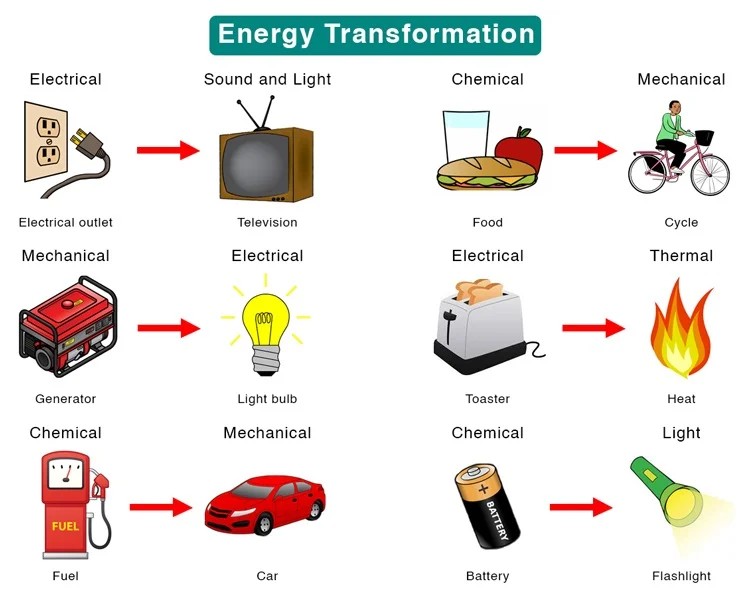
Appliance Power: When you turn on a toaster, electrical energy from the outlet flows through the wires and converts into thermal energy (heat) to brown your bread. A blender uses electrical energy to convert into kinetic energy to spin the blades, which chop up your ingredients.
Transportation: A car engine burns gasoline (chemical energy), which creates an explosion. The engine burns the fuel, releasing the chemical energy and converting that chemical energy into thermal energy. This thermal energy then expands gases, which push on pistons, creating mechanical energy that moves the wheels (kinetic energy).
Electronics: A light bulb seems simple, but it involves a two-step transformation. Electrical energy is converted into heat energy, which then excites atoms in the filament, causing them to glow and produce light. This filament also emits light energy, illuminating your surroundings. Your smartphone uses electrical energy for various functions. Some of this energy is stored in the battery, while some is converted into light energy for the display or sound energy for the speakers.
Body in Motion: The food we eat contains chemical energy. Our bodies break down this chemical energy and convert it into thermal energy (to maintain body heat) and kinetic energy (to allow us to move). Our bodies use this energy to perform actions, converting it into kinetic energy for movement.
Bells and Whistles: Electronic devices like smartphones rely on electrical energy. This energy can be used for various functions, transforming into light for the screen, sound for the speakers, or heat for processing power.
Forms of Energy and Energy Transformations
Energy cannot be created or destroyed; it only changes from one form to another. This scientific rule is known as the Law of Conservation of Energy, and it explains how energy transformations occur in nature and technology every day.
Key Facts About Energy
- The Sun is the primary source of energy for life on Earth.
- Plants transform light energy into chemical energy through photosynthesis.
- Fossil fuels such as coal, oil, and natural gas store ancient chemical energy.
- Renewable energy sources help reduce environmental pollution and climate change.
- Energy efficiency is becoming a global priority in 2026 due to increasing electricity demand.
Real-Life Energy Transformation Examples
- In transportation, cars transform chemical energy in fuel into kinetic energy and heat energy, while electric vehicles convert electrical energy into motion.
- In homes, microwaves transform electrical energy into thermal energy to heat food quickly.
- In Nature: Waterfalls transform gravitational potential energy into kinetic energy as water flows downward.
- In Communication Technology, Smartphones convert electrical energy into light, sound, and thermal energy during operation.
Energy and Environmental Protection
Modern countries are investing heavily in clean energy technologies to reduce carbon emissions. Solar energy, wind power, and hydropower are among the fastest-growing renewable energy sources in 2026. Energy transformations in renewable systems are designed to maximize efficiency while minimizing waste and pollution.
Advanced Energy Technologies in 2026
- Smart Grids: Smart electrical grids use artificial intelligence to distribute electricity more efficiently and reduce power loss.
- Hydrogen Energy: Hydrogen fuel cells convert chemical energy directly into electrical energy with water as the only byproduct.
- Battery Innovations: Modern lithium and solid-state batteries store more energy and charge faster than older battery technologies.
- Nuclear Fusion Research: Scientists are working on nuclear fusion systems that may provide clean and nearly unlimited energy in the future.
Interesting Scientific Facts
- Lightning is a natural transformation of electrical energy into light, heat, and sound energy.
- The human brain uses electrical signals to communicate between nerve cells.
- Sound cannot travel in space because there is no medium for vibrations.
- Wind energy is actually created by uneven heating of Earth’s atmosphere by the Sun.
Importance of Studying Energy Transformations
Studying energy helps students understand physics, engineering, environmental science, and modern technology. Energy concepts are also essential for developing sustainable solutions for future generations. Understanding energy transformations can help societies improve transportation, communication, healthcare, and industrial systems while protecting natural resources.
FAQ about Forms of Energy
What are the main forms of energy?
- Energy comes in different forms, including:
- Kinetic energy (energy of motion).
- Potential energy (stored energy).
- Thermal (heat) energy.
- Electrical energy.
- Chemical energy.
- Light (radiant) energy.
- Sound energy.
- Nuclear energy.
- Mechanical energy (kinetic + potential).
What is energy transformation?
Energy transformation means converting energy from one form to another. Energy is not created or destroyed (Law of Conservation of Energy) — it only changes form. Example: A light bulb converts electrical energy → light + heat energy.
Why is energy transformation important?
Energy transformations make everyday technology possible:
- Powering homes.
- Running vehicles.
- Using phones and computers.
- Cooking food.
- Generating electricity.
Without energy changes, nothing would work.
What are examples of energy changes in daily life?
Almost everything around you involves energy changes, such as:
- Charging your phone.
- Cooking on a stove.
- Riding a bicycle.
- Using fans and air conditioners.
- Turning on the lights.
Can energy be lost during transformation?
Energy is not lost, but some of it changes into heat or sound, which may seem “wasted.” Example: In a car engine, chemical energy turns into motion, but some energy becomes heat.
What is the difference between kinetic and potential energy?
Kinetic energy is the energy an object has because it is moving. Potential energy is the energy an object has because of its position or stored condition.
Examples: A moving car has kinetic energy, but a parked car at the top of a hill has potential energy. When a ball is thrown into the air, it has kinetic energy while moving and potential energy at its highest point. Water flowing in a river has kinetic energy, while water stored behind a dam has potential energy.
How does energy change in living organisms?
- In living things: Chemical energy (food) → mechanical energy (movement) + heat energy
- Example: Your body converts food into energy for walking, thinking, and breathing.
20 Examples of Energy Transformation in Daily Life
- Electric fan: Electrical → Kinetic (motion) + Sound
- Light bulb: Electrical → Light + Heat
- Mobile phone charging: Electrical → Chemical (battery)
- Solar panel: Light → Electrical
- Car engine: Chemical (fuel) → Kinetic + Heat
- Gas stove: Chemical → Heat + Light
- Television: Electrical → Light + Sound
- Speaker: Electrical → Sound
- Bicycle riding: Chemical (food) → Kinetic
- Microwave oven: Electrical → Heat
- Wind turbine: Kinetic (wind) → Electrical
- Hydroelectric dam: Potential (water) → Kinetic → Electrical
- Torch/Flashlight: Chemical (battery) → Electrical → Light
- Laptop: Electrical → Light + Sound + Heat
- Iron: Electrical → Heat
- Hair dryer: Electrical → Heat + Kinetic (air movement)
- Playing guitar: Mechanical → Sound
- Photosynthesis in plants: Light → Chemical
- Doorbell: Electrical → Sound
- Running: Chemical (food) → Kinetic + Heat
What are the 7 main forms of energy?
Kinetic, potential, thermal, electrical, chemical, light, sound.
What is the law of conservation of energy?
Energy cannot be created or destroyed, only changed from one form to another.
What is the best example of energy transformation?
A light bulb converts electrical energy into light and heat.
How does a solar panel transform energy
It converts light energy from the sun into electrical energy.
What energy transformation happens in the human body?
Chemical energy from food changes into movement and heat.
You can subscribe to Science Online on YouTube from this link: Science Online
Shocking Energy Transformations 2026, Forms of Energy and their Changes