
Reflex Action in the Human Body 2026: Amazing Fast Responses That Protect Your Life
Reflex action is one of the fastest protective mechanisms in the human body. It allows the body to react immediately to dangerous situations without waiting for conscious brain processing. Through the reflex arc, sensory neurons quickly send signals to the spinal cord, which instantly activate motor neurons to protect organs and tissues from harm.
Reflex action
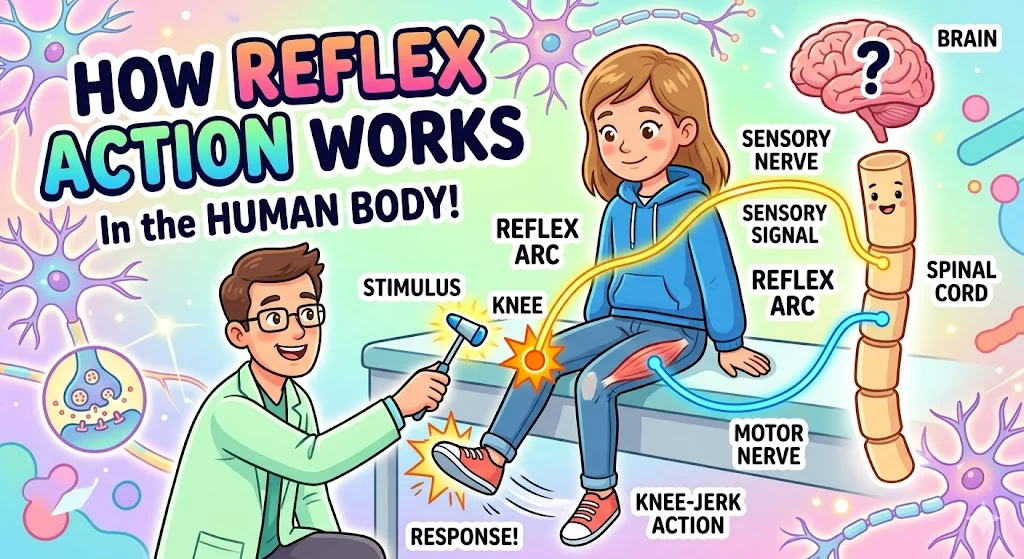
Reflex action
Your body makes an involuntary response by the nervous system, and this happens when your body is subjected to external stimuli such as strong light, heat, or smell ……..etc.
This involuntary response is called the reflex action. The reflex action is the automatic (spontaneous) response of the body to different stimuli, and the responsible organ for the reflexes is the spinal cord.
Examples of the reflex action
Your body makes a reflex action when you touch a plant with sharp thorns; you move your hand away quickly. The body withdraws the hand quickly on touching a hot surface, and it sweats in the hot days.
Constriction of the eye pupil occurs in intense light, and its widening occurs in dim light. You blink when something gets close to the eye, and your body is trying to balance while sliding down due to the reflex action.
We run quickly when we see a fast-moving car coming towards us or when we hear a near explosion due to the reflex action, and we secrete saliva on seeing or smell the good food.
How does the reflex action occur when you touch a plant with sharp thorns?
The severity of the thorns affects the nerve endings in the fingers, producing nerve impulses. The nerve impulses are transmitted to the spinal cord through a sensory nerve fiber.
There are some nerve impulses produced by the spinal cord that are transmitted through a motor nerve fiber to the arm muscles (without the brain’s intervention). So, the muscles contract and the arm is withdrawn away from the thorns.
The other nerve impulses produced by the spinal cord are transmitted to the sensory centers in the brain, which lead to the true sense of pain.
Reflex action when you touch a hot surface
The sensory neuron carries the information in the form of a nerve impulse to the spinal cord. The sensory receptor in the hand detects the hot object. An interneuron in the spinal cord passes the impulse to a motor neuron. The motor neuron carries the nerve impulse to the muscle, so, the muscle contracts and the hand pulls away from the hot object.
Reflex Action Review
Reflex action is an automatic, rapid, and involuntary response to a stimulus. It helps the body react quickly to sudden dangers such as touching a hot object, stepping on a sharp item, or exposure to bright light. These responses occur without conscious thinking, making them extremely fast and protective.
The reflex action mainly involves the spinal cord and nerves. When receptors detect a stimulus, sensory neurons carry the message to the spinal cord. The spinal cord immediately sends commands through motor neurons to muscles or glands, producing a quick response. The brain becomes aware of the event shortly afterward.
How Does Reflex Action Occur in the Human Body?
Reflex action occurs through a special pathway called the reflex arc. The process begins when receptors in the skin or sense organs detect a stimulus. Sensory neurons transmit electrical impulses to the spinal cord, where interneurons process the information rapidly.
After processing, motor neurons carry impulses from the spinal cord to the effector organs, such as muscles or glands. The muscles respond instantly by contracting or moving away from danger. This entire process takes only fractions of a second and helps prevent injuries.
The pathway of reflex action can be summarized as:
Stimulus → Receptor → Sensory Neuron → Spinal Cord → Motor Neuron → Effector → Response
Importance of Reflex Action
Reflex action is essential for survival because it protects the body from harmful situations. Fast reflexes reduce tissue damage and help maintain safety before the brain fully analyzes the situation.
Reflexes also help maintain body balance and posture. For example, knee-jerk reflexes support standing and walking stability. Reflex actions additionally regulate internal body functions such as blinking, coughing, sneezing, and pupil adjustment in bright light.
Another important role of reflexes is maintaining homeostasis. Automatic reflexes help regulate breathing, heartbeat, digestion, and blood pressure, ensuring the body functions efficiently without conscious effort.
Examples of Reflex Actions
- Pulling the hand away from a hot surface.
- Blinking when dust enters the eye.
- Sneezing due to irritation in the nose.
- Knee-jerk reflex during medical examination.
- Coughing when food enters the airway.
FAQ About Reflex Action
1. What is reflex action?
Reflex action is a quick, automatic, and involuntary response to a stimulus that protects the body from danger.
2. What is a reflex arc?
A reflex arc is the pathway followed by nerve impulses during a reflex action from receptor to effector.
3. Why are reflex actions fast?
Reflex actions are fast because signals are processed mainly in the spinal cord without waiting for full brain involvement.
Which organ controls most reflex actions?
The spinal cord controls most simple reflex actions, while the brain handles more complex responses.
What are examples of reflex actions?
Examples include blinking, sneezing, coughing, and pulling the hand away from heat.
Are reflex actions voluntary?
No, reflex actions are involuntary and occur automatically without conscious control.
Why is reflex action important?
Reflex action protects the body from injuries and helps maintain balance, posture, and internal body functions.
You can follow science online on YouTube from this link: Science online
Histological organization spinal cord, Relation between spinal & vertebral segments
Physiology & function of the spinal cord, Lateral & medial brainstem pathway
Physiology of central human reflexes, Types & properties of Spinal cord reflexes
Nervous system in man, Nerve cells types & Nature of nerve impulse
Nervous system (Central nervous system, Peripheral nervous system & Autonomic nervous system)
Human Transport System, Structure of human circulatory system (heart, blood vessels and blood)




Awesome what a shortcut writing
Thank you very much for your comment