
Figure Tested Its New Robot in 30 Homes. Did It Work?: Shocking Results!
Figure Tested Its New Robot in 30 Homes to discover whether its advanced humanoid technology could handle everyday household chores. Powered by AI, the robot demonstrated promising abilities in making beds, folding towels, and tidying toys. But with an overall success rate of 56%, are humanoid robots finally ready to become reliable household helpers? Discover the surprising results and what they mean for the future of robotics.
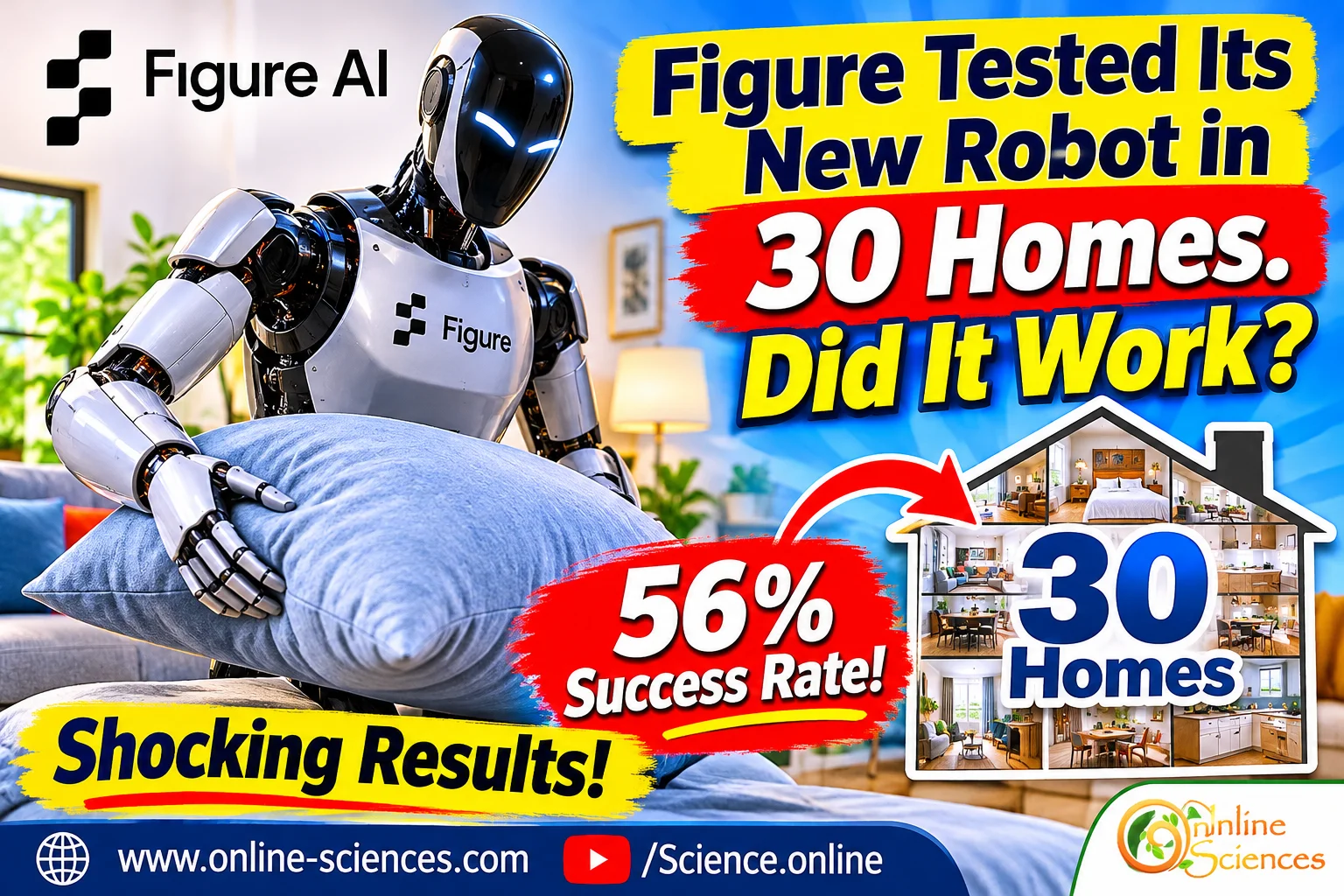
Figure Tested Its New Robot in 30 Homes.
Figure Robots
Figure Robots are advanced humanoid robots developed by Figure AI to perform physical tasks in homes, factories, and other real-world environments. Powered by artificial intelligence, these robots are designed to understand instructions, recognize objects, move naturally, and manipulate items using human-like hands.
Figure aims to develop general-purpose robots that can assist with everyday activities, including organizing objects, folding towels, and performing repetitive tasks. Although these robots represent an exciting breakthrough in robotics, improving their reliability, safety, and ability to work independently remains essential for bringing them into everyday life.
Can Figure AI Robots Be Used at Home?
Figure AI robots are being developed to perform household tasks such as making beds, folding towels, organizing objects, and assisting with repetitive chores. Figure’s tests in 30 previously unseen homes demonstrated that its Helix 2.5 system could perform selected tasks in real-world environments, achieving a reported overall success rate of 56%.
However, these results do not mean that Figure robots are ready to manage an entire household independently. Further improvements in reliability, safety, and task completion are needed before humanoid robots can become practical everyday home assistants.
Figure Tested Its New Robot in 30 Homes: What Does It Mean?
What happens when a humanoid robot leaves the laboratory and enters real homes? Figure is exploring how its robots can perform useful tasks in everyday environments, where unpredictable situations challenge even the most advanced artificial intelligence systems.
Testing robots in homes can reveal whether they can move safely, understand instructions, manipulate objects, and assist people with routine activities. But does testing in 30 homes mean that a robot is ready to become a reliable household helper? Let’s explore what real-world home testing can reveal about the future of humanoid robotics.
Humanoid robots are moving beyond research laboratories into environments designed for humans. One company attracting considerable attention is Figure AI, which develops general-purpose humanoid robots intended to perform physical tasks in homes, workplaces, and industrial environments.
Testing a robot in 30 homes sounds like an important step toward bringing humanoid robots into everyday life. Unlike factories, where workstations and procedures can be carefully controlled, homes contain unpredictable obstacles, different furniture arrangements, fragile objects, pets, and people moving around.
However, an important distinction must be made: a reported test involving 30 homes does not automatically prove that a robot can independently manage an entire household. The results depend on what tasks were tested, how much human supervision was required, and whether the robot performed reliably across different environments. Understanding these factors helps explain both the potential and the limitations of home robots.
Why Test Figure Humanoid Robots in Real Homes?
A robot can perform impressively during a laboratory demonstration but struggle when confronted with ordinary household situations.
For example, picking up a cup from a fixed table is relatively straightforward when the cup’s position is known. Finding a cup among other objects, recognizing that it contains liquid, grasping it without spilling, and placing it somewhere else requires several abilities working together.
Real homes provide a valuable testing environment because they introduce variations that are difficult to reproduce in controlled experiments. A home robot may need to navigate narrow passages, recognize unfamiliar objects, open doors, avoid obstacles, and adjust its movements when something changes unexpectedly.
Testing across multiple homes can help researchers identify weaknesses that might remain hidden during carefully staged demonstrations. It can also reveal whether a robot‘s capabilities transfer from one environment to another rather than depending on a single room layout.
What Can a Home Robot Actually Do?
The potential applications of humanoid robots extend across several everyday activities.
1. Pick Up and Move Objects
One important capability is object manipulation. A robot must recognize objects, estimate their positions, reach toward them, grasp them securely, and move them without causing damage.
Household objects vary considerably in size, weight, shape, and material. A soft towel requires a different grasp from a glass, a book, or a plastic container. Successful manipulation therefore requires coordination between computer vision, motion planning, and robotic control.
2. Navigate Around Furniture
Homes are not designed specifically for robots. Chairs can move, bags may be left on the floor, and people can suddenly enter a robot‘s path. A useful household robot needs to recognize obstacles, select safe routes, and continuously update its movements as the environment changes. Navigation becomes especially challenging in narrow spaces, dim lighting, and rooms containing reflective or transparent surfaces.
3. Understand Human Instructions
A household robot needs to interpret instructions that people naturally give. For example, someone might say, “Please pick up the book beside the sofa and put it on the table.”
Completing this task requires the robot to understand the instruction, identify the correct objects, determine their locations, plan the necessary movements, and check whether the task was completed successfully. Artificial intelligence can help connect language understanding with physical actions, but reliable execution remains a major engineering challenge.
4. Adapt to Different Household Environments
A robot trained or tested in one home may encounter unfamiliar furniture, different kitchen layouts, or objects it has never handled before. Generalization is therefore essential.
A successful robot should use its existing knowledge to handle new situations instead of requiring extensive reprogramming whenever its surroundings change. Testing across multiple homes can help researchers evaluate this adaptability, provided the experiments include meaningful differences between the environments.
Why is Testing in 30 Homes Important?
The number of homes involved in a test can attract attention, but the quality of the experiment matters more than the number alone. Thirty homes could provide a useful collection of real-world environments. Nevertheless, researchers would need to examine several factors before concluding that the robot is ready for widespread household use.
- First, what percentage of tasks did the robot complete successfully?
- Second, how long did each task take?
- Third, how often did the robot make mistakes or require human assistance?
- Fourth, were the tasks performed autonomously, or did a remote operator help the robot?
- Finally, could the robot repeat the same tasks reliably in unfamiliar environments?
- These measurements offer a much clearer picture of performance than a demonstration video.
For example, a robot that completes nine out of ten simple tasks with minimal supervision may be useful for certain applications. However, a robot that completes the same tasks only when a human provides frequent instructions may be much less practical. The real measure of progress is reliable performance, not simply the number of homes visited.
What is Figure Helix 2.5 and How Does It Work?
Figure introduced Helix 2.5 in September 2026 as an advanced AI system designed to help humanoid robots perform physical tasks in unfamiliar environments.
The system was tested using Figure’s humanoid robot hardware and a foundation model pretrained on a dataset called Index, which contains human-behavior data. The goal is to help robots learn general physical skills from broad experience rather than relying entirely on examples collected in the exact location where they will work.
According to Figure, Helix 2.5 was adapted to perform three household behaviors: tidying a living room, folding towels, and making beds.
The important innovation is the ability to transfer learned behaviors into homes that were not represented in the task-specific training data. Figure reported that its robot could perform these activities in 30 previously unseen Bay Area homes without collecting new data or adapting the model inside those homes.
How Does the Robot Learn From Human Behavior?
Traditional robot training can require extensive demonstrations and data collected in the environments where robots will operate. Figure is pursuing a different approach by using a broad foundation model trained on human-behavior data. The idea is that humans already demonstrate a huge variety of physical interactions, including walking, reaching, grasping, folding, and manipulating objects.
By learning from this experience, a robot may develop representations that help it perform related tasks in new situations. For example, folding a towel on one table should not require the robot to learn the entire task again when it encounters a different table.
However, human-behavior data does not automatically provide a robot with human-level physical understanding. A robot must still translate learned patterns into accurate movements using its sensors, actuators, and control systems. Figure‘s experiment suggests that broad pretraining can substantially improve the transfer of physical skills to unfamiliar environments.
The Results: Did Figure’s Robot Actually Work?
The results are promising, but they are not perfect. Figure reported that its Index-pretrained system completed 56% of the evaluated tasks successfully across the 30 homes. In a comparison using the same task-specific data but without Index pretraining, the system achieved a 9% success rate.
This is a substantial improvement. Nevertheless, it also means that many attempts did not meet the complete-task success criteria. The experiment involved 420 trials across three activities. Figure’s reported results were making beds, folding towels and tidying toys. These results were reported in Figure‘s evaluation and summarized by robotics industry publications.
Making beds produced the highest success rate, followed by towel folding. Tidying toys was more difficult, suggesting that searching for and collecting multiple scattered objects can present significant challenges. The overall result demonstrates progress in transferring learned behaviors between environments. However, it does not establish that the robot can reliably perform every household chore.
Why is a 56% Success Rate Both Impressive and Concerning?
From a research perspective, the improvement from 9% to 56% is important because it indicates that pretraining on broad human-behavior data can help a robot handle unfamiliar environments. For everyday consumers, however, a 56% success rate raises practical questions.
Imagine asking a household robot to make your bed before you leave for work. If it succeeds only slightly more than half the time under the reported evaluation conditions, you may still need to finish the task yourself. The consequences could be more serious if a robot mishandles fragile objects, spills liquids, or makes mistakes while operating near children or pets.
It is also important to distinguish between completing a task and completing it efficiently. A robot might eventually finish a chore but take much longer than a human. Therefore, future evaluations should consider completion rates, task duration, recovery from mistakes, safety, and the amount of human assistance required.
What Were the Biggest Challenges?
- Handling Different Objects: Household objects have different shapes, weights, and textures. A towel is flexible, while a toy may be rigid, slippery, or difficult to grasp. Robots must adjust their movements to these differences.
- Understanding Unfamiliar Rooms: Every home has a different layout. Furniture, lighting, and available working surfaces can affect how a robot approaches a task. A system must recognize the environment and plan its movements accordingly.
- Completing Long Sequences of Actions: Making a bed involves several steps, including positioning around the bed, manipulating the bedding, and arranging the pillows. Even if every individual movement is relatively simple, a mistake early in the sequence can affect the final result.
- Recovering From Mistakes: Humans naturally adjust when something goes wrong. A robot must detect errors, reconsider its position, and select an alternative action. Figure has highlighted self-correction as an important capability of Helix 2.5. However, more testing is needed to understand how consistently robots can recover from mistakes in everyday situations.
Could Figure’s Robot Become a Household Helper?
Humanoid robots could eventually help people with repetitive physical activities, particularly when tasks are predictable and can be performed safely. Potential applications include:
- Picking up toys and placing them in containers.
- Folding towels and organizing laundry.
- Making beds and straightening bedding.
- Moving suitable household objects.
- Assisting with selected repetitive chores.
- Supporting people who need help with everyday activities.
However, these are potential applications, not proof that the tested robot can already perform every task independently. A practical home robot will need to work reliably around people, recognize when it cannot complete a task, and stop safely when it encounters an unexpected situation.
Affordability, maintenance, privacy, battery life, and the cost of ownership will also influence whether consumers adopt humanoid robots. For now, Figure’s experiment is best understood as a research milestone rather than evidence that fully capable robotic housekeepers are ready for every home.
How Does Figure’s Experiment Affect the Future of Robotics?
The experiment addresses one of the central challenges in robotics: generalization, or the ability to apply learned skills in environments that differ from those encountered during training. If every new home requires extensive data collection and retraining, deploying robots at scale becomes expensive and time-consuming. A system that can transfer skills between homes could reduce the amount of environment-specific training required.
Figure reported that Helix 2.5 matched a representative Helix 02 behavior’s success rate while using approximately half as much task-specific data, extending that behavior to 30 unfamiliar homes. This finding suggests that pretraining may make it more efficient to develop new robotic behaviors.
Nevertheless, progress in one experiment does not guarantee that the same approach will work equally well for cooking, cleaning bathrooms, handling hot objects, or performing delicate tasks. Each activity introduces different physical and safety requirements.
The next major milestone will be demonstrating that robots can complete a broader range of tasks consistently, over extended periods, in ordinary homes without frequent human intervention.
Final Verdict: Did Figure’s Robot Pass the Test?
Figure‘s 30-home experiment produced an encouraging but incomplete result. Its Helix 2.5 system demonstrated that a humanoid robot could transfer selected household behaviors to unfamiliar homes, with a reported 56% overall success rate. The improvement over the 9% baseline also highlights the potential value of training robots on broad human-behavior data.
However, the results do not mean that household robotics is a solved problem. Many trials still failed to meet the complete-task criteria, and independent validation would help establish how well the findings generalize beyond the reported experiment.
The bottom line: Figure has demonstrated meaningful progress toward more adaptable humanoid robots, but reliable, affordable, and genuinely independent household assistance remains a work in progress.
The next question is not simply whether a robot can make a bed once. It is whether it can perform useful tasks safely, repeatedly, and efficiently in different homes without needing a human to rescue it whenever something goes wrong.
Frequently Asked Questions (FAQs)
1. Did Figure really test its robot in 30 homes?
Yes. Figure reported testing its Helix 2.5 system in 30 previously unseen homes in the San Francisco Bay Area. The evaluation covered bed making, towel folding, and tidying toys.
2. What was Figure’s robot success rate?
Figure reported an overall success rate of 56% across 420 household-task trials. Success required completing the entire task rather than receiving partial credit.
3. What is Figure Helix 2.5?
Helix 2.5 is an AI system developed by Figure to control humanoid robot behaviors. It uses pretraining on human-behavior data to improve the transfer of physical skills to unfamiliar environments.
4. What household chores did the robot perform?
The evaluation covered three activities: tidying a living room by collecting toys, folding towels and placing them in a basket, and making a bed by arranging pillows and smoothing the comforter.
5. Why is testing robots in unfamiliar homes important?
Unfamiliar homes reveal whether robots can apply learned skills in new environments instead of relying on training in one specific location. This is essential for developing robots that can work in many households.
6. Why did the robot fail some tasks?
Household chores involve complex movements, changing environments, flexible objects, and long sequences of actions. Errors in perception, grasping, navigation, or task execution can prevent the robot from completing the entire activity.
7. Can Figure’s robot replace a human housekeeper?
The reported experiment does not demonstrate that the robot can replace a human housekeeper. It tested three selected chores, and the overall success rate indicates that substantial reliability improvements are still needed.
8. What is zero-shot generalization in robotics?
Zero-shot generalization means applying a learned capability to an environment or object not encountered during the relevant training or adaptation process. In Figure‘s experiment, the homes and manipulated objects were unfamiliar, although the tested behaviors had been trained elsewhere.
9. Is Figure’s humanoid robot available for home use?
The 30-home experiment alone does not establish consumer availability. Prospective buyers should consult Figure‘s official announcements for current product availability and deployment information.
10. What is the future of humanoid household robots?
Future household robots may help with cleaning, organizing, laundry, and other repetitive tasks. Their success will depend on better reliability, safety, adaptability, affordability, and the ability to operate with minimal human supervision.
Explore more science and technology articles on Science Online: https://www.online-sciences.com/
Watch more technology videos on Science Online Channel: https://www.youtube.com/@Science.online
Figure 02 robot review, advantages, disadvantages, features, and Is the Figure AI robot real?
Top trending topics on Emo robots and What can Emo do?
Fun facts about Emo robot pets and will your best friend be a robot?
Ameca robot review, features, advantages, disadvantages and What can Ameca Do?
Eilik Desktop Companion Robot structure, features, use, advantages and disadvantages
Humanoid robots use, types, risks, advantages, and disadvantages
Sophia robot review, features, use, advantages and disadvantages