
How Does the Plant Make Its Own Food by Photosynthesis Process? 7 Powerful Facts Explained
Photosynthesis isn’t just a plant process—it’s the foundation of life on Earth. From producing the oxygen we breathe to forming the base of our food supply, in just a few simple steps, plants turn sunlight into energy, producing the food they need to survive. Let’s explore how this fascinating process works and why it’s essential for life on Earth.
Photosynthesis process
The green plant makes its own food by the photosynthesis process in its green leaves, which contain the chloroplasts. The green plant is called a producer organism, and the plant is the main source of food and energy for man and most animals.
The photosynthesis process is a biological process that takes place in the green parts (the leaves) of the plant to make its own food (the carbohydrate, which is sugar or starch) in the presence of sunlight, water, carbon dioxide gas, and some mineral salts, and oxygen gas is released.
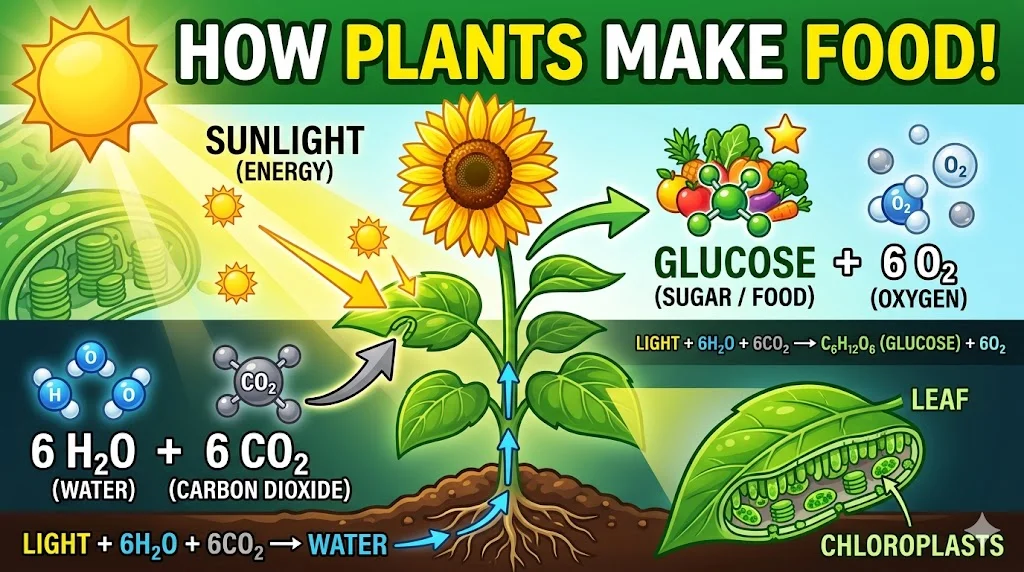
Photosynthesis Process
The factors for the photosynthesis process are sunlight, chloroplasts, carbon dioxide gas (produced from respiration), water, and mineral salts. A green plant produces starch or sugar (carbohydrate) and oxygen gas (needed for respiration). The green leaves of the plant absorb the sunlight through the chloroplasts, which give the plant its green colour.
The plant absorbs water and mineral salts from the soil through the roots that transport them to the stem, then to the leaves. The plant leaves absorb carbon dioxide gas from the air, and all the previous substances react together to produce the plant food (starch or sugar) and oxygen gas.
In the photosynthesis process, green plants use carbon dioxide gas and release oxygen gas. In the respiration process of plants and animals, oxygen gas is used, and carbon dioxide gas is produced. The green plant is necessary for keeping the ratio of oxygen gas and carbon dioxide gas constant in the air.
How Does the Plant Make Its Own Food by the Photosynthesis Process?
Plants make their own food through a process called photosynthesis, which takes place mainly in the leaves. Special structures called chloroplasts contain a green pigment known as chlorophyll that captures sunlight. Using this light energy, plants combine carbon dioxide from the air and water from the soil to produce glucose, a type of sugar that serves as food.
The process of photosynthesis can be divided into two main stages: light-dependent reactions and light-independent reactions. In the first stage, sunlight is absorbed and converted into chemical energy. In the second stage, this energy is used to convert carbon dioxide into glucose. Oxygen is released as a byproduct, which is essential for the survival of humans and animals.
Photosynthesis is extremely important because it forms the base of almost all food chains on Earth. It not only provides energy for plants but also supports life by producing oxygen and maintaining the balance of gases in the atmosphere. Without photosynthesis, life as we know it would not exist.
7 Powerful Facts About Photosynthesis
- Plants Make Their Own Food: Unlike humans and animals, plants produce their own food using sunlight, water, and carbon dioxide through photosynthesis.
- Chlorophyll is the Key: The green pigment chlorophyll captures sunlight and powers the entire photosynthesis process.
- Oxygen is a Byproduct: Photosynthesis releases oxygen into the atmosphere, making it essential for all living organisms that breathe.
- It Happens Mostly in Leaves: Leaves are the main site of photosynthesis because they contain the highest number of chloroplasts.
- Sunlight Is Essential: Without sunlight, photosynthesis cannot occur, which is why plants depend on light to survive and grow.
- It Supports All Food Chains: Photosynthesis forms the base of nearly every food chain on Earth, directly or indirectly feeding all living organisms.
- It Helps Fight Climate Change: By absorbing carbon dioxide, photosynthesis helps reduce greenhouse gases and maintain environmental balance.
FAQ About Photosynthesis
1. What is photosynthesis?
Photosynthesis is the process by which plants use sunlight, water, and carbon dioxide to make their own food.
2. Where does photosynthesis occur in plants?
It mainly occurs in the leaves, inside structures called chloroplasts.
3. What is the role of chlorophyll?
Chlorophyll absorbs sunlight and helps convert it into energy for food production.
4. What are the raw materials needed for photosynthesis?
Plants need sunlight, carbon dioxide, and water.
5. What is produced during photosynthesis?
Glucose (food) and oxygen are produced.
6. Why is photosynthesis important for humans?
It provides oxygen for breathing and forms the basis of all food chains.
7. Can photosynthesis happen at night?
No, photosynthesis requires sunlight, so it mainly occurs during the day.
You can follow Science Online on YouTube from this link: Science online
Structure of leaf & green plastid, Mechanism of photosynthesis in green plants
Light and dark reactions of the photosynthesis process
Excretion in plants, Importance & types of transpiration for the plant