States of matter (solid, liquid, gas, plasma & Bose–Einstein Condensate), Is plasma a state of matter?
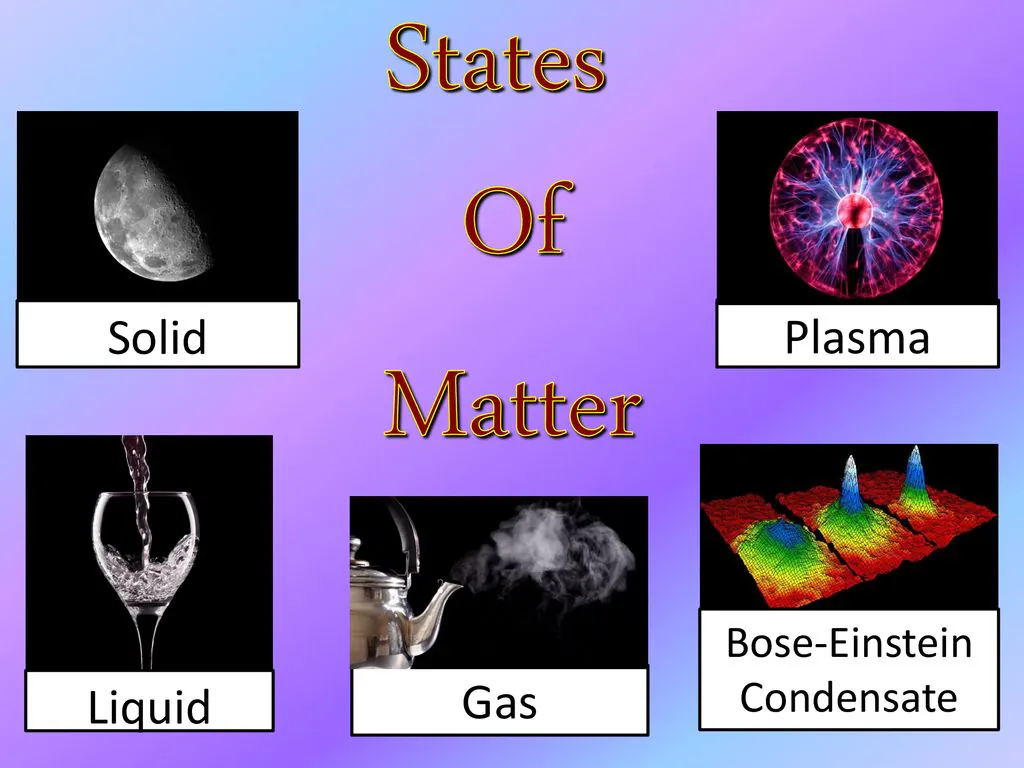
All matters have a mass and take up space; the state of matter is one of the distinct forms that matter takes on, and there are four states of matter observable in our lives, which are solid, liquid, gas, plasma, and Bose–Einstein Condensate (BEC).
The states of matter
There are five main states of matter known today — each with distinct physical properties:
The solid-state
The solid is the state in which matter maintains a definite (fixed) volume and shape, the motion of its particles is limited motion (oscillatory motion), and they are packed closely together.
The intermolecular forces between the solid particles are very strong that the particles can not move freely; they can only vibrate. Some examples of solid-state such as iron, aluminum, and copper.
The solid has very small intermolecular spaces; it can transform into a liquid through the melting process, the liquid can change into a solid by the freezing process, and the solid can change into a gas by the sublimation process.
Shape is fixed, Volume is fixed, particles are packed tightly in a regular pattern; they only vibrate in place. Examples: Ice, wood, metal.
States of matter
The liquid state
The liquid is the state in which matter adapts to the shape of its container but varies only slightly in volume. The liquid state has definite volume and indefinite shape if the temperature and pressure are constant.
The motion of the liquid particles is more free, the intermolecular spaces between its particles are relatively large, and the intermolecular forces are relatively weak. Examples of liquid states such as water, alcohol, oil, milk, and juice.
The liquid can be changed to a gas by heating at constant pressure to the substance’s boiling point or through reduction of pressure at a constant temperature, and it is called the evaporation process.
The shape of the liquid takes the shape of its container, volume is fixed, particles are close together but can move/slide past each other.
The gaseous state
The gas is the state in which matter expands to occupy the volume and shape of its container, and it has indefinite shape and indefinite volume. The motion of gas molecules is completely free (unlimited), the intermolecular spaces are very large, and the intermolecular forces are very weak or almost do not exist.
The plasma state
The plasma does not have a definite shape or volume; it is electrically conductive, it produces magnetic fields and electric currents, and responds strongly to electromagnetic forces.
Lighting, electric sparks, fluorescent lights, neon lights, plasma televisions, some types of flame, and the stars are examples of illuminated matter in the plasma state. The gas is usually changed to plasma in one of two ways: when there is a huge voltage difference between two points, or by exposing it to extremely high temperatures.
- Shape & Volume: No fixed shape or volume.
- Particles: Superheated gas of ions and electrons (electrically charged).
- Conducts electricity and responds to magnetic fields.
- Examples: Sun, lightning, neon lights, stars.
Bose–Einstein Condensate (BEC)
Bose–Einstein Condensate (BEC) is a state of matter that occurs when a group of atoms is cooled to extremely low temperatures, very close to absolute zero (0 Kelvin or –273.15 °C). At this point, the atoms lose almost all their energy and begin to behave as a single quantum entity, acting like one “super-atom.”
Bose–Einstein Condensate (BEC) was predicted by Satyendra Nath Bose and Albert Einstein in the 1920s. It was first created in a laboratory in 1995 using rubidium atoms. It helps scientists study quantum mechanics on a large, visible scale. The particles in a BEC overlap their wave functions, meaning they can no longer be distinguished from one another.
A Bose–Einstein Condensate is a state of matter formed at near absolute zero (–273°C or 0 K), where atoms merge into one quantum state and behave as a single particle. Atoms clump together and behave as a single quantum entity. Extremely low-energy state. Examples: Rubidium atoms cooled by lasers in lab experiments.
Is plasma a state of matter?
Plasma is a state of matter. It’s often called the fourth state of matter, alongside solid, liquid, and gas. In a gas, atoms or molecules move freely but remain electrically neutral. In plasma, the gas becomes so hot or energized that electrons are stripped away from atoms, forming a mixture of free electrons and ions (charged particles). This gives plasma unique properties — for example, it can conduct electricity, respond to magnetic fields, and emit light.
Examples of plasma: Lightning, Neon signs, Flames (partially contain plasma at very high temperatures), the Sun, and other stars.
You can subscribe to Science Online on YouTube from this link: Science Online