15 Amazing Facts About the Importance and Medical Uses of Laser Beams
The importance and medical uses of laser beams have transformed modern healthcare by enabling highly precise, minimally invasive treatments for a wide range of medical conditions. From correcting vision and removing tumors to treating skin disorders and performing delicate surgeries, laser technology offers greater accuracy, faster recovery, reduced bleeding, and improved patient outcomes. Understanding how laser beams work highlights their essential role in today’s advanced medical treatments.
Importance and Medical Uses of Laser Beams
The laser
The laser is a device that emits light through a process of optical amplification based on the stimulated emission of electromagnetic radiation. The laser is highly coherent. It is monochromatic in nature, and the laser beams are hardly divergent.
Medical uses of lasers
The laser is used in medicine to improve the precision work such as surgery, especially it is used in the brain surgery. The operations are quick and heal quickly when using lasers; they are less painful than ordinary surgery, which is performed with a scalpel.
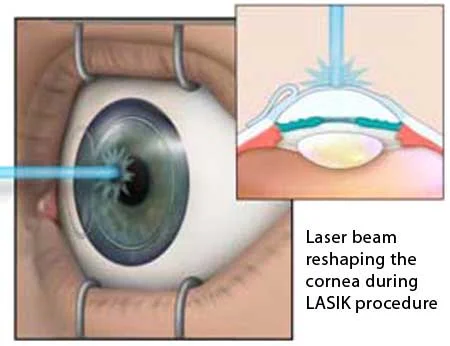
Eye surgery with lasers
Lasers are used for photocoagulation of the retina to halt retinal hemorrhaging and for the tracking of retinal tears. Higher power lasers are used after cataract surgery if the supportive membrane surrounding the implanted lens becomes milky.
Lasers are used in eye surgery, refractive surgery, soft tissue surgery, laser scalpel, and photobiomodulation (laser therapy). Lasers are used in the “No-Touch” removal of tumors, especially the tumors of the brain and the spinal cord.
Lasers are used in dentistry for caries removal, tooth whitening, and oral surgery. Lasers can be used to treat urethral strictures, benign warts, urinary stones, bladder obstructions, and enlarged prostates.
Lasers can be used for precision cutting and endoscopic guidance into the brain and spinal cord. Lasers can be used for endoscopic procedures, the photocoagulation of tumors, the excision, and photodynamic therapy.
Lasers can be used for drilling the cavities, gum surgery, antibacterial treatments, tooth desensitization, and orofacial diagnostics. Lasers have played an important role in medical device manufacturing.
Lasers are used to treat cases of long and short-sightedness; therefore, the patient can dispose with glasses, they are used in endoscopy using the optical fibers, operative surgery, and diagnosis.
Importance and Medical Uses of Laser Beams
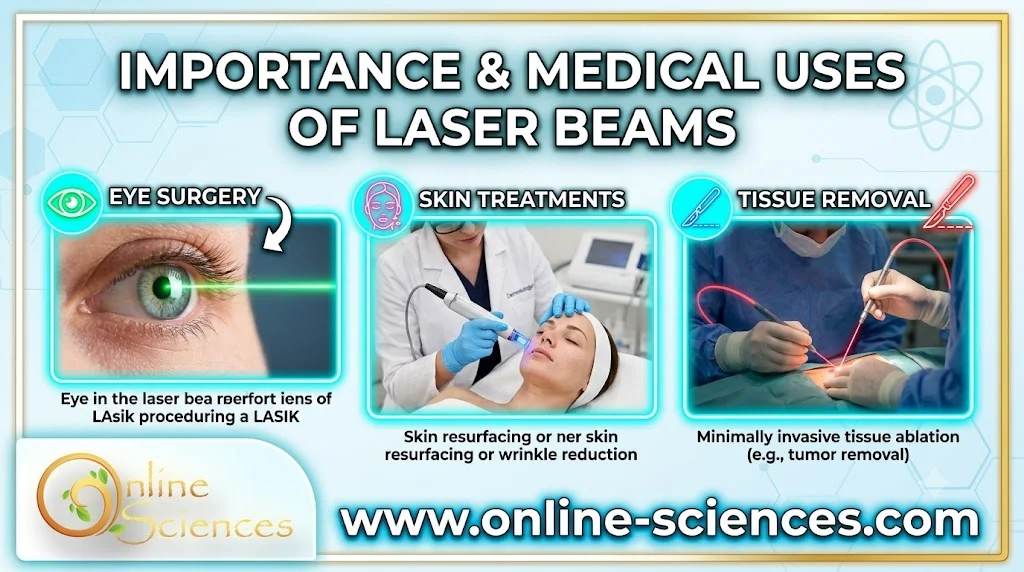
1. Laser beams provide exceptional precision: One of the greatest advantages of laser beams is their ability to focus light into an extremely small, concentrated spot. This allows doctors to target specific tissues with remarkable accuracy while minimizing damage to surrounding healthy cells.
2. Laser procedures are often minimally invasive: Many laser treatments require little or no surgical incision. As a result, patients usually experience less pain, reduced bleeding, fewer complications, and a quicker recovery compared with traditional surgical procedures.
3. Laser beams revolutionized vision correction: Laser technology has transformed eye care by making procedures such as LASIK possible. These treatments reshape the cornea with incredible precision, helping millions of people reduce or eliminate their dependence on glasses and contact lenses.
4. Lasers are widely used in skin treatments: Dermatologists use laser beams to treat acne scars, wrinkles, birthmarks, tattoos, unwanted hair, vascular lesions, and pigmentation disorders. Many cosmetic procedures can be completed with minimal discomfort and downtime.
5. Laser beams improve dental care: Modern dentistry uses lasers to remove tooth decay, reshape gum tissue, treat gum disease, whiten teeth, and sterilize infected areas. Laser-assisted procedures often reduce the need for drills and anesthesia while promoting faster healing.
6. Lasers can help treat certain types of cancer: Doctors use laser beams to destroy or shrink tumors, remove precancerous tissues, relieve blockages caused by cancers, and support photodynamic therapy. Their precision helps preserve nearby healthy tissues during treatment.
7. Laser beams seal blood vessels during surgery: As lasers cut tissue, they can simultaneously seal small blood vessels. This significantly reduces bleeding, lowers the risk of infection, and provides surgeons with a clearer operating field.
8. Laser treatments usually leave less scarring: Because laser procedures cause minimal trauma to surrounding tissues, patients often experience less swelling, reduced inflammation, and smaller scars than with conventional surgery.
9. Different medical lasers are designed for different purposes: There is no single laser for every treatment. Carbon dioxide (CO₂), Nd:YAG, diode, excimer, erbium, argon, and pulsed dye lasers each produce different wavelengths, making them suitable for specific medical and surgical applications.
10. Laser beams are used in many medical specialties: Laser technology plays an important role in ophthalmology, dermatology, dentistry, urology, gynecology, cardiology, oncology, plastic surgery, neurosurgery, and physical rehabilitation, demonstrating its versatility across modern medicine.
11. Laser procedures often shorten recovery time: Since laser treatments are less invasive and cause less tissue damage, patients frequently recover faster, experience less postoperative pain, and can return to normal activities sooner than after traditional surgery.
12. Laser technology continues to advance rapidly: Modern laser systems are becoming more precise, faster, and safer. Innovations in imaging, robotics, and computer-guided surgery are making laser-assisted procedures increasingly effective for both patients and healthcare professionals.
13. Laser beams are used to break up kidney stones: Specialized laser systems, such as those used in laser lithotripsy, can break kidney and ureteral stones into tiny fragments that are easier to pass naturally or remove during minimally invasive procedures.
14. Medical lasers improve patient safety: When performed by trained healthcare professionals, laser treatments can reduce the risk of excessive bleeding, lower infection rates, minimize complications, and improve overall treatment outcomes compared with many conventional surgical techniques.
15. Laser beams are shaping the future of healthcare: Researchers continue to develop new laser applications in regenerative medicine, robotic surgery, targeted cancer therapy, medical imaging, and precision microsurgery. As technology evolves, laser beams are expected to play an even greater role in improving diagnosis, treatment, and patient care around the world.
FAQ About Laser Beams
1. What is a laser beam?
A laser beam is a highly focused, intense beam of light with a single wavelength. Unlike ordinary light, laser light is coherent, monochromatic, and travels in a narrow, concentrated beam, making it ideal for precision medical procedures.
2. Why are laser beams important in medicine?
Laser beams allow doctors to perform highly accurate treatments while minimizing damage to surrounding healthy tissues. They often reduce pain, bleeding, infection risk, and recovery time compared with conventional surgical methods.
3. How do laser beams work in medical treatments?
Laser beams deliver concentrated light energy to targeted tissues. Depending on the wavelength and intensity, the laser can cut, vaporize, seal blood vessels, destroy abnormal cells, or stimulate tissue repair.
4. What are the main medical uses of laser beams?
Laser beams are widely used in:
- Eye surgery.
- Dermatology.
- Cosmetic procedures.
- Dentistry.
- Cancer treatment.
- General surgery.
- Urology.
- Gynecology.
- Cardiology.
- Physical rehabilitation.
5. How are lasers used in eye surgery?
Lasers are commonly used to correct refractive errors such as nearsightedness, farsightedness, and astigmatism. They are also used to treat glaucoma, retinal disorders, and cataract-related conditions with high precision.
6. How are lasers used in dermatology?
Dermatologists use lasers to remove unwanted hair, tattoos, birthmarks, scars, wrinkles, pigmented lesions, and vascular abnormalities while improving skin appearance and texture.
7. How are lasers used in dentistry?
Dental lasers help treat gum disease, remove tooth decay, whiten teeth, reshape gum tissue, perform biopsies, and reduce bacteria in the mouth. Many laser dental procedures are less painful than traditional treatments.
8. Can laser beams be used to treat cancer?
Yes. Lasers can destroy or shrink certain tumors, relieve symptoms caused by cancers blocking organs, activate light-sensitive drugs during photodynamic therapy, and assist surgeons in removing cancerous tissue with greater precision.
9. Are laser surgeries less invasive than traditional surgeries?
In many cases, yes. Laser procedures often require smaller or no incisions, cause less bleeding, reduce tissue damage, lower infection risk, and allow faster healing than conventional surgery.
10. Are laser treatments safe?
Laser treatments are generally safe when performed by trained healthcare professionals using the appropriate equipment and protective measures. Safety depends on the patient’s condition, the type of laser used, and proper technique.
11. What are the advantages of laser treatments?
Some major advantages include:
- High precision.
- Minimal bleeding.
- Reduced pain.
- Lower infection risk.
- Faster recovery.
- Less scarring.
- Shorter hospital stays.
- Improved cosmetic outcomes.
12. Are there any risks associated with laser treatments?
Although generally safe, possible risks include temporary redness, swelling, burns, infection, scarring, changes in skin pigmentation, or eye injury if proper protection is not used. These risks are usually low when procedures are performed correctly.
13. What types of lasers are commonly used in medicine?
Common medical lasers include:
- Carbon dioxide (CO₂) lasers.
- Nd:YAG lasers.
- Diode lasers.
- Excimer lasers.
- Argon lasers.
- Pulsed dye lasers.
- Erbium lasers.
- Alexandrite lasers.
Each type is designed for specific medical applications.
14. Why are laser beams preferred for delicate surgeries?
Because laser beams can be focused into extremely small spots, surgeons can target tiny structures with exceptional accuracy while preserving nearby healthy tissues. This makes lasers especially valuable in ophthalmology, neurosurgery, and microsurgery.
15. What is the future of laser technology in medicine?
Advances in laser technology continue to improve precision, safety, and effectiveness. Future developments are expected to expand laser-assisted robotic surgery, personalized cancer therapy, regenerative medicine, minimally invasive procedures, and AI-guided surgical systems.
You can subscribe to Science Online on YouTube from this link: Science Online