EchoLaser for Prostate Treatment (2026): A Minimally Invasive Alternative to Surgery, Benefits, Procedure, Recovery & FAQs
EchoLaser for prostate treatment is one of the latest minimally invasive techniques used to treat benign prostatic hyperplasia (BPH). Instead of removing prostate tissue through traditional surgery, EchoLaser delivers precise laser energy directly into the enlarged prostate under ultrasound guidance, reducing its size while preserving surrounding healthy tissues. The procedure is performed with tiny needles, requires minimal recovery time, and allows many patients to return to normal activities within a few days.
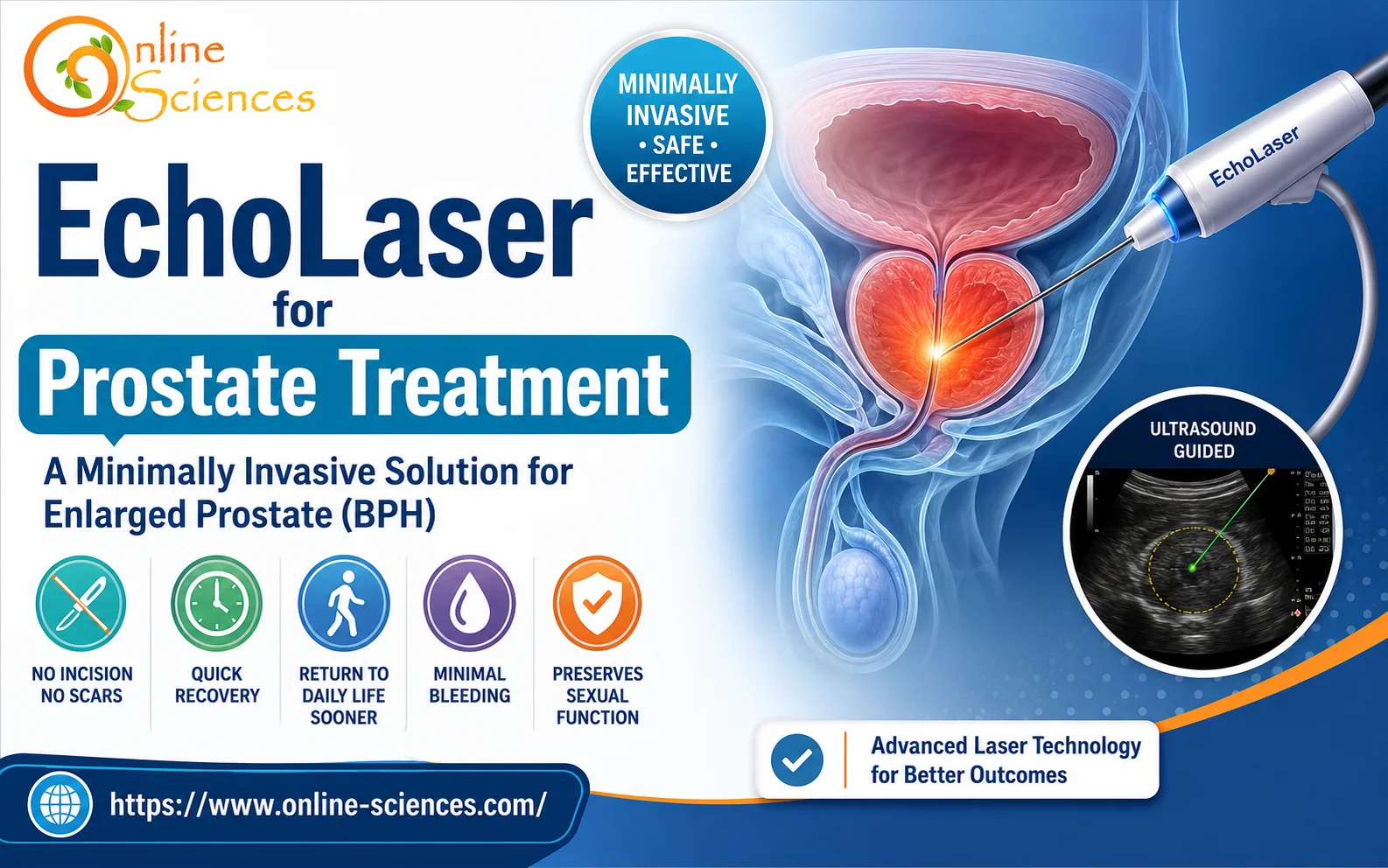
EchoLaser for prostate treatment
What is EchoLaser for prostate treatment?
EchoLaser is an advanced image-guided laser ablation system designed to shrink enlarged prostate tissue using extremely thin optical fibers. The treatment combines:
- Real-time ultrasound guidance.
- Precise laser energy delivery.
- Needle-based access without surgical incisions.
- Targeted destruction of excess prostate tissue.
Unlike conventional surgery, EchoLaser preserves the urinary sphincter and surrounding nerves, helping maintain urinary and sexual function.
How does EchoLaser work?
The procedure follows several steps:
- Local anesthesia is administered.
- Ultrasound identifies the enlarged prostate tissue.
- Very thin needles are inserted through the perineum.
- Laser fibers are introduced through the needles.
- Controlled laser energy heats and destroys the enlarged tissue.
- Over the following weeks, the treated tissue naturally shrinks.
- Urinary flow gradually improves as pressure on the urethra decreases.
Because everything is performed under continuous ultrasound imaging, treatment accuracy is extremely high.
Who is a candidate for EchoLaser?
EchoLaser may be suitable for patients who have:
- Benign prostatic hyperplasia (BPH).
- Frequent urination.
- Nighttime urination.
- Weak urine stream.
- Difficulty emptying the bladder.
- Urinary retention.
- Poor response to medications.
- High surgical risk.
- Desire to preserve ejaculation and sexual function.
A specialist determines eligibility after imaging studies and prostate evaluation.
Benefits of EchoLaser for prostate treatment
The growing popularity of EchoLaser is due to its numerous advantages.
- Minimally invasive: No surgical incision is required.
- Local anesthesia: General anesthesia is usually unnecessary.
- Less bleeding: The laser seals blood vessels during treatment.
- Short procedure: Treatment often takes less than one hour.
- Faster recovery: Most patients resume daily activities quickly.
- Minimal pain: Patients usually experience only mild discomfort.
- Preservation of sexual function: The procedure is designed to minimize damage to surrounding nerves.
- Low complication rate: Compared with conventional surgery, complications are generally fewer.
- High precision: Real-time ultrasound guidance improves treatment accuracy.
Conditions treated with EchoLaser
EchoLaser technology may be used for:
- Benign prostatic hyperplasia (BPH).
- Selected localized prostate lesions.
- Certain thyroid nodules.
- Liver tumors.
- Kidney tumors.
- Soft tissue lesions.
Its applications continue to expand with advances in interventional radiology.
Advantages over traditional prostate surgery
EchoLaser for prostate treatment offers several important advantages over traditional prostate surgery, especially for men seeking a less invasive treatment for benign prostatic hyperplasia (BPH). Because the procedure is performed through very small needle punctures under ultrasound guidance, there is no large surgical incision. This results in less trauma to surrounding tissues, reduced postoperative discomfort, and a lower risk of visible scarring.
Another major advantage is the reduced need for general anesthesia. In many cases, EchoLaser can be performed under local anesthesia or light sedation, making it a suitable option for older patients or those with medical conditions that may increase the risks associated with conventional surgery. The minimally invasive nature of the procedure also helps reduce blood loss and lowers the likelihood of complications related to bleeding.
Recovery after EchoLaser is typically much faster than after traditional prostate surgery. Many patients are able to return home the same day and resume normal daily activities within a few days. In contrast, conventional surgical procedures may require a longer hospital stay and a more extended recovery period before patients can return to work and regular activities.
EchoLaser is also valued for its precision. Real-time ultrasound guidance allows the physician to target only the enlarged prostate tissue while preserving surrounding healthy structures. This targeted approach may help maintain urinary control and reduce the risk of complications affecting sexual function, including ejaculation and erectile function, although individual results can vary.
Overall, EchoLaser provides an effective treatment option with less pain, minimal downtime, lower bleeding risk, shorter hospitalization, and a quicker return to normal life compared with many traditional prostate surgery techniques. For appropriately selected patients, these benefits make it an attractive alternative to conventional surgical treatment.
What happens after the procedure?
Patients usually experience:
- Mild soreness.
- Temporary urinary symptoms.
- Gradual improvement over several weeks.
- Follow-up ultrasound examinations.
- Return to work within a few days in many cases.
Doctors may prescribe medications temporarily during recovery.
Possible side effects
Although generally safe, some patients may experience:
- Mild discomfort.
- Temporary urinary frequency.
- Minor blood in urine.
- Mild swelling.
- Temporary burning during urination.
Serious complications are uncommon when performed by experienced specialists.
Recovery time
Recovery is typically faster than conventional prostate surgery.
Many patients:
- Go home the same day.
- Walk immediately after treatment.
- Resume office work within several days.
- Notice urinary improvement within weeks.
- Continue improving over several months.
Why patients choose EchoLaser
Many men prefer EchoLaser because it offers:
- A non-surgical solution.
- Minimal downtime.
- Lower complication rates.
- Reduced hospital stay.
- Less pain.
- Excellent cosmetic outcome.
- High precision.
- Faster return to normal life.
Is EchoLaser effective?
Clinical studies have shown significant improvements in:
Long-term outcomes continue to demonstrate encouraging results in appropriately selected patients.
Future of EchoLaser in 2026
EchoLaser technology is becoming increasingly popular worldwide as hospitals adopt minimally invasive treatments. Improvements in laser systems, ultrasound imaging, and treatment planning continue to enhance precision, safety, and patient outcomes. As awareness grows, EchoLaser is expected to become an important option for men seeking effective treatment without conventional surgery.
Frequently Asked Questions (FAQ) about EchoLaser
1. What is EchoLaser for prostate treatment?
It is a minimally invasive laser therapy that reduces enlarged prostate tissue using ultrasound-guided laser fibers.
2. Is EchoLaser painful?
Most patients experience minimal discomfort because the procedure is performed under local anesthesia.
3. Does EchoLaser require surgery?
No. It is performed through tiny needle punctures without surgical incisions.
4. How long does the procedure take?
The treatment usually takes approximately 30 to 60 minutes, depending on prostate size.
5. Can I go home the same day?
Yes. Many patients are discharged on the same day.
6. Is hospitalization necessary?
Hospitalization is usually not required unless there are specific medical concerns.
7. How long is recovery?
Most patients return to normal activities within several days.
8. Does EchoLaser preserve sexual function?
The treatment is designed to minimize injury to surrounding nerves, helping preserve erectile function and ejaculation in many patients, although outcomes vary by individual.
9. Who should not undergo EchoLaser?
Patients with certain prostate conditions or medical issues may require alternative treatments. A specialist evaluation is essential.
10. Is EchoLaser better than surgery?
For selected patients, EchoLaser offers a less invasive alternative with shorter recovery, but the best treatment depends on prostate size, anatomy, symptoms, and overall health.
Conclusion
EchoLaser for prostate treatment represents a major advancement in the management of benign prostatic hyperplasia. By combining precise ultrasound guidance with targeted laser energy, it provides an effective, minimally invasive option that can relieve urinary symptoms while reducing recovery time and preserving quality of life. Patients considering treatment should consult an experienced interventional radiologist or urologist to determine whether EchoLaser is the most appropriate choice for their condition.
You can subscribe to Science Online on YouTube from this link: Science Online
Benign prostatic hyperplasia (BPH), TRUS biopsy, Prostate disease symptoms and treatment
Enlarged prostate symptoms, Prostatic artery embolization (PAE) importance and risks
Prostate function, structure, lobes, Benign enlargement of prostate and malignant prostatic tumor
Nephroblastoma (Wilm’s tumor), Risk factors of Urothelial tumors (Tumors of transitional epithelium)
Urinary bladder structure, function, Control of micturition by Brain and Voluntary micturition
Urinary system structure, function, anatomy, organs, Blood supply and Importance of renal fascia
Histological structure of kidneys, Uriniferous tubules & Types of nephrons