Top 5 Robots That Look Like Humans in 2026 🤯 | Most Powerful Lifelike AI Humanoid Robots | They Look TOO Real!
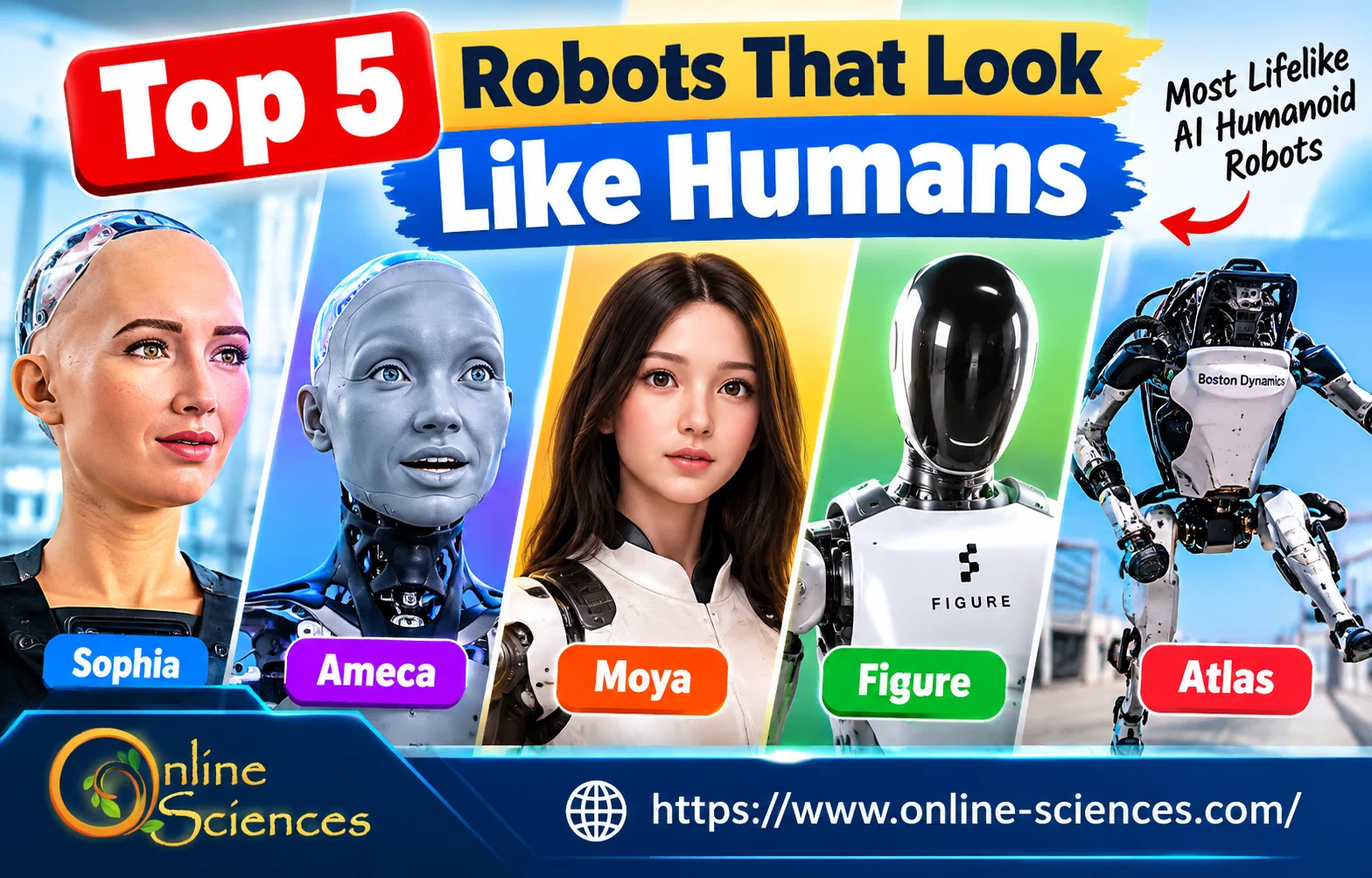
Top 5 Lifelike AI Humanoid Robots are changing the way we imagine the future of robotics, combining realistic human-like faces, natural movements, advanced artificial intelligence, and impressive communication abilities. From Ameca and Sophia to Moya, Figure, and Atlas, these humanoid robots are becoming increasingly realistic and capable, bringing us closer to a future where AI robots can interact, work, and communicate alongside humans.
Top 5 Robots That Look Like Humans in 2026
Top 5 Robots That Look Like Humans
Most Lifelike AI Humanoid Robots are no longer limited to science-fiction movies. Modern humanoids can recognize faces, understand spoken language, display facial expressions, and perform increasingly complex movements. Their combination of AI, computer vision, sensors, and robotic systems is opening new possibilities in education, healthcare, customer service, manufacturing, and everyday human-robot interaction. 🤖✨
What if you saw a robot walking, talking, smiling, and moving almost like a real person? 🤖 The latest generation of humanoid robots is making that futuristic idea a reality. From incredibly realistic facial expressions to AI-powered conversations and human-like movements, these machines are becoming more lifelike than ever.
In this article, we explore the Top 5 robots that look like humans in 2026, including some of the world’s most impressive lifelike AI robots and humanoid robots. While some focus on realistic faces and emotional interaction, others combine human-like bodies with advanced artificial intelligence, mobility, and physical skills.
1. Ameca – One of the Most Lifelike Robots Ever Created
When discussing robots that look like humans, Ameca is almost impossible to ignore. Created by Engineered Arts, Ameca is famous for its remarkably expressive face and extremely detailed facial movements. Instead of simply having a human-shaped body, Ameca can move its eyes, eyebrows, mouth, and other facial features in ways that make interactions feel surprisingly natural.
One reason Ameca stands out is the large number of movements concentrated in its head and face. Published specifications describe 61 actuated movements, with 27 associated with the head. Its expressive capabilities include numerous preset facial expressions and individually controlled facial movements.
Ameca is not designed primarily as a household assistant. Instead, it is an advanced platform for human-robot interaction, artificial intelligence demonstrations, research, entertainment, and exhibitions.
Why Ameca looks so human-like
- Highly expressive face.
- Realistic eye and mouth movements.
- Advanced conversational interaction.
- Large number of facial actuators.
- Designed specifically for human-robot interaction.
Verdict: If your definition of a lifelike robot is an incredibly expressive face and realistic human interaction, Ameca is one of the strongest examples in the world.
2. Sophia – The Famous AI Robot With a Human-Like Face
Sophia is arguably the most famous AI humanoid robot on this list. Developed by Hanson Robotics, Sophia was designed to communicate with people and demonstrate the possibilities of social robotics. Her human-like face, moving eyes, facial expressions, and conversational abilities helped make her an international robotics celebrity.
Sophia uses a flexible artificial skin technology known as Frubber, which allows the robot to create a range of facial expressions. Comparisons with Ameca often highlight Sophia‘s more human-oriented facial appearance, while Ameca focuses heavily on expressive robotic movement.
Sophia‘s biggest advantage is not simply appearance. She represents an attempt to combine robotics, artificial intelligence, computer vision, natural-language interaction, and social communication into a single platform.
Of course, Sophia is still a machine. Her conversations and abilities should not be confused with human-level understanding or consciousness.
Why Sophia is special
- Human-like facial design.
- Flexible artificial skin.
- Facial expressions.
- AI-based interaction.
- Designed for social robotics.
Verdict: Sophia remains one of the most recognizable examples of a human-like AI robot and an important milestone in the development of social humanoid robotics.
3. Moya – A New Generation of Human-Like Humanoid Robot
Moya is part of a newer generation of humanoid robots attracting attention because of its human-like appearance and increasingly sophisticated interaction capabilities. Unlike traditional industrial robots, newer humanoids such as Moya are designed around the idea that robots may eventually operate in environments created for humans.
The broader 2026 humanoid-robot landscape shows a major shift toward combining AI, natural movement, human-like bodies, computer vision, and autonomous decision-making. Moya has been included among the notable human-like humanoid robots of 2026 alongside names such as Sophia and Ameca.
The goal of these robots is not simply to make machines look like people. The more important challenge is making them understand their surroundings, communicate naturally, move safely, and perform useful tasks. That combination could eventually make humanoid robots useful in entertainment, education, customer service, healthcare support, research, and other environments.
Verdict: Moya represents the new wave of humanoid robots attempting to combine realistic appearance with increasingly advanced AI and physical capabilities.
4. Figure AI Humanoid Robots – Human-Like Body Meets Advanced AI
Figure’s humanoid robots take a somewhat different approach. Instead of focusing mainly on creating an extremely realistic human face, Figure emphasizes the combination of a human-shaped body, artificial intelligence, computer vision, dexterous hands, and real-world task execution.
Figure 02 has been demonstrated in industrial environments, including BMW’s manufacturing operations. Reports on its deployment describe the robot performing repetitive manufacturing tasks in a real production environment.
This makes Figure particularly interesting because the future of humanoid robots will not be determined by appearance alone. A robot can look perfectly human but still be relatively useless if it cannot safely manipulate objects or navigate its environment. Figure’s approach focuses on creating robots capable of performing practical work.
What makes Figure interesting?
- Human-like body structure.
- AI-powered perception.
- Dexterous robotic hands.
- Autonomous task execution.
- Industrial applications.
Verdict: Figure may not have the most realistic human face, but it demonstrates why AI + humanoid robotics could become one of the most important technologies of the next decade.
5. Boston Dynamics Atlas – The Humanoid Robot That Moves Like a Machine From the Future
Boston Dynamics’ Atlas is different from Sophia and Ameca because its greatest strength is not realistic skin or facial appearance. Atlas is famous for extraordinary movement, balance, agility, and physical manipulation.
The latest electric Atlas is being developed for industrial applications, showing how humanoid robots can use a human-like body to interact with environments designed for people. Current 2026 reporting describes Atlas as a major benchmark for industrial humanoid robotics.
Atlas demonstrates an important direction for the future: humanoid robots do not necessarily need to look exactly like humans. Instead, they need to move and work effectively in human environments.
Imagine a robot capable of entering a factory, picking up objects, carrying components, climbing, balancing, and performing repetitive tasks without requiring the environment to be completely redesigned. That is the real promise of humanoid robotics.
Verdict: Atlas is one of the best examples of how robotic mobility and physical intelligence are evolving toward increasingly human-like capabilities.
What Makes a Robot Look Human?
A truly lifelike robot requires more than a human-shaped body. There are several factors that determine how human-like a robot appears:
- Facial Expressions: Eyes, eyebrows, lips, cheeks, and head movements can make a huge difference.
- Human-Like Movement: Smooth walking, hand gestures, head movement, and body balance make robots appear more natural.
- Artificial Skin: Flexible materials can make a robot‘s face and body look much closer to human skin.
- Artificial Intelligence: AI allows robots to recognize objects, understand speech, generate responses, and interact with people.
- Human-Robot Interaction: The ultimate goal is not simply copying human appearance. A useful humanoid robot should be able to understand its environment and respond appropriately.
Which is the Best Humanoid Robot?
There is no single winner because each robot is designed for a different purpose.
- Ameca is one of the strongest choices for facial realism and expression.
- Sophia stands out for social interaction and its recognizable human-like appearance.
- Moya represents the newer generation of highly realistic humanoid robots.
- Figure is particularly impressive for combining AI with practical industrial tasks.
- Atlas stands out for movement, balance, agility, and industrial robotics.
The most realistic robot and the most capable robot are therefore not necessarily the same machine.
The Future of Lifelike AI Robots
The biggest change in robotics is happening at the intersection of AI and physical machines. Modern humanoid robots are increasingly being designed to learn from demonstrations, understand visual information, interact with people, and execute tasks in the physical world. Research into human-like robot motion is also exploring how robots can reproduce human movement more naturally.
This could eventually lead to robots that work alongside humans in factories, warehouses, hospitals, homes, hotels, and public spaces. However, there is still a huge difference between a robot that looks human and a robot that actually understands the world like a human. The next major challenge is therefore not simply “Can we make a robot look human?”
It is: “Can we make a robot think, learn, move, and interact safely like a human?”
That question could define the next decade of artificial intelligence and robotics.
FAQ: Top Human-Like Robots
What is the most human-like robot?
Ameca and Sophia are among the most recognizable human-like robots because of their advanced facial expressions and social interaction capabilities.
What is the best humanoid robot in 2026?
It depends on the purpose. Ameca is excellent for expressive interaction, Sophia for social robotics, Figure for AI-powered industrial tasks, and Atlas for advanced physical movement.
Which robot looks most like a real human?
Sophia is particularly known for its human-like facial appearance, while Ameca is famous for its highly expressive robotic face.
Are humanoid robots powered by AI?
Yes. Modern humanoid robots can combine AI with computer vision, speech recognition, machine learning, planning, and robotic control.
Can humanoid robots replace humans?
Humanoid robots can already perform specific repetitive or physically demanding tasks, but they are not general replacements for humans. Their capabilities remain specialized and rapidly evolving.
Are humanoid robots available for homes?
Some companies are developing robots for home environments, but highly capable humanoid robots remain largely focused on research, demonstrations, industry, and specialized applications.
Final Verdict
The era of human-like AI robots is no longer science fiction. Ameca and Sophia demonstrate how realistic facial expressions can become, while Moya represents the growing interest in lifelike humanoids. Figure shows how AI can turn a human-shaped robot into a practical worker, and Atlas demonstrates how far robotic movement and physical intelligence can advance.
The most exciting part is that these technologies are still developing. The best humanoid robot of 2026 may look primitive compared with the robots we will see later this decade.
You can follow Science Online on YouTube at this link: Science Online
Gemini Takes Over: The End of Google Assistant in 2026! 🚀
Goodbye Google Assistant: Can Your Android Phone Actually Run Gemini? 🚀
Loona robot review, advantages, disadvantages and what can Loona do?
Sophia robot review, features, use, advantages and disadvantages
Humanoid robots use, risks, advantages, and disadvantages
Advantages and disadvantages of using robots in our life
Robot teachers use, advantages and disadvantages
Ameca robot review, features, advantages, disadvantages and what can Ameca do?
China’s AI Robot MOYA Feels Too Real: The amazing Humanoid Robot With a 92% Human-Like Gait
Boston Dynamics Atlas review, advantages and features, How does Atlas robot work?
Figure 02 robot importance and drawbacks, What can Figure 02 do?