
10 Amazing Adaptations in Aquatic Submerged Plants: Powerful Underwater Plant Survival Secrets (2026)
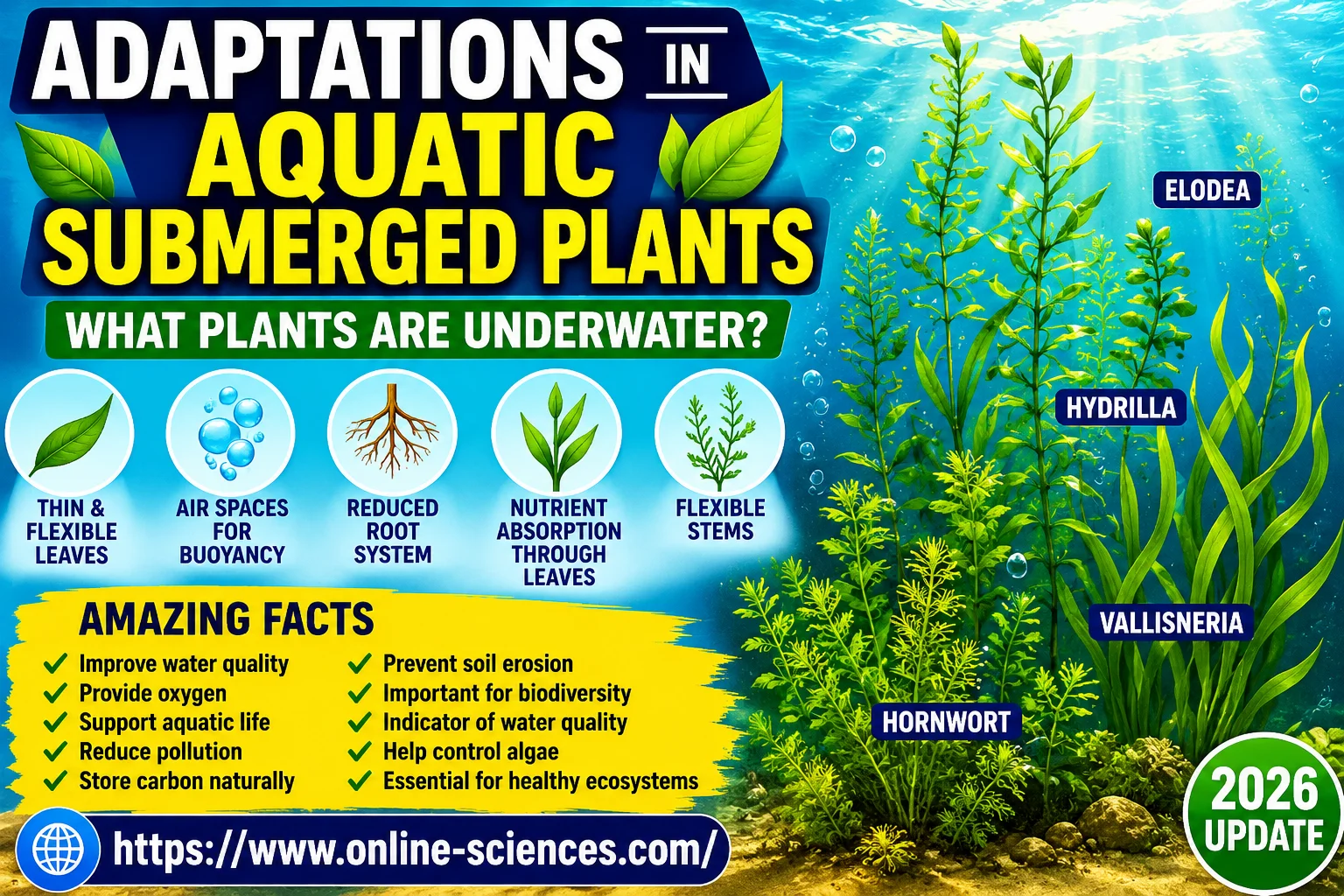
Aquatic submerged plants are divided into those that are totally submerged in the water, such as the Elodea plant, and those that are partially submerged in the water, such as the Hyacinth (Nil rose). Aquatic plants are exposed (especially the totally submerged ones) to a shortage of oxygen, which is dissolved in the water, a shortage of light, and the presence of water currents.
Adaptations in Aquatic Submerged Plants
Adaptation in aquatic plants
Aquatic plants can overcome some unique challenges compared to their land-dwelling relatives. To thrive underwater, they’ve developed a fascinating array of adaptations. Adaptation in aquatic submerged plants enables these fascinating organisms to survive and thrive completely underwater. Unlike terrestrial plants, submerged aquatic plants face challenges such as limited sunlight, reduced oxygen availability, and water currents.
Over millions of years, they have developed specialized structures and physiological features that allow them to carry out photosynthesis, absorb nutrients, and reproduce efficiently beneath the water surface.
Understanding the adaptations of underwater plants helps scientists study aquatic ecosystems and highlights the importance of these plants in maintaining water quality and supporting aquatic life. In 2026, submerged aquatic plants continue to play a crucial role in biodiversity conservation, carbon storage, and ecosystem stability.
Aquatic submerged plants
Adaptation of the Elodea plants
The Elodea plants are totally submerged plants. They have weak roots because they do not need to fix the plants or to absorb water. The leaves of the Elodea plants are small-sized, thin, and ribbon-like, So, They will not be cut by the water currents.
Aquatic plants
The leaves of the Elodea plant are sessile (neckless), so their connection with the stem will be stronger. The stem of the Elodea plant is elastic, so the water currents will not cut it.
The stem of the Elodea plant contains many air chambers to store the amount of oxygen gas that is produced during the photosynthesis process. The Elodea plants use oxygen gas in the respiration process, and oxygen gas helps the Elodea plant to float in the lighted regions of the water.
What are adaptations to aquatic life?
Sunlight weakens as it penetrates water, making it less available underwater, especially at deeper depths. Aquatic plants have features to maximize light absorption. Floating plants often have flat, broad leaves lying on the water’s surface to capture the most sunlight. Water lilies and lotus pads are classic examples.
Submerged leaves maximize light absorption in low-light conditions. Waterweeds and hornworts showcase this adaptation. Some plants have leaves that rise above the water’s surface to access more sunlight. Many submerged plants have thin, ribbon-like leaves to increase surface area for light penetration and reduce shading.
Many aquatic plants have lightweight, spongy tissue in their stems and leaves. This air-filled tissue, called aerenchyma, helps them float and reach the sunlight at the water’s surface, crucial for photosynthesis. Examples include water lilies and bulrushes.
Some plants, like water lilies, have air pockets in their petioles (leaf stalks) that help keep their leaves buoyant near the surface for better light access. Staying afloat or remaining anchored can be a challenge depending on the type of aquatic plant. The air pockets within the aerenchyma tissue not only aid gas exchange but also help the plant float.
Some plants have well-developed root systems that anchor them to the sediment, while others have specialized structures like bladders or floats to aid buoyancy. Some plants, like bladderworts, have inflated sacs containing air that keep them afloat. These bladders can also help them adjust their buoyancy to move up or down in the water column.
Air is essential for plant respiration, but underwater, it’s not readily available. Aquatic plants have special features for gas exchange. Many aquatic plants have air-filled spaces in their stems and leaves (aerenchyma) that facilitate gas transport throughout the plant.
Aerenchyma: This is a spongy tissue found in the stems and leaves of many aquatic plants. It contains air pockets that facilitate oxygen transport throughout the plant and aid buoyancy.
Plants need carbon dioxide (CO2) for photosynthesis, but obtaining it can be trickier in water compared to air. Some plants have stomata (pores for gas exchange) on their upper leaf surfaces, allowing them to capture CO2 from the air during calm periods.
Snorkels (Pneumatophores): Some plants, like mangroves, have air roots that grow upwards out of the water. These snorkels allow them to take in oxygen directly from the air. Some emergent plants, like reeds and cattails, have air channels running through the stems that allow them to transport oxygen from the atmosphere down to their roots submerged in water.
Unlike land plants that get nutrients from the soil, aquatic plants absorb them from the water. Obtaining essential nutrients can be more difficult in water than in soil. Many aquatic plants have finely divided roots or root hairs to absorb more dissolved minerals from the water column.
Aquatic plants may have root modifications to increase surface area for better nutrient absorption from the water column or sediment. Some plants, like bladderworts, trap tiny aquatic animals to obtain nutrients. Some aquatic plants form symbiotic relationships with fungi (mycorrhizae) that help them access nutrients more efficiently.
Water currents can be strong. Aquatic plants have features to stay anchored and upright. Many submerged plants have extensive root systems that anchor them to the sediment. Some plants have hollow, water-filled stems that act like weights, keeping them upright.
Aquatic plants have some unique strategies for reproduction in water. Some plants have evolved waterproof flowers that can be pollinated underwater. Many aquatic plants have waterproof coatings on their seeds and fruits, allowing them to float long distances on currents, spreading the plant to new habitats. Coconuts are a familiar example.
Many aquatic plants reproduce asexually by fragmentation or through specialized structures like tubers or runners. where a broken stem or leaf fragment can develop into a new plant. This is a quick and efficient way to spread in vegetatively dominated environments.
Aquatic plants often have well-developed root systems to anchor themselves in loose underwater sediments. Some, like mangroves, have specialized prop roots that help them grip the muddy bottoms and breathe air. Others, like water hyacinths, have fewer roots and rely on their buoyant structures for support, absorbing nutrients directly from the water.
What are Underwater Plants?
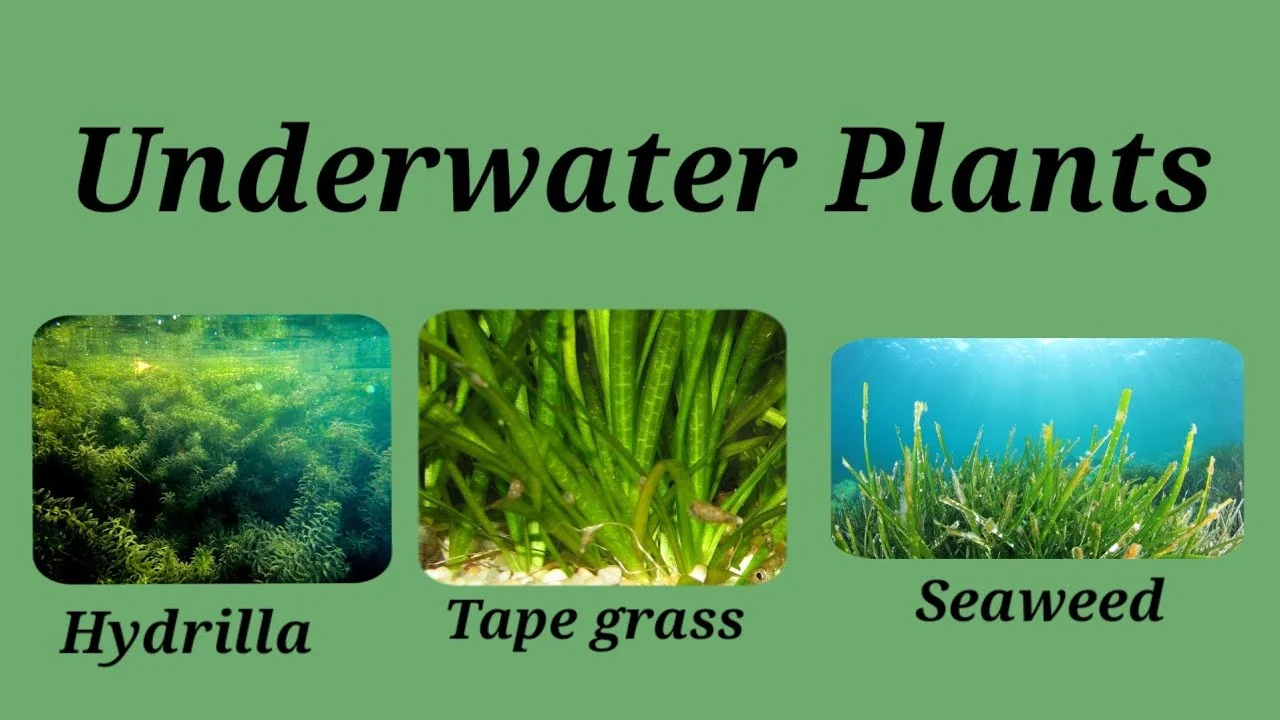
Underwater plants, also known as submerged aquatic plants or hydrophytes, are plants that grow entirely beneath the surface of water. These plants are commonly found in ponds, lakes, rivers, wetlands, and shallow coastal waters.
Examples include:
- Elodea.
- Hydrilla.
- Vallisneria.
- Eelgrass.
- Hornwort.
- Pondweed.
- Waterweed.
- Tape Grass.
Adaptation in Aquatic Submerged Plants
- Thin and Flexible Leaves: Submerged plants possess thin, narrow, and flexible leaves that reduce resistance to water currents. These leaves can bend easily without breaking, allowing the plants to survive in moving water environments.
- Absence of a Thick Cuticle: Most terrestrial plants have a waxy cuticle that prevents water loss. Since submerged plants are surrounded by water, they either lack a cuticle or have a very thin one, allowing direct absorption of dissolved gases and nutrients.
- Reduced Root System: The roots of submerged plants are generally poorly developed because water and dissolved minerals are readily available around the entire plant body. Nutrients can be absorbed through stems and leaves.
- Large Air Spaces (Aerenchyma): Many aquatic plants contain large internal air spaces called aerenchyma. These spaces help transport gases throughout the plant and provide buoyancy in water.
- Flexible Stems: The stems are soft and flexible, allowing them to withstand water movement and currents without being damaged.
- Direct Absorption of Nutrients: Unlike land plants, submerged plants absorb nutrients directly through their leaves and stems from the surrounding water.
- Reduced Mechanical Tissues: Because water provides support, submerged plants do not require strong supporting tissues. This adaptation saves energy and resources.
- Thin Epidermis: A thin epidermal layer facilitates efficient exchange of gases and nutrients with the surrounding aquatic environment.
Importance of Aquatic Submerged Plants
Aquatic submerged plants provide oxygen through photosynthesis, offer shelter for fish and aquatic organisms, reduce water pollution, stabilize sediments, and contribute to healthy aquatic ecosystems. They are also important in controlling excess nutrients that may otherwise cause harmful algal blooms.
Amazing Facts About Underwater Plants in 2026
- Some underwater plants can absorb nutrients through nearly every part of their body.
- Eelgrass meadows are among the world’s most productive ecosystems.
- Submerged plants improve water clarity by trapping suspended particles.
- Many fish species rely on underwater plants for breeding and protection.
- Certain aquatic plants can reproduce from small stem fragments.
- Aquatic plants help store carbon and reduce greenhouse gas levels.
- Some submerged plants can survive in both freshwater and brackish environments.
- Underwater plants provide food for turtles, fish, and aquatic birds.
- Dense underwater vegetation can help reduce shoreline erosion.
- Scientists increasingly use aquatic plants as indicators of water quality in environmental monitoring programs.
FAQs about adaptation in aquatic submerged plants
1. What are submerged aquatic plants?
Submerged plants are plants that grow completely underwater, with all parts (leaves, stems, and sometimes flowers) below the water surface. They are commonly found in lakes, rivers, and ponds.
Examples:
- Hydrilla.
- Elodea.
- Vallisneria.
- Ceratophyllum.
2. How are submerged plants adapted to living underwater?
Submerged plants have special adaptations, such as:
- Thin and flexible leaves move with water currents.
- Reduced or no cuticle (outer layer) since water loss isn’t a problem.
- Ability to absorb gases and nutrients directly from water.
3. Why do submerged plants have thin or narrow leaves?
Thin leaves:
- Help reduce resistance to water currents.
- Allow efficient absorption of carbon dioxide and dissolved nutrients.
4. Do submerged plants have roots?
Yes, but:
- Roots are often poorly developed.
- Their main role is anchorage, not absorption (since nutrients come from water).
5. How do submerged plants perform photosynthesis underwater?
They:
- Use dissolved carbon dioxide in water.
- Have chloroplasts adapted to capture limited light underwater?
6. Why are stems of submerged plants soft and flexible?
Soft stems:
- Prevent damage from water currents.
- Allow plants to bend instead of breaking.
7. Do submerged plants have stomata?
Most submerged plants:
- Lack of stomata (pores found in land plants).
- Exchange gases directly through their surfaces.
8. How do submerged plants reproduce?
They reproduce by:
- Fragmentation (pieces grow into new plants).
- Sometimes by flowers and seeds (though less common underwater).
9. Why don’t submerged plants need strong support tissues?
Water provides buoyancy, so they don’t need rigid stems like land plants.
10. What color are submerged plants usually, and why?
They are usually green because:
- They contain chlorophyll for photosynthesis.
- Some may appear darker due to low light conditions.
11. Where are submerged plants commonly found?
They grow in:
- Freshwater habitats like ponds, lakes, and slow-moving rivers.
- Sometimes in shallow coastal marine areas.
Submerged aquatic plants are specially adapted to live entirely underwater. Their structure is simplified compared to land plants, allowing them to efficiently absorb nutrients, perform photosynthesis, and survive in aquatic environments.
Conclusion
Adaptation in aquatic submerged plants allows these remarkable organisms to survive entirely underwater despite challenging environmental conditions. Features such as flexible leaves, reduced roots, thin cuticles, and specialized air spaces help them thrive in aquatic habitats. These underwater plants are essential for maintaining healthy ecosystems, supporting aquatic biodiversity, and improving water quality, making them an indispensable part of nature in 2026 and beyond.
You can subscribe to Science Online on YouTube from this link: Science Online
Adaptation in insectivorous & birds, Hibernation, Aestivation, Birds migration, and Camouflage
Adaptation reasons, types, diversity of living organisms and motion in mammals
Adaptation and the nature of the food in the birds
Adaptation and continuity of life by hibernation and aestivation






cooool
Thank you very much