Animal Cell Guide 2026: Structure, Functions & Key Organelles You Must Know
The animal cell is the basic structural and functional unit of animals, responsible for carrying out essential life processes. Unlike plant cells, animal cells do not have a cell wall or chloroplasts, but they contain specialized organelles that perform vital functions such as energy production, waste removal, and protein synthesis.
The animal cell
The animal tissue is composed of small units called animal cells, where each cell contains many components. The animal cells are of various sizes and have irregular shapes, and most of the cells range in size between 1 and 100 micrometers.
The animal cell is surrounded by a flexible cell membrane that controls the movement of substances in and out of the cell. Inside the cell, the cytoplasm provides a medium where various organelles are suspended and metabolic reactions occur. The nucleus is one of the most important components, acting as the control center that regulates cell activities and stores genetic information.
Animal cells contain several organelles that perform specific functions. Mitochondria are responsible for producing energy through cellular respiration, while ribosomes synthesize proteins needed for growth and repair. The endoplasmic reticulum helps in the production and transport of proteins and lipids, and the Golgi apparatus modifies, packages, and distributes these molecules within or outside the cell.
Another important feature of animal cells is the presence of lysosomes, which contain digestive enzymes that break down waste materials and cellular debris. Centrioles play a key role in cell division, ensuring the proper distribution of chromosomes. Together, all these organelles work in coordination to maintain the cell’s function, support growth, and ensure survival.
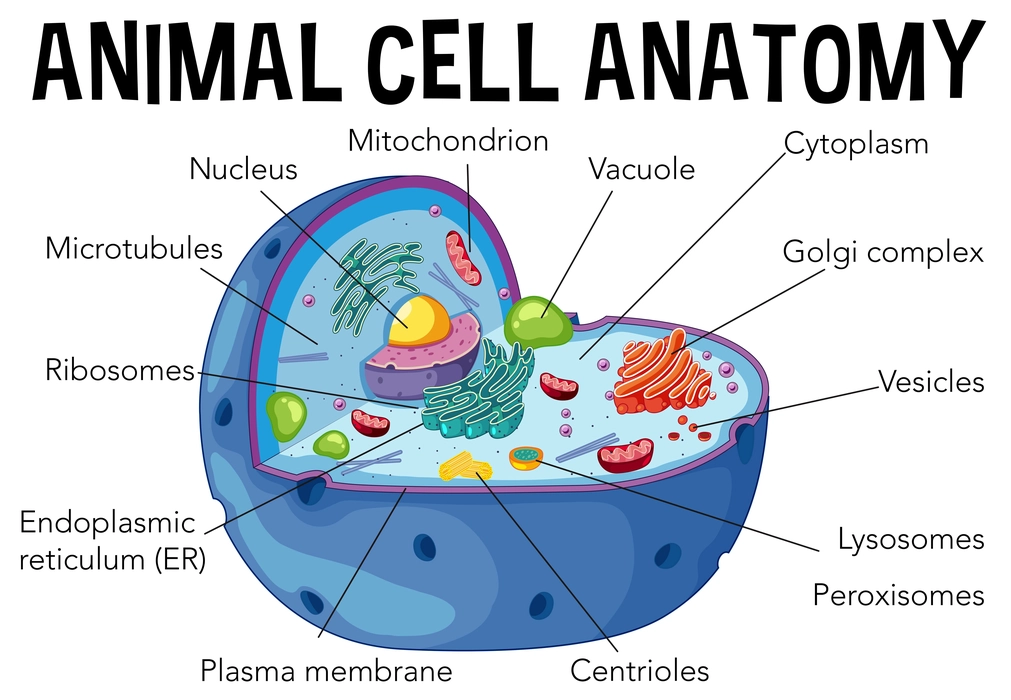
Structure of an animal cell
Plasma (cell) membrane
The plasma membrane is the outer membrane of the animal cell. It controls the substances that enter or leave the cell, and the cell membrane is made up of phospholipids, which have polar (hydrophillic) heads and non-polar (hydrophobic) tails.
Cytoplasm
All the cell components are suspended in the cytoplasm, which is a fluid that fills the cell. The cytoplasm maintains the pressure of the cell, and it ensures the cell doesn’t shrink or burst, and all the biological operations of the cell occur in the cytoplasm.
Nucleus
The nucleus organizes the biological processes in the cell, and it is responsible for cell division. The nucleus is surrounded by a porous membrane known as the nuclear membrane. The nucleus controls the activity of the cell and is known as the control center.
Small vacuoles
The small vacuoles are bound by a single membrane and small organelles, and they are storage organelles in many organisms.
Ribosomes
The ribosomes are found freely suspended in the cytoplasm, and they are attached to the endoplasmic reticulum. The ribosomes are found in large numbers in all cells, as protein synthesis is very important to the cell. The ribosome is the site for protein synthesis where the translation of the RNA takes place.
The plant cell is characterized than the animal cell by the presence of the cell wall and the green plastids (the chloroplasts), Both the animal and plant cells are similar in the presence of plasma membrane, cytoplasm, and nucleus. The animal cell has an indefinite shape due to the absence of a cell wall.
FAQ About Animal Cell Structure & Organelles
1. What is an animal cell?
An animal cell is the basic unit of structure and function in animals.
2. What is the main difference between animal and plant cells?
Animal cells lack a cell wall and chloroplasts, which are present in plant cells.
3. What is the function of the cell membrane?
It regulates the entry and exit of substances in the cell.
4. What does the nucleus do?
It controls cell activities and contains genetic material (DNA).
5. What is the role of mitochondria?
They produce energy needed for cellular processes.
6. What do lysosomes do?
They break down waste materials and damaged cell parts.
7. What is the function of ribosomes?
They are responsible for protein synthesis.
You can follow science online on YouTube from this link: Science online
Differentiation of cells & Diversity of animal tissues
Diversity of cells, Cell theory, Role of scientists in discovering cell & its structure
Parts of cell & How can the cell perform its functions?
Histology, Molecular structure of the cell membrane, Cell function & structure