
Characteristics and Importance of thermosphere layer, Ionosphere layer and Exosphere layer
The thermosphere layer is called the thermal layer as it is the hottest layer of the atmospheric envelope. It is the fourth layer of the atmospheric envelope, The temperature of the thermosphere layer increases at a high rate as we go up until it reaches 1200° Celsius.
Thermosphere layer
Thermosphere layer extends from the mesopause (at a height of 85 km above sea level) to a height of 675 km above sea level, Its thickness is 590 kilometres. The upper part of the thermosphere layer contains charged ions, and the pressure of these ions extends up to 700 km above sea level. So this part is called the ionosphere.
Thermosphere layer is the layer of the Earth’s atmosphere directly above the mesosphere and below the exosphere. Within this layer of the atmosphere, ultraviolet radiation causes the photoionization/photodissociation of molecules, creating ions in the ionosphere.
The thermosphere layer begins at about 85 km above sea level. At these high altitudes, the residual atmospheric gases sort into strata according to molecular mass. Thermospheric temperatures increase with altitude due to the absorption of highly energetic solar radiation.
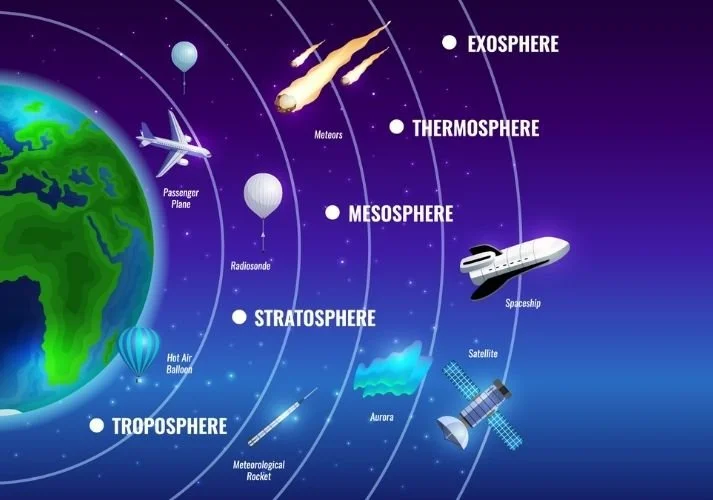
Thermosphere layer
Temperatures are highly dependent on solar activity and can rise to 1,700 °C or more, Radiation causes the atmosphere particles in this layer to become electrically charged (see ionosphere), which enables radio waves to be refracted and thus be received beyond the horizon.
Dynamics of the thermosphere are dominated by the atmospheric tides, which are driven by the very significant diurnal heating, The Atmospheric waves dissipate above this level because of collisions between the neutral gas and the ionospheric plasma. It can be affected by solar activity. During solar flares and coronal mass ejections, the thermosphere can become hotter and more expanded.
The thermosphere layer contains an appreciable concentration of elemental sodium located in a 10-km thick band at the mesosphere’s edge, 80 to 100 km above the Earth’s surface. The last layer of the atmospheric envelope is called the thermal layer because it is the hottest layer in the atmospheric envelope.
The thermosphere is the least dense layer of Earth’s atmosphere, with air pressure less than one trillionth of sea level pressure. The thermosphere absorbs the sun’s extreme ultraviolet (EUV) and X-ray radiation, which is why it is so hot. The thermosphere is home to the International Space Station and many other satellites.
The thermosphere is where auroras, or the northern and southern lights, occur. The thermosphere is home to the ionosphere, a region of the atmosphere where atoms and molecules have been stripped of some of their electrons. This gives the ionosphere special electrical properties that are used by radio and communication systems. This ionization is caused by the sun’s ultraviolet radiation.
The thermosphere is very hot, and although the temperature is in the thousands of degrees Fahrenheit, you would freeze if you were there. This is because there are few air molecules and there is insufficient heat transfer to keep you warm. The thermosphere is constantly expanding and contracting. This is because the amount of solar radiation it absorbs varies depending on the time of day and the sun‘s activity level.
The thermosphere is so thin that the air molecules are spaced far apart. This means that sound waves cannot travel through the thermosphere, so it is completely silent there. The thermosphere is so thin that if you were to stand at the bottom of the thermosphere, you would be able to see the stars during the day.
The thermosphere is a very important layer of the Earth’s atmosphere because it protects us from harmful radiation from the sun. The thermosphere is where space shuttles and other spacecraft re-enter the Earth’s atmosphere.
The thermosphere expands and contracts during the day and night, due to the Sun‘s heat. This expansion and contraction can cause drag on satellites, which can shorten their lifespan. The thermosphere is home to a variety of space weather phenomena, such as geomagnetic storms and solar flares. These phenomena can disrupt radio communications and power grids on Earth.
The ionosphere layer
The ionosphere layer is a layer that contains charged ions, and it has an important role in wireless communications and broadcasting as it reflects the radio waves transmitted by the radio stations and the communication centres.
The ionosphere layer is surrounded by two magnetic belts, which are known as Van-Allen belts. These belts play an important role in the scattering of the harmful charged cosmic radiations away from the Earth. This scattering causes the occurrence of the Aurora phenomenon. Van-Allen belts are called by this name related to the scientist Van-Allen who discovered them.
Van-Allen belts play an important role in protecting the Earth because they play an important role in scattering the harmful charged cosmic radiations away from the Earth.
Aurora phenomenon
The Aurora phenomenon appears as brightly coloured light curtains seen from both poles (the North and the South Poles) of the Earth.
The occurrence of the aurora phenomenon is due to the scattering of harmful charged cosmic radiations away from the Earth by Van-Allen belts.
Exosphere layer
The atmospheric envelope is inserted with the outer space in a region known as the Exosphere, in which the satellites orbit around the Earth with cameras and a telescope. The satellites are used to transmit weather condition information and TV programs.
What can fly in the thermosphere?
In the thermosphere, only certain types of vehicles or objects can operate effectively.
- Satellites (Low Earth Orbit – LEO): Many satellites, including the International Space Station (ISS), orbit within the thermosphere (typically around 400 km altitude). Though technically they are in orbit, not “flying” in the traditional aerodynamic sense, they are the main human-made objects in this layer.
- Spacecraft in Transit: Spacecraft heading to or returning from orbit or space (e.g., rockets, space shuttles, Crew Dragon, etc.) pass through the thermosphere. They briefly experience this layer during ascent or re-entry.
- Ionospheric Research Probes: Specialized research rockets and probes, such as sounding rockets, can enter the thermosphere for short durations to study upper atmospheric conditions, solar radiation, and auroras.
- Aurora Activity: While not “flying objects,” auroras (northern and southern lights) occur in the thermosphere due to interactions between solar wind and Earth’s magnetic field.
What cannot Fly There?
Airplanes, balloons, and drones cannot fly in the thermosphere. There’s too little air for aerodynamic lift or for engines that rely on oxygen.
Objects that orbit (like satellites and the ISS) or pass through (like rockets) are the main things that “fly” in the thermosphere. Traditional flight is not possible due to the thin atmosphere.
FAQ about the Thermosphere, Ionosphere, and Exosphere
What is the thermosphere?
The thermosphere is the second-highest layer of the Earth’s atmosphere, located above the mesosphere and below the exosphere. It extends from about 85 km to 600 km above Earth’s surface.
What are the main characteristics of the thermosphere?
- Extremely high temperatures (can reach 1500°C or more).
- Very thin air (low density of gas molecules).
- Contains charged particles (ions).
- The International Space Station (ISS) orbits in this layer.
Why is the thermosphere important?
- Absorbs harmful X-rays and ultraviolet (UV) radiation from the Sun.
- Protects Earth from extreme solar radiation.
- Region where auroras (Northern and Southern Lights) occur.
- Supports satellite and space station orbits.
Ionosphere Layer
What is the ionosphere?
The ionosphere is a region of the upper atmosphere (mainly in the thermosphere) that contains electrically charged particles called ions. It extends from about 60 km to 1000 km above Earth.
What are the characteristics of the ionosphere?
- Contains free electrons and ions.
- Formed by solar radiation, ionizing atmospheric gases.
- Divided into D, E, and F layers.
- Changes depending on day and night.
Why is the ionosphere important?
- Reflects and transmits radio waves.
- Makes long-distance radio communication possible.
- Plays a major role in GPS and satellite communication.
- Responsible for auroras.
Exosphere Layer
What is the exosphere?
- The exosphere is the outermost layer of Earth’s atmosphere.
- It extends from about 600 km to 10,000 km into space.
What are the characteristics of the exosphere?
- Extremely thin air (almost a vacuum).
- Contains mainly hydrogen and helium.
- Particles can escape into space.
- Gradually merges with outer space.
Why is the exosphere important?
- A region where many artificial satellites orbit.
- Acts as the transition between Earth’s atmosphere and outer space.
- Protects Earth by slowly losing light gases instead of heavier essential gases.
You can subscribe to Science Online on YouTube from this link: Science Online
Atmospheric layers and pressure, Troposphere, Stratosphere, Mesosphere, and Thermosphere
The characteristics and the importance of the mesosphere layer
The characteristics and the importance of the troposphere layer
The characteristics and the importance of the stratosphere layer


Nice work!
Thank you very much
Thanks u so much.
You are welcome
Thank you very much for your comment
this is really cool!!!!
Thank you very much for your comment
This is very encouraging research. Thanks a lot.
You are welcome
Thank you very much for your comment
Hello, Thank you