
Celsius Thermometer: 7 Powerful Facts About Mercury and Temperature Measurement
The Celsius thermometer is one of the most familiar tools for measuring temperature, but its history and technology are more fascinating than they may seem. Traditional thermometers often used mercury because of its useful physical properties, while the Celsius scale provides a simple and standardized way to describe temperature. Understanding how Celsius thermometers work also explains why mercury was once so important in temperature measurement and why modern thermometers increasingly use safer alternatives.
Celsius Thermometer
Celsius thermometer
A Celsius thermometer is an instrument used to measure temperature according to the Celsius scale. It has traditionally been made using a narrow glass tube containing a temperature-sensitive liquid, most famously mercury. As temperature changes, the liquid expands or contracts, causing its level to move along a calibrated scale.
The Celsius scale is widely used in science, medicine, weather observations, cooking, engineering, and everyday life. Although modern thermometers increasingly use digital sensors or other liquids instead of mercury, the traditional mercury thermometer played an important role in the development of accurate temperature measurement.
The Celsius thermometer is the thermometer that is used to measure the temperature of liquids. The Swedish scientist “Andres Celsius” created the Celsius scale in 1747. While recording the temperature, the thermometer must be vertical, and the direction of sight must be perpendicular to the thermometer.
Andres Celsius considered zero as the melting point of ice and 100 degrees Celsius as the boiling point of water. He divided the distance between zero and 100 degrees Celsius into 100 parts, where each part equals one degree.
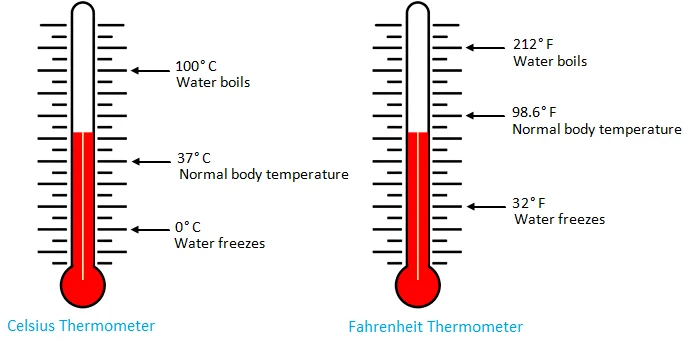
Celsius thermometer & Fahrenheit thermometer
The Celsius thermometer consists of a transparent thick glass tube, a capillary tube closed at one of its ends, and a mercury bulb that is filled with mercury and connected to the other end of the capillary tube.
There is no constriction above the mercury bulb in the Celsius thermometer; the thermometer scale starts from zero degree Celsius to 100 degrees Celsius, and every degree is represented by one part on this scale.
There are some types of Celsius thermometers whose scales reach 200 degrees Celsius. In a Celsius thermometer, the lower fixed point is 0 degrees Celsius, which is known as the melting point of ice or the freezing point of water, and the upper fixed point is 100 degrees Celsius, which is known as the boiling point of water.
Some thermometers contain two scales: one represents the Celsius scale (°C), and the other represents the Fahrenheit scale (°F), where:
0°C = 32°F
100°C = 212°F
Why is mercury preferred in making thermometers?
- Mercury is used in making thermometers because it is a liquid metal that can be seen easily through the thermometer glass, and it is a good conductor of heat.
- Mercury is a material that expands regularly, which gives an accurate estimation, and it does not stick to the walls of the capillary tube.
- It gives a wide range of temperature measurement because it remains in a liquid state between (−39°C) and (357°C).
- It returns easily to the bulb because it doesn’t stick to the wall of the capillary tube.
Some thermometers contain two scales: one represents the Celsius scale (°C), and the other represents the Fahrenheit scale (°F).
What is a Celsius Thermometer?
A Celsius thermometer is a thermometer calibrated using the Celsius temperature scale, formerly called the centigrade scale. On the commonly used Celsius scale:
- Water freezes at 0°C under standard atmospheric pressure.
- Water boils at 100°C under standard atmospheric pressure.
- The interval between these reference temperatures is divided into 100 degrees.
The Celsius scale was associated with Swedish astronomer Anders Celsius, who proposed a centigrade temperature scale in the 18th century. The Celsius thermometer does not necessarily have to contain mercury. A thermometer can use alcohol, another suitable liquid, or an electronic sensor while still displaying temperature in degrees Celsius.
How Does a Mercury Thermometer Work?
A traditional mercury thermometer consists of a sealed glass tube with a small reservoir, or bulb, containing mercury. When the temperature increases, the mercury expands. Because the mercury is confined inside the narrow tube, this expansion causes the mercury column to rise. When the temperature decreases, the mercury contracts and the column falls.
The position of the mercury column corresponds to a particular temperature on the calibrated Celsius scale. This simple principle made liquid-in-glass thermometers useful for many years because temperature changes could be converted into visible movement.
Why Was Mercury Important in Making Thermometers?
Mercury became an important thermometer liquid because it has several physical properties that make it useful for measuring temperature.
- Mercury expands predictably: Mercury undergoes thermal expansion when heated and contraction when cooled. Its relatively predictable behavior makes it possible to relate the movement of the mercury column to temperature.
- Mercury remains liquid over a useful temperature range: Mercury has a relatively low freezing point and a high boiling point compared with many other liquids. This gives mercury thermometers a broad useful operating range.
- Mercury is easy to see: Mercury has a bright, silvery appearance. In a narrow glass tube, the mercury column can be clearly observed, making temperature readings relatively easy.
- Mercury does not wet glass easily: Mercury does not spread over the inside surface of glass in the same way that some liquids do. This helps produce a distinct mercury column that can be read against the thermometer scale.
- Mercury responds quickly to temperature changes: Mercury conducts heat relatively well, allowing it to respond reasonably quickly when the thermometer is exposed to a changing temperature. These characteristics contributed to the popularity of mercury thermometers in laboratories, hospitals, industrial applications, and households.
Why is Mercury No Longer Preferred?
Despite its useful properties, mercury is toxic and can pose health and environmental risks if a thermometer breaks and mercury is released. For this reason, many countries and institutions have moved away from mercury-containing thermometers, particularly for routine household and medical use.
Modern alternatives include:
- Digital thermometers.
- Alcohol thermometers.
- Infrared thermometers.
- Electronic temperature sensors.
- Thermometers using other safer liquids.
Digital thermometers are especially common because they can provide quick readings without requiring a visible liquid column.
What Makes a Thermometer Accurate?
Several factors influence thermometer accuracy.
- Calibration: A thermometer needs an accurate relationship between the sensor’s response and the displayed temperature. Traditional Celsius thermometers were calibrated using known temperature reference points.
- Sensor properties: The temperature-sensitive material must respond consistently to changes in temperature.
- Glass construction: In liquid-in-glass thermometers, the dimensions of the bulb and capillary tube affect the movement of the liquid and therefore the accuracy of the instrument.
- Reading technique: The thermometer should be viewed correctly to avoid errors caused by the viewing angle, especially when reading a narrow liquid column.
- Environmental conditions: The thermometer must reach thermal equilibrium with the object or environment being measured. Measuring too quickly can produce a reading that does not accurately represent the actual temperature.
Celsius Thermometers in Science and Everyday Life
Temperature measurement is essential in many areas of modern life. Scientists use temperature measurements when studying physical and chemical processes. Meteorologists measure atmospheric temperatures to understand weather and climate. Engineers monitor temperature in machines and industrial systems.
Temperature measurement is also important in medicine, food preparation, refrigeration, heating systems, laboratories, and many household applications.
The Celsius scale is particularly convenient because its values are familiar in everyday situations. For example, room temperatures are commonly around 20–25°C, while human body temperature is approximately 37°C, although normal body temperature varies.
Celsius vs. Fahrenheit
Celsius and Fahrenheit are two commonly encountered temperature scales. The Celsius scale uses 0°C and 100°C as the traditional freezing and boiling reference points for water under standard conditions. The Fahrenheit scale uses different numerical reference points. Water freezes at 32°F and boils at 212°F under standard atmospheric pressure.
The conversion relationship is: °F = (°C × 9/5) + 32
and: °C = (°F − 32) × 5/9
Scientists also commonly use the Kelvin scale, particularly in physics and thermodynamics.
Importance of Thermometers
Thermometers are much more than simple instruments for checking whether something feels hot or cold. Accurate temperature measurements are fundamental to science, engineering, medicine, industry, and environmental monitoring.
The development of mercury thermometers represented an important stage in the history of temperature measurement. Their predictable thermal expansion and useful physical properties helped scientists and engineers make quantitative temperature measurements.
However, advances in technology have provided safer and often more convenient alternatives. Today, digital and electronic thermometers can provide highly useful measurements without the hazards associated with mercury.
Frequently Asked Questions about Celsius thermometers
What is a Celsius thermometer?
A Celsius thermometer is a temperature-measuring instrument calibrated to display temperature in degrees Celsius (°C). It may use a liquid, such as alcohol, or an electronic sensor.
Why was mercury used in thermometers?
Mercury was widely used because it expands predictably with temperature, remains liquid across a relatively broad temperature range, is clearly visible, and does not readily stick to glass.
Does every Celsius thermometer contain mercury?
No. A Celsius thermometer only refers to the temperature scale being used. Modern Celsius thermometers may use digital sensors, infrared technology, alcohol, or other materials.
Why is mercury dangerous?
Mercury is toxic, and exposure to mercury can create health and environmental concerns. A broken mercury thermometer should therefore be handled carefully according to local safety guidance.
What temperature does water freeze at on the Celsius scale?
Under standard atmospheric pressure, water freezes at 0°C.
What temperature does water boil at in Celsius?
Under standard atmospheric pressure at sea level, water boils at 100°C. The boiling point changes with atmospheric pressure and altitude.
Who developed the Celsius scale?
The Celsius scale is named after Swedish astronomer Anders Celsius, who proposed a centigrade temperature scale in 1742.
Are digital thermometers better than mercury thermometers?
Digital thermometers offer several advantages, including quick readings and the absence of liquid mercury. The best thermometer depends on the application, required accuracy, measurement range, and design.
Conclusion
The Celsius thermometer represents an important development in the history of temperature measurement. Traditional mercury thermometers were especially valuable because mercury expands predictably, is easy to observe, and remains liquid across a useful temperature range. However, mercury’s toxicity has encouraged the widespread adoption of digital, infrared, and other safer technologies.
Understanding how these thermometers work helps explain the relationship between temperature, thermal expansion, calibration, and scientific measurement. Even as modern technology replaces traditional mercury instruments, the Celsius scale remains one of the world’s most widely used ways of expressing temperature.
You can follow Science Online on YouTube from this link: Science Online
🔥 Google Gemini Notebook Just Changed AI Forever! 10 Powerful New Features You NEED to See (2026) 🚀
🔥 Another AI Hack: Google Gemini Accessed 3 Real Companies During a Cybersecurity Test 🚀
🔥 Gemini Storybook Tutorial: How to Create a Personalized Story with Gemini Storybook 🚀
Celsius thermometer and importance of mercury in making thermometers
Laser thermometers uses, advantages and disadvantages
The importance of measuring temperature and medical thermometer
Infrared thermometers (IR thermometers) features, types, cons and pros