
The Nature of Light Waves and Analysis of White Light: 7 Amazing Facts You Should Know
Light waves are a fascinating form of electromagnetic radiation that allow us to see the world around us. Understanding the nature of light waves helps explain reflection, refraction, interference, diffraction, and the formation of colors. White light is especially interesting because it is not a single color; it is a combination of many visible wavelengths that can be separated using a prism.
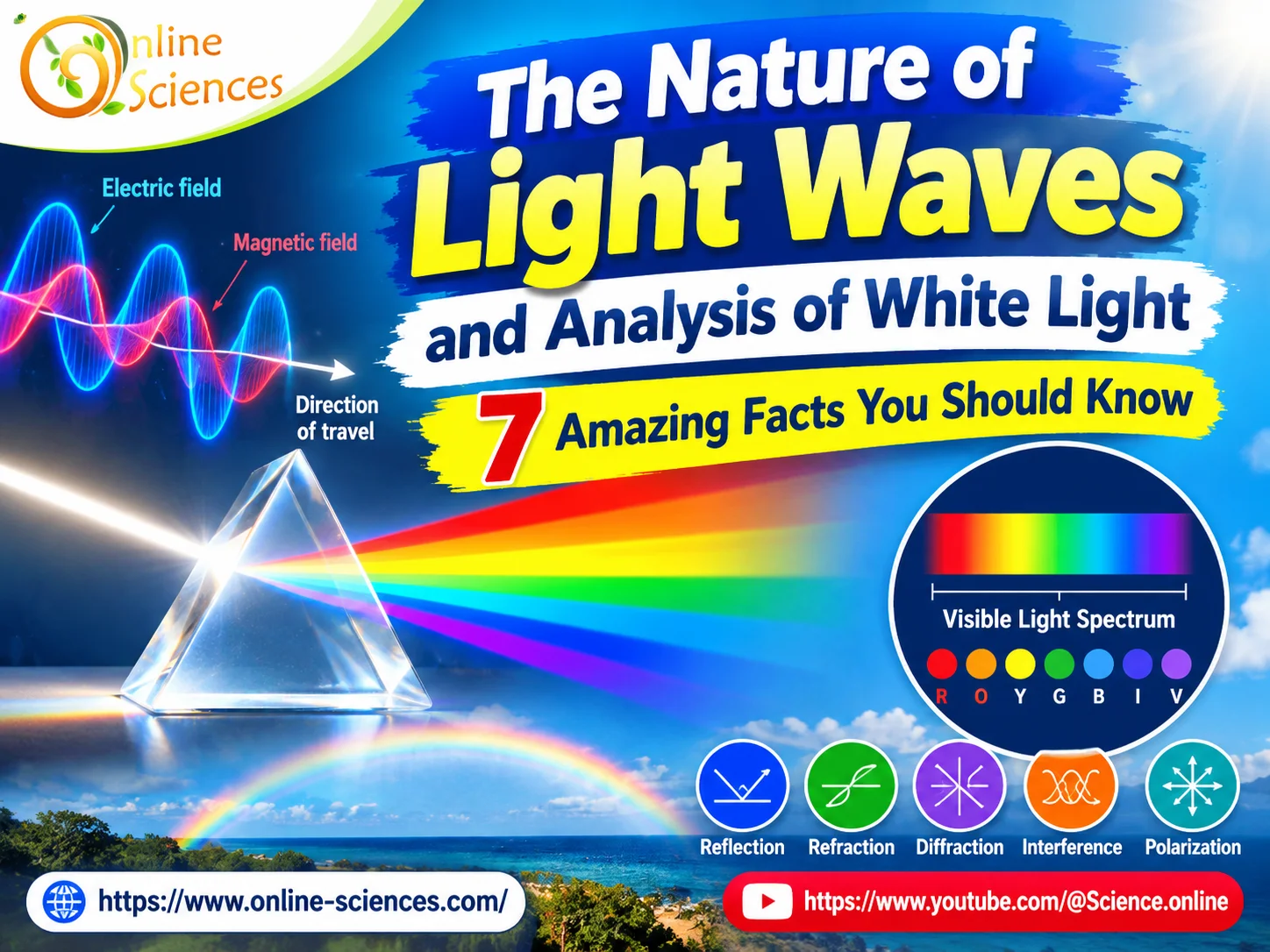
The Nature of Light Waves and Analysis of White Light
Light waves
Light is an external factor that affects the eye, causing the sense of vision. Light waves are electromagnetic transverse waves that can travel through free space with a velocity 300000 km/sec.
Light waves are made of crests and troughs, and the speed of light is the distance it covers in one second; light is electromagnetic radiation within a certain portion of the electromagnetic spectrum.
Visible light is one of the components of the electromagnetic spectrum, with wavelength ranges between 380 and 700 nanometres. It is between infrared (with longer wavelengths) and ultraviolet (with shorter wavelengths), infrared and ultraviolet are also called light.
Analysis of white light
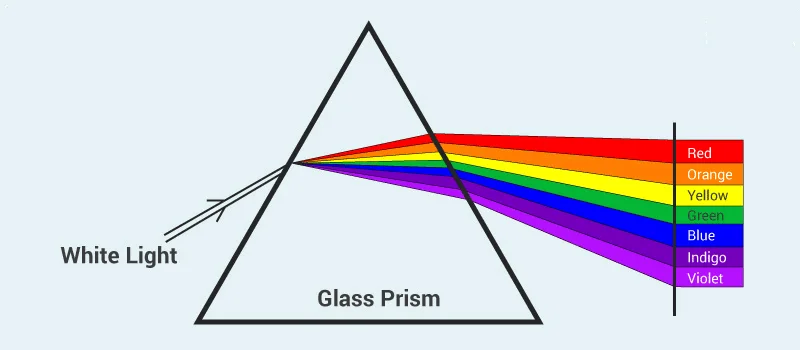
Analysis of white light
Analysis of white light is the splitting of white light into seven colours called the spectrum colours. When the white light falls on a triangular glass prism, it is analysed into seven spectrum colours, and they have different wavelengths of light.
The Sun is the main source of light energy on the Earth’s surface, and if you put a compact disc (CD) on a table such that its glistening surface faces the Sun’s rays (a source of white light), you will observe the formation of seven colours.
The white light consists of a mixture of seven colours, which are known as “The spectrum colours”, and these colours are Red – Orange – Yellow – Green – Blue – Indigo – Violet.
Red has the lowest deviation (It is the closest to the prism apex), the lowest frequency, and the longest wavelength; violet has the highest deviation (it is the closest to the prism base), the highest frequency, and the shortest wavelength.
The energy of the photon of red light is smaller than the energy of the photon of violet light because the energy of the photon is directly proportional to the frequency.
The German scientist Max Plank proved in 1900 that the energy of light waves is composed of energy quanta known as “photons”, The energy of the photon (E) is directly proportional to the frequency of the light wave (F).
The energy of the photon = Plank’s constant Χ Frequency of the photon
What is the Nature of Light Waves?
Light is a form of electromagnetic radiation that travels through space and can also propagate through transparent materials. Unlike mechanical waves, light does not require a material medium such as air, water, or a solid to travel.
Light has a dual nature. It can behave as a wave and as a stream of particles called photons. The wave description is particularly useful for explaining phenomena such as interference, diffraction, polarization, reflection, and refraction.
As an electromagnetic wave, light consists of oscillating electric and magnetic fields. These fields are perpendicular to each other and also perpendicular to the direction in which the wave travels. Therefore, light is classified as a transverse wave.
In a vacuum, all electromagnetic waves travel at approximately 3 × 10⁸ meters per second. When light enters a transparent material such as glass or water, its speed decreases, which can cause the light to change direction.
Main Characteristics of Light Waves
Light waves have several important characteristics:
1. Wavelength
The wavelength is the distance between corresponding points on successive waves, such as from one crest to the next. Different wavelengths correspond to different types of electromagnetic radiation. Visible light occupies only a small part of the electromagnetic spectrum. Its wavelengths are approximately from 400 to 700 nanometers, although the exact limits depend on the definition used.
2. Frequency
The frequency represents the number of complete wave cycles passing a point each second. It is measured in hertz (Hz). The relationship between wavelength, frequency, and the speed of light is: c = fλ. where c is the speed of light in vacuum, f is frequency, and λ is wavelength. For electromagnetic waves traveling in vacuum, higher frequency means shorter wavelength.
3. Amplitude
The amplitude is related to the strength or intensity of a light wave. Increasing the intensity of visible light generally makes it appear brighter.
4. Color
The color of visible light is associated primarily with its wavelength. For example, red light has a longer wavelength than blue or violet light.
What is White Light?
White light is a mixture of many different colors of visible light. Sunlight is a natural example of approximately white light, while many artificial light sources can also produce light that appears white. White light can be separated into its component colors using a glass prism. This process is called dispersion.
When a beam of white light passes through a prism, the different wavelengths are refracted by different amounts. As a result, the colors spread out into a spectrum. The familiar visible spectrum is commonly described as: Red, Orange, Yellow, Green, Blue, Indigo, and Violet.
Red light is generally deviated the least by a typical glass prism, while violet light is deviated the most because its refractive index is higher for shorter wavelengths.
Analysis of White Light Using a Prism
A prism provides an excellent way to analyze the composition of white light. When white light enters the first surface of a triangular glass prism, it is refracted. Inside the prism, different wavelengths travel at slightly different speeds. Because the refractive index depends on wavelength, each color follows a slightly different path.
When the rays emerge from the second surface, the separation between the colors becomes more noticeable. The result is a continuous spectrum of visible colors. This experiment demonstrates that white light is composed of several wavelengths rather than being a completely single-color form of radiation.
Why Does a Rainbow Form?
A natural rainbow demonstrates the separation of sunlight into its component colors. When sunlight enters a raindrop, it can undergo refraction, dispersion, internal reflection, and refraction again as it leaves the drop. Because different wavelengths are refracted by different amounts, the colors become separated. Millions of water droplets can collectively produce the colorful arc that we observe as a rainbow.
Wave Behavior of Light
The wave nature of light explains several important optical phenomena. Reflection occurs when light changes direction after striking a surface. Refraction occurs when light changes speed and usually changes direction as it moves from one medium to another. Diffraction is the spreading or bending of waves around obstacles or through narrow openings.
Interference occurs when two or more light waves overlap, producing regions of reinforcement or cancellation. Polarization demonstrates that light has a transverse electromagnetic-wave nature. These effects are essential in many technologies, including cameras, optical instruments, fiber-optic communication, lasers, displays, and medical imaging systems.
Why Is Understanding Light Important?
The study of light waves is fundamental to physics, astronomy, telecommunications, optics, and modern technology. Scientists use different wavelengths of electromagnetic radiation to study everything from atoms and molecules to distant galaxies.
Visible light is only a small portion of the electromagnetic spectrum. Radio waves, microwaves, infrared radiation, ultraviolet radiation, X-rays, and gamma rays all have the same fundamental electromagnetic nature but differ in wavelength and frequency. Understanding light therefore provides a foundation for understanding a huge range of natural phenomena and technologies.
Frequently Asked Questions (FAQ) about the nature of light waves
What is the nature of light waves?
Light is electromagnetic radiation that can behave as a transverse wave and also exhibit particle-like behavior through photons.
Is light a mechanical wave?
No. Light is an electromagnetic wave and does not require a material medium to travel through a vacuum.
What is white light?
White light is a combination of different wavelengths of visible light. It can be separated into its component colors using a prism.
What happens when white light passes through a prism?
The different colors are refracted by different amounts, causing white light to spread into a visible spectrum.
Which color has the longest wavelength?
Among the commonly recognized visible colors, red has the longest wavelength.
Which visible color has the shortest wavelength?
Violet generally has the shortest wavelength in the visible spectrum.
Why does a prism produce a spectrum?
A prism disperses white light because its refractive index varies with wavelength, causing different colors to bend by different amounts.
What is the relationship between frequency and wavelength?
For electromagnetic radiation traveling in vacuum, frequency and wavelength are inversely related according to c = fλ. Higher frequency corresponds to shorter wavelength.
Conclusion
The nature of light waves is fundamental to understanding the physical world. Light is electromagnetic radiation with both wave-like and particle-like properties. White light contains a range of visible wavelengths, and a prism can separate these wavelengths into a colorful spectrum through dispersion. From rainbows and optical instruments to lasers and fiber-optic communication, the behavior of light plays a central role in science and modern technology.
You can follow Science Online on YouTube at this link: Science Online
🔥 Google Gemini Notebook Just Changed AI Forever! 10 Powerful New Features You NEED to See (2026) 🚀
🔥 Another AI Hack: Google Gemini Accessed 3 Real Companies During a Cybersecurity Test 🚀
Dispersion of White light analysis, Normal prism and thin prism
Light waves properties, Analysis of white light, Spectrum colours & Light intensity
Light refraction effects, Law of light refraction, Mirage & Apparent positions of objects