10 Massive Economic Benefits of Unicellular Organisms That Are Worth Billions
Did you know that some of the smallest living organisms on Earth play a massive role in global industries? From producing life-saving medicines to helping create everyday foods like bread and yogurt, unicellular organisms are economic powerhouses. Understanding their importance can completely change how we see the microscopic world around us.
Unicellular organisms
A unicellular organism is an integrated living organism that proves that the cell is the unit of structure and function because it has the ability to perform all its biological functions. Unicellular organisms—including bacteria, yeasts, and microalgae—play a massive role in the global economy, often acting as “micro-factories” for various industries.
There are a lot of unicellular micro-organisms around us that can not be seen by the naked eye, such as bacteria and yeast fungus. Some unicellular organisms are harmful, and others are useful.
There are harmful unicellular organisms, such as bacteria, that cause a lot of diseases. There are also useful unicellular organisms, such as bacteria, which are used in making yoghurt and some types of cheese.
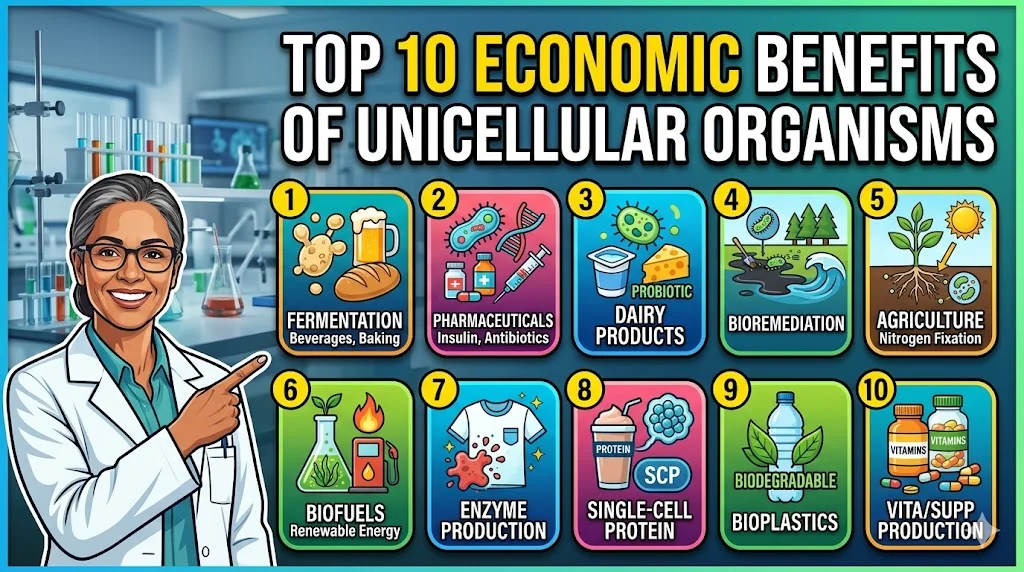
Top 10 Economic Benefits of Unicellular Organisms
Top 10 Economic Benefits of Unicellular Organisms
- Fermentation Industry: Yeasts are the backbone of the multibillion-dollar beverage and baking industries, converting sugars into ethanol and carbon dioxide.
- Pharmaceutical Production: Genetically engineered bacteria (like E. coli) are used to mass-produce life-saving medicines, including insulin, human growth hormones, and various antibiotics.
- Probiotics and Dairy: Bacteria such as Lactobacillus are essential for the production of yogurt, cheese, and kefir, supporting a massive global functional food market.
- Waste Management & Bioremediation: Specific microbes are used to clean up oil spills and treat sewage by breaking down organic waste, significantly reducing environmental cleanup costs.
- Agricultural Fertilizers: Nitrogen-fixing bacteria in the soil reduce the need for expensive chemical fertilizers by naturally enriching the ground for crops.
- Biofuel Production: Unicellular algae are being developed as a sustainable source of biodiesel and bioethanol, offering a renewable alternative to fossil fuels.
- Enzyme Manufacturing: Bacteria and fungi produce enzymes used in laundry detergents (to break down stains) and in the textile industry to process fabrics.
- Single-Cell Protein (SCP): Microbes are grown as a high-protein food source for livestock and even human consumption (like Quorn), addressing global food security.
- Bioplastics: Some bacteria can produce PHAs (polyhydroxyalkanoates), which are used to create 100% biodegradable plastics, tapping into the growing eco-friendly packaging market.
- Vitamin and Supplement Production: Many B-vitamins and amino acids are produced through large-scale microbial fermentation rather than complex chemical synthesis.
Yeast fungus
The yeast fungus is composed of one cell that contains many components. The yeast fungus is a unicellular microorganism composed of a cell wall that determines cell shape, the nucleus, the cytoplasm, and the vacuole.
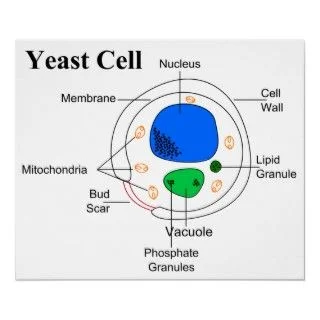
Yeast cell
Yeast fungus economic importance
The yeast fungus is used in making bread, where the yeast fungus produces carbon dioxide gas that causes the swelling of the bread, and it makes it porous and light. The yeast fungus is used to make alcohol, where it converts a sugar solution into alcohol and carbon dioxide gas.
Uses of Some Unicellular Organisms
Unicellular organisms such as bacteria, yeast, and protozoa are essential to many industries worldwide. One of their most significant contributions is in the food industry, where yeast is used in baking and fermentation processes to produce bread, beer, and wine. Similarly, bacteria are vital in the production of dairy products like yogurt and cheese, improving both flavor and shelf life.
In the medical and pharmaceutical fields, unicellular organisms are indispensable. Certain bacteria are used to produce antibiotics, vaccines, and insulin, which are critical for treating diseases. Biotechnology heavily relies on these organisms to develop new drugs and therapies, making them a cornerstone of modern medicine and healthcare advancement.
Additionally, unicellular organisms contribute to the environment and the agricultural sector. They help in nitrogen fixation, improving soil fertility and boosting crop production. Some microorganisms are also used in waste decomposition and sewage treatment, helping maintain environmental balance while supporting sustainable economic development.
FAQ About the Economic Importance of Unicellular Organisms
1. What are unicellular organisms?
Unicellular organisms are living organisms made up of a single cell, such as bacteria, yeast, and protozoa.
2. How do unicellular organisms benefit the economy?
They contribute to industries like food production, medicine, agriculture, and environmental management, generating significant economic value.
3. What is the role of yeast in the economy?
Yeast is widely used in baking and fermentation industries to produce bread, alcohol, and biofuels.
4. Why are bacteria important in medicine?
Bacteria are used to produce antibiotics, vaccines, and essential hormones like insulin.
5. How do unicellular organisms help agriculture?
They improve soil fertility through nitrogen fixation and help increase crop yields.
6. Can unicellular organisms help the environment?
Yes, they play a key role in waste decomposition, recycling nutrients, and sewage treatment.
7. Are all unicellular organisms beneficial?
No, some can cause diseases, but many have essential economic and ecological benefits.
You can follow Science Online on YouTube from this link: Science online