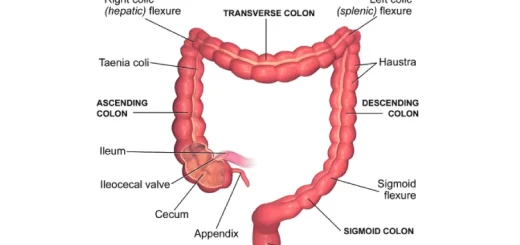
Digestive System Explained: Structure, Functions and Secrets of How Your Body Processes Food
Everyone eats complex food such as bread, cheese, jam, and beans for breakfast. So, how can the body benefit from this food every day? The digestive system is responsible for breaking down this complex food into simple substances.
Digestive system
The digestive system absorbs the digested food and transfers it to the blood, which transports this digested food all over the body to benefit from it. The digestive system is a complex network of organs that work together to convert food into essential nutrients. It begins in the mouth, where food is chewed and mixed with saliva, then moves through the esophagus to the stomach. Each organ plays a specific role in breaking down food into simpler forms that the body can use.
As food reaches the stomach, it is mixed with strong acids and enzymes that help break it down into a semi-liquid substance. It then moves into the small intestine, where most digestion and nutrient absorption occur. Here, nutrients pass into the bloodstream and are transported to different parts of the body for energy, growth, and repair.
The large intestine is the final stage of digestion, where water and salts are absorbed, and waste is formed for elimination. Supporting organs such as the liver, pancreas, and gallbladder enhance the digestive process by producing enzymes and bile. Understanding how the digestive system works helps us maintain better health through proper nutrition and lifestyle choices.
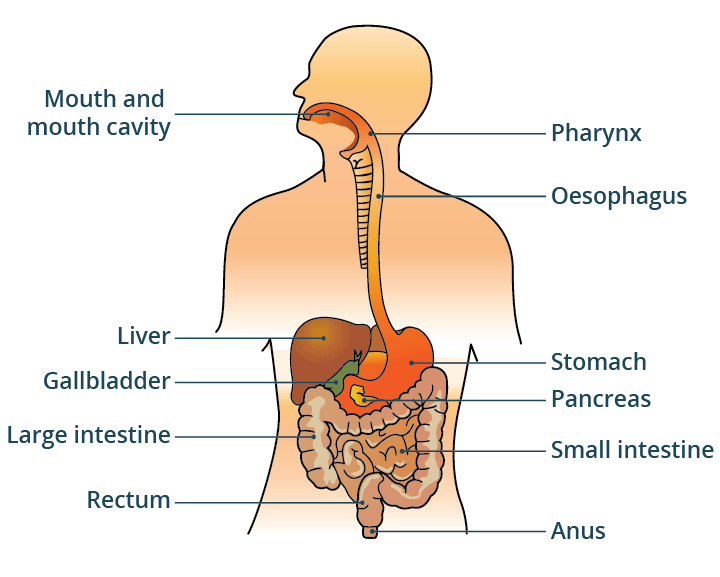
The digestive system in the human body
Digestion process
The food should be passed by the digestion process which is the process of breaking down the food from a complex form into simple substances to let the body get benefit from them.
The digestion process takes place in special organs forming the digestive system, and the main organs of the digestive system lie in a cavity that is called the abdominal cavity.
Structure of the digestive system
The digestive system is made up of the digestive canal and the digestive canal supplementaries. The digestive canal is made up of a group of organs in the shape of a long pipe with a length from 9 to 10 meters, and it starts with the mouth opening and ends with the anus opening.
The digestive canal consists of the mouth, the pharynx, the esophagus, the stomach, the small intestine, and the large intestine.
The function of the digestive canal is to digest and absorb food. The digestive canal supplementaries consist of the liver, the pancreas, and the salivary glands.
FAQ about the Digestive System
1. What is the digestive system?
The digestive system is a group of organs that work together to break down food, absorb nutrients, and remove waste from the body.
2. What are the main organs of the digestive system?
The main organs include the mouth, esophagus, stomach, small intestine, and large intestine. Accessory organs such as the liver, pancreas, and gallbladder also play important roles.
3. What is the function of the digestive system?
Its main function is to convert food into nutrients like carbohydrates, proteins, and fats that the body can absorb and use for energy, growth, and repair.
4. How does digestion begin?
Digestion begins in the mouth, where food is chewed and mixed with saliva, which contains enzymes that start breaking down carbohydrates.
5. What happens in the stomach during digestion?
In the stomach, food is mixed with digestive juices and acids that break it down into a semi-liquid substance, making it easier for further digestion in the intestines.
6. What is the role of the small intestine?
The small intestine is where most digestion and nutrient absorption occur. Nutrients pass through its walls into the bloodstream.
7. What does the large intestine do?
The large intestine absorbs water and salts from undigested food and forms waste (feces) for elimination.
8. What is the role of the liver in digestion?
The liver produces bile, which helps break down fats into smaller droplets, making them easier to digest.
9. How does the pancreas help in digestion?
The pancreas releases digestive enzymes into the small intestine to break down proteins, fats, and carbohydrates.
10. Why is the digestive system important?
It is essential because it provides the body with nutrients and energy needed for survival and removes waste products.
11. How long does digestion take?
Digestion can take anywhere from 24 to 72 hours, depending on the type of food and individual metabolism.
12. What are common digestive problems?
Common issues include indigestion, constipation, diarrhea, and acid reflux, which can affect how the system functions.
You can follow science online on YouTube from this link: Science online
Digestion in man, Buccal digestion and Gastric digestion (digestion in stomach)
Small intestine, Absorption of digested food, Metabolism, Large intestine and defecation
The function of the large intestine in the human digestive system