
Structure and Importance of the Nervous System: 7 Shocking Facts Explained
Have you ever wondered how your body reacts instantly to pain, remembers important moments, or controls every heartbeat? The nervous system is the body’s command center, working non-stop to keep you alive and functioning. Understanding its structure and importance reveals just how incredible and complex the human body truly is.
Human nervous system
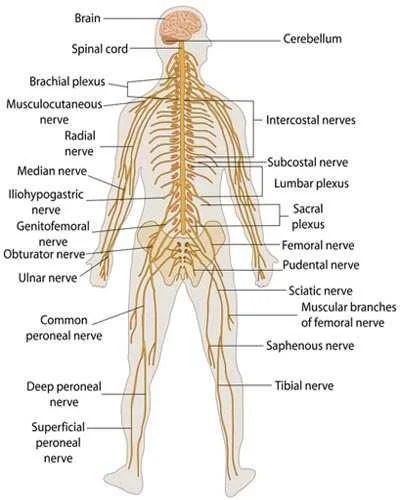
Nervous system structure
The nervous system is a communication and controlling body system, It consists of the brain, the spinal cord, and the nerves, and it is the most important system inside your body. The nervous system controls and regulates all vital operations of the body because it receives the information from the environment and from the body, then it interprets this information and makes the body respond to it.
The nervous system is responsible for knowing if things are hot or cold, sweet or bitter, rough or smooth. The nervous system adjusts the responses that require the emotions, so it makes you sad or happy, angry or calm. The nervous system oversees and regulates the multiple functions performed by the human body, such as moving, feeding, digestion, breathing, thinking, and others.
Structure and Importance of the Nervous System
The nervous system is divided into two main parts: the central nervous system (CNS) and the peripheral nervous system (PNS). The CNS includes the brain and spinal cord, which process and interpret information. The PNS consists of nerves that connect the CNS to the rest of the body, transmitting signals between the brain and different organs. This organized structure allows the body to respond quickly and efficiently to internal and external stimuli.
The importance of the nervous system lies in its ability to control and coordinate all body activities. It regulates voluntary actions like movement and involuntary functions such as breathing, heartbeat, and digestion. Without the nervous system, communication between body parts would not be possible, making survival impossible.
In addition, the nervous system plays a key role in thinking, learning, memory, and emotions. It enables humans to interact with their environment, make decisions, and adapt to changes. This makes it not only essential for basic survival but also for higher cognitive functions that define human behavior and intelligence.
Structure and Importance of the Nervous System
Structure of the nervous system
The nervous system consists of two major systems, which are the central nervous system and the peripheral nervous system.
The neuron
The building unit of the nervous system is the nerve cell, which is called the neuron, and it consists of two main parts: the cell body and the axon. The cell body contains a nucleus, the cytoplasm, and the plasma membrane.
Some branches extend from the neuron’s body, called the dendrites. The dendrites are connected to the neighbouring neurons to form the synapse (the synaptic areas).
The axon is a cylindrical axis covered with a fatty layer called the myelin sheath, and it ends with nerve endings called the axon terminals. The axon terminals are connected to the muscles or form a synapse with other neurons. The nerve cell’s axons are grouped together, forming the nerve fibre. and the nerve fibres are grouped together forming the nerve.
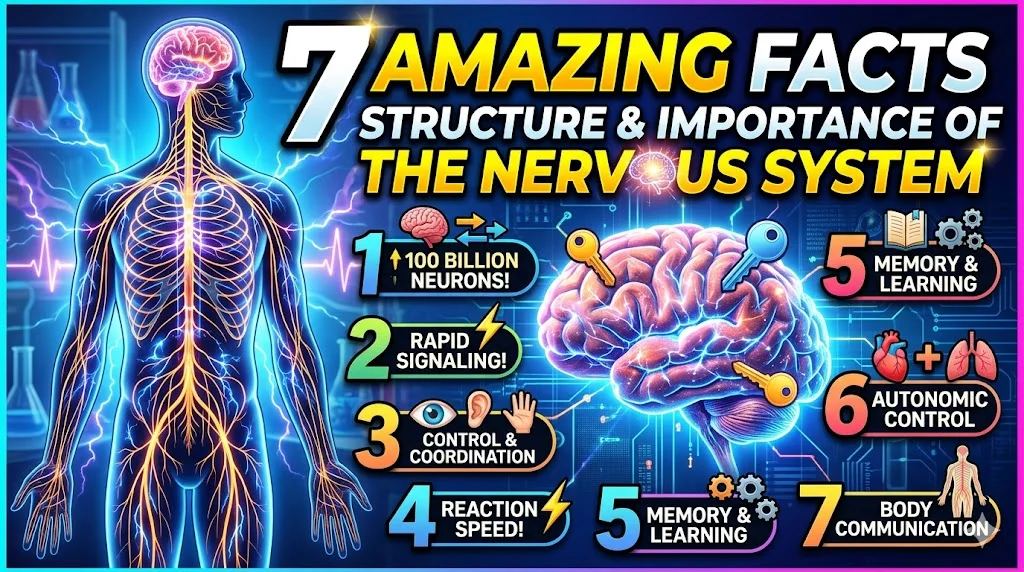
7 Amazing Facts About the Structure and Importance of the Nervous System
The nervous system is the body’s prime communication network, a complex structure that coordinates every movement, thought, and sensation. Its design is a masterpiece of biological engineering, capable of processing information at speeds that rival modern supercomputers.
- A Network of 100 Billion Neurons: The human brain alone contains approximately 100 billion neurons. These specialized cells are the building blocks of the system. If you were to line up all the neurons in a single person’s body, the chain would stretch nearly 1,000 kilometers (about 600 miles).
- Information Travels at Racing Speeds: Signals within the nervous system don’t just “drift”; they fly. Nerve impulses can travel at speeds of up to 120 meters per second (about 270 mph). This rapid-fire communication is why you can pull your hand away from a hot stove before your brain even fully registers the pain.
- The Myelin “Superhighway”: To maintain these high speeds, many nerve fibers are wrapped in a fatty substance called myelin. Think of myelin as the insulation on an electrical wire. It prevents “leaking” of the electrical signal and allows impulses to jump across gaps, significantly boosting transmission efficiency.
- Constant Electrical Activity: Your nervous system is never truly “off.” Even while you sleep, your brain and nerves are firing. In fact, a single human brain generates more electrical impulses in a single day than all the telephones in the world combined.
- The Power of Neuroplasticity: For a long time, scientists believed the nervous system was “fixed” after childhood. We now know that the system is plastic. It can reorganize itself by forming new neural connections throughout life, allowing you to learn new languages, recover from injuries, and adapt to new environments.
- Autonomic Control: The Silent Operator: The importance of the nervous system is most evident in the Autonomic Nervous System (ANS). This subsystem manages all the functions you don’t think about, such as your heartbeat, digestion, and breathing. Without this “silent operator,” the basic biological functions required for life would cease.
- The Gut-Brain Connection: Often called the “second brain,” the enteric nervous system in your digestive tract contains over 100 million neurons. It can operate independently of the brain and is responsible for that “gut feeling” you experience during stressful or exciting situations.
Which of these facts surprised you the most?
FAQ About Structure and Importance of the Nervous System
1. What are the main parts of the nervous system?
The nervous system consists of the central nervous system (brain and spinal cord) and the peripheral nervous system (nerves throughout the body).
2. What is the function of the nervous system?
It controls body activities, processes information, and coordinates responses to stimuli.
3. Why is the nervous system important?
It allows communication between different parts of the body and controls vital functions like breathing and heartbeat.
4. What is the role of the brain in the nervous system?
The brain acts as the control center, interpreting signals and sending instructions to the body.
5. How does the peripheral nervous system work?
It transmits signals between the central nervous system and the rest of the body.
6. What happens if the nervous system is damaged?
Damage can lead to loss of movement, sensation, or control of body functions, depending on the affected area.
7. How can we keep the nervous system healthy?
By maintaining a healthy diet, exercising regularly, managing stress, and getting enough sleep.
You can follow Science Online on YouTube from this link: Science online
Autonomic nervous system, Reflex action types & Autonomic ganglia function
Functions of Sympathetic nervous system & Role of the sympathetic in emergencies
Nervous system in man, Nerve cells types & Nature of nerve impulse
Nervous system (Central nervous system, Peripheral nervous system & Autonomic nervous system)
Human Transport System, Structure of human circulatory system (heart, blood vessels and blood)