
Melting Point and Boiling Point: 10 Amazing Facts, Key Differences, and Everyday Applications
Melting Point and Boiling Point are two essential physical properties that describe how matter changes from one state to another. The melting point is the temperature at which a solid becomes a liquid, while the boiling point is the temperature at which a liquid changes into a gas. Understanding these phase changes is important in chemistry, physics, manufacturing, cooking, medicine, and many everyday applications.
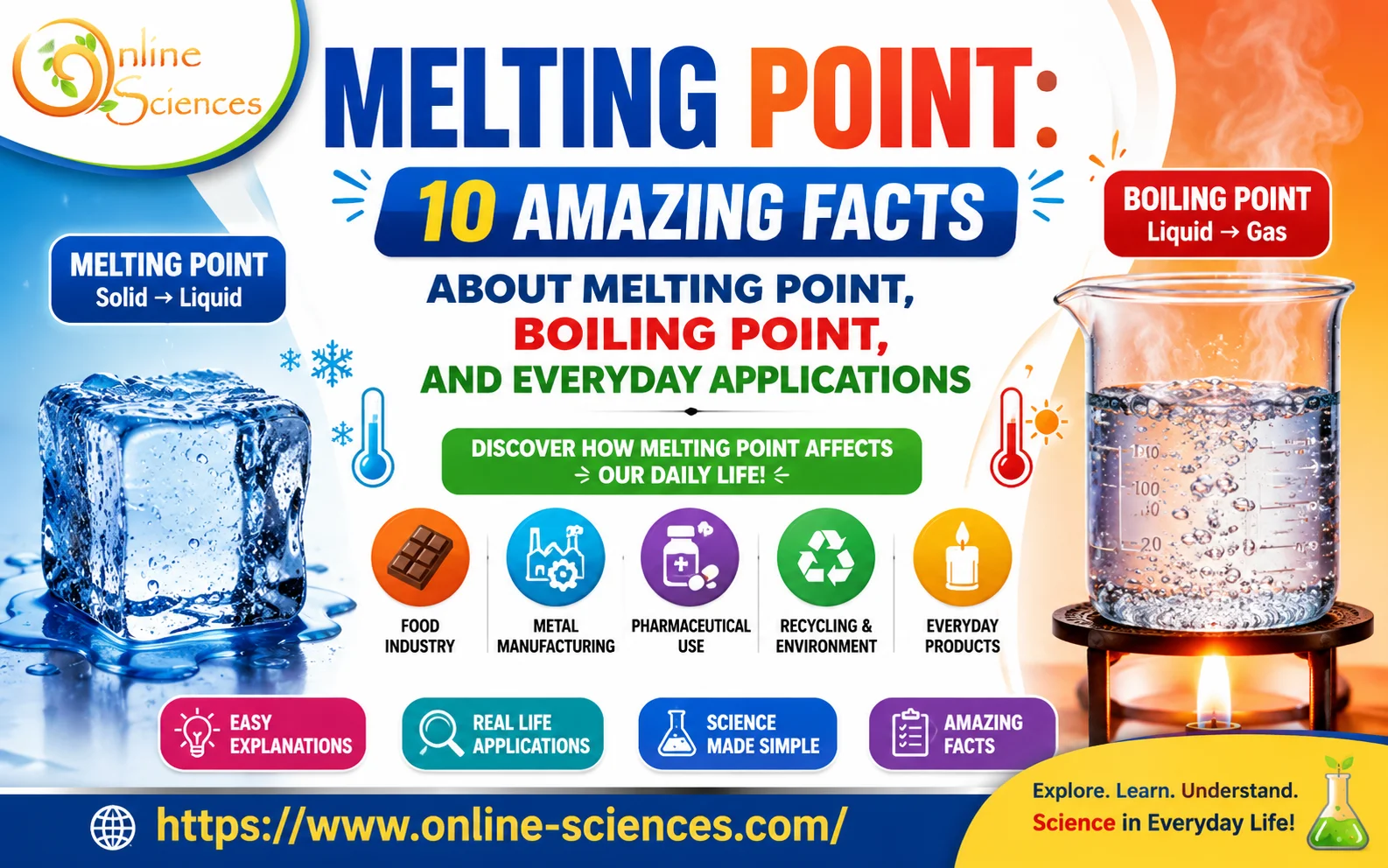
Melting Point and Boiling Point
Melting point
The melting point is one of the most important physical properties of matter. It tells us the exact temperature at which a solid changes into a liquid under normal atmospheric pressure. From making chocolate and glass to producing medicines and metals, understanding the melting point is essential in science, engineering, medicine, and everyday life.
Matter exists in three states, which are solid, liquid, and gas, and the matter can change from one state to another by heating. The change of matter from the solid state to the liquid state is known as melting, and the temperature at which the matter begins to melt is called the melting point.
The melting point is the temperature at which a solid begins to change into a liquid. The melting point of ice is 0 °C, where ice begins to change into water.
Each substance has a definite melting point, which is used to differentiate between substances. Different solids have different melting points; some solids have low melting points, such as wax, butter, and ice.
Some solid substances have high melting points, such as iron, copper, aluminum, and table salt. The melting point of a substance depends on the pressure, and it is usually specified at standard pressure.
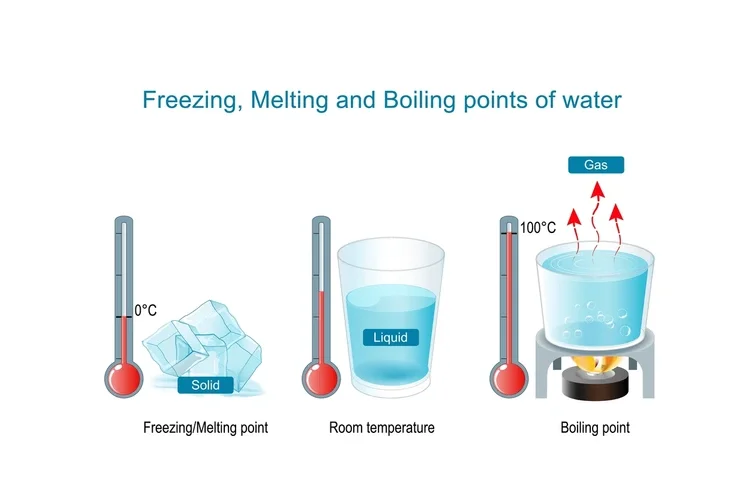
Boiling point and melting point
Measurements of the melting point of a solid can provide information about the purity of the substance, where mixtures tend to melt at temperatures below the melting points of the pure solids.
Life applications about the melting process
The workmen melt the solid metals to make them easy to mix and shape in the manufacture of alloys. Alloys are very important in our lives, such as copper-gold alloy and nickel-chrome alloy.
Copper-gold alloy is an alloy used in making jewels, which are used for decoration, and nickel-chrome alloy is an alloy used in making heating coils. The materials with high melting points are valuable for making products that need to resist high heat.
Tungsten has an extremely high melting point, and it is used in the filaments for light bulbs. If you have a mixture of several solid substances, melting is a way by which some substances (with lower melting points) can be separated from others (with higher melting points).
Difference between boiling point and melting point
The boiling point and melting point are two important physical properties of a substance, but they represent different phase transitions. Melting point and boiling point are both important properties that help us understand the behavior of substances under different conditions.
The melting point: this is the temperature at which a solid substance changes into a liquid state. such as the melting point of ice is 0°C.
The boiling point is the temperature at which a liquid substance changes into a gaseous state. For example, the boiling point of water is 100°C at standard atmospheric pressure.
Phase transition: Melting involves a transition from solid to liquid, while boiling involves a transition from liquid to gas. Temperature: The melting point and boiling point of a substance are specific to that substance and can vary depending on external conditions like pressure.
Intermolecular forces: Both melting and boiling involve overcoming intermolecular forces, but the forces involved are different, Melting involves overcoming forces between molecules in a solid, while boiling involves overcoming forces between molecules in a liquid.
What is the Melting Point?
The melting point is the temperature at which a solid changes into a liquid without changing its chemical composition. During melting, the particles gain enough energy to overcome the attractive forces that hold them in a fixed arrangement. Instead of vibrating in place, they begin moving freely, forming a liquid.
For example:
- Ice melts at 0°C (32°F).
- Gold melts at 1,064°C.
- Iron melts at 1,538°C.
Every pure substance has its own characteristic melting point, making it useful for identifying materials.
How Does the Melting Process Work?
Melting occurs when heat energy is supplied to a solid.
The process follows these steps:
- Heat is absorbed by the solid.
- Particle vibration increases.
- Attractive forces weaken.
- Particles move more freely.
- The solid becomes a liquid.
Interestingly, the temperature remains constant during melting until the entire solid has melted. The absorbed energy is known as the latent heat of fusion.
Examples of Melting Point
- Ice: 0°C.
- Butter: 32–35°C.
- Chocolate: 30–32°C.
- Aluminum: 660°C.
- Silver: 962°C.
- Gold: 1,064°C.
- Copper: 1,085°C.
- Iron: 1,538°C.
- Tungsten: 3,422°C.
Factors Affecting Melting Point
Several factors influence a substance’s melting point.
- Purity: Pure substances have a sharp melting point, while impurities usually lower and broaden the melting range.
- Pressure: Pressure can slightly alter the melting point, especially for substances like ice.
- Molecular Structure: Strong chemical bonds require more energy to break, resulting in higher melting points.
- Crystal Structure: Different crystal arrangements can lead to different melting temperatures.
Life Applications of the Melting Process
The melting process is essential in countless industries and everyday activities.
- Food Industry: Chocolate, butter, cheese, sugar, and cooking fats melt during food preparation and manufacturing.
- Metal Manufacturing: Metals are melted before being cast into tools, machinery, automotive parts, and construction materials.
- Glass Production: Glass is produced by melting silica and other materials at very high temperatures before shaping.
- Plastic Manufacturing: Plastic pellets are melted and molded into bottles, containers, toys, and household products.
- Jewelry Making: Gold, silver, and platinum are melted to create rings, necklaces, and decorative items.
- Pharmaceutical Industry: Scientists measure melting points to identify compounds and verify the purity of medicines.
- Recycling: Recycling plants melt metals, plastics, and glass to manufacture new products while reducing waste.
- Electronics: Solder is melted to connect electrical components on printed circuit boards.
- Road Construction: Bitumen is heated until it softens before being used in asphalt paving.
- Candle Manufacturing: Wax is melted, colored, scented, and poured into molds to produce candles.
Importance of Melting Point
Knowing a material’s melting point helps scientists and engineers:
- Identify unknown substances.
- Test material purity.
- Select suitable materials for manufacturing.
- Design industrial processes.
- Improve product quality.
- Ensure safety in engineering applications.
Melting Point vs Boiling Point
- Melting Point: The temperature at which a solid changes into a liquid.
- Boiling Point: The temperature at which a liquid changes into a gas.
- State Change: Melting involves solid → liquid, while boiling involves liquid → gas.
- Energy Required: Melting requires latent heat of fusion; boiling requires latent heat of vaporization.
- Particle Behavior: During melting, particles move more freely but remain close together. During boiling, particles gain enough energy to escape into the gas phase.
- Temperature Example (Water): Water melts at 0°C (32°F) and boils at 100°C (212°F) at standard atmospheric pressure.
- Pressure Effect: Both melting and boiling points can change with pressure, but boiling points are generally more sensitive to pressure changes.
- Industrial Uses: Melting points are important in metal casting, plastic molding, and material identification, while boiling points are used in distillation, purification, cooking, and sterilization.
- Physical Property: Both the melting point and boiling point are characteristic physical properties used to identify pure substances.
- Phase Transition: Melting occurs between the solid and liquid phases, whereas boiling occurs between the liquid and gas phases.
Why Do Different Materials Have Different Melting Points?
Different substances have different melting points because their atoms and molecules are held together with varying strengths.
For example:
- Metals have strong metallic bonds.
- Ionic compounds have powerful electrostatic attractions.
- Molecular substances often have weaker intermolecular forces.
The stronger the bonding, the higher the melting point.
Interesting Facts About Melting Point
- Ice expands when it freezes, unlike most substances.
- Tungsten has one of the highest melting points of all metals.
- Mercury is already liquid at room temperature.
- Diamonds do not melt easily under normal conditions.
- Pure substances have precise melting points, making them useful for identification.
Advantages of Knowing the Melting Point
- Helps identify unknown chemicals.
- Ensures pharmaceutical quality.
- Improves manufacturing precision.
- Supports recycling technologies.
- Enhances material selection in engineering.
- Assists quality control laboratories.
Frequently Asked Questions (FAQ) about Melting Point and Boiling Point
1. What is the melting point?
The melting point is the temperature at which a solid changes into a liquid under standard atmospheric pressure.
2. Why is the melting point important?
It helps identify substances, test purity, and determine the best materials for industrial and scientific applications.
3. What happens during melting?
Particles absorb heat, overcome attractive forces, and move freely, transforming the solid into a liquid.
4. Is melting a physical or chemical change?
Melting is a physical change because the substance’s chemical composition remains unchanged.
5. Does pressure affect the melting point?
Yes. Pressure can change the melting point of some materials, especially ice.
6. What is the difference between the melting point and the boiling point?
The melting point is where a solid becomes a liquid, while the boiling point is where a liquid changes into a gas.
7. Can impurities change the melting point?
Yes. Impurities generally lower the melting point and broaden the melting temperature range.
8. Which metal has the highest melting point?
Tungsten has one of the highest melting points among pure metals at approximately 3,422°C.
9. Why does ice melt at 0°C?
At 0°C under standard atmospheric pressure, water molecules have enough energy to break the crystal structure of ice and become liquid.
10. How is the melting point measured?
Scientists use instruments such as a melting point apparatus or differential scanning calorimetry (DSC) to determine the temperature at which a substance melts.
Conclusion
The melting point is a fundamental property that describes the temperature at which a solid becomes a liquid. It plays a vital role in chemistry, physics, engineering, medicine, manufacturing, and daily life. Understanding the melting process, the factors that influence it, and how it differs from the boiling point helps explain countless natural phenomena and industrial processes. Whether designing advanced materials, producing pharmaceuticals, recycling metals, or simply cooking food, knowledge of melting points is essential for science and technology.
You can subscribe to Science Online on YouTube from this link: Science Online
Heat changes accompanying physical changes and Explanation of the source of the heat of solution
Matter, Properties and Kinds of molecules, Melting process and Vaporization process
Atomic structure of matter, Energy levels, Electronic distribution and chemical activity




It’s good
Thank you for your comment