
Powerful Types and Uses of Lenses in 2026 You Should Know
The rapid development of optical engineering has made modern lenses more powerful and efficient than ever before. From smartphones and virtual reality headsets to microscopes and telescopes, lenses play a major role in improving image quality and enhancing scientific discoveries. Understanding the different types and uses of lenses helps students and technology enthusiasts explore the fascinating world of optics and modern innovation.
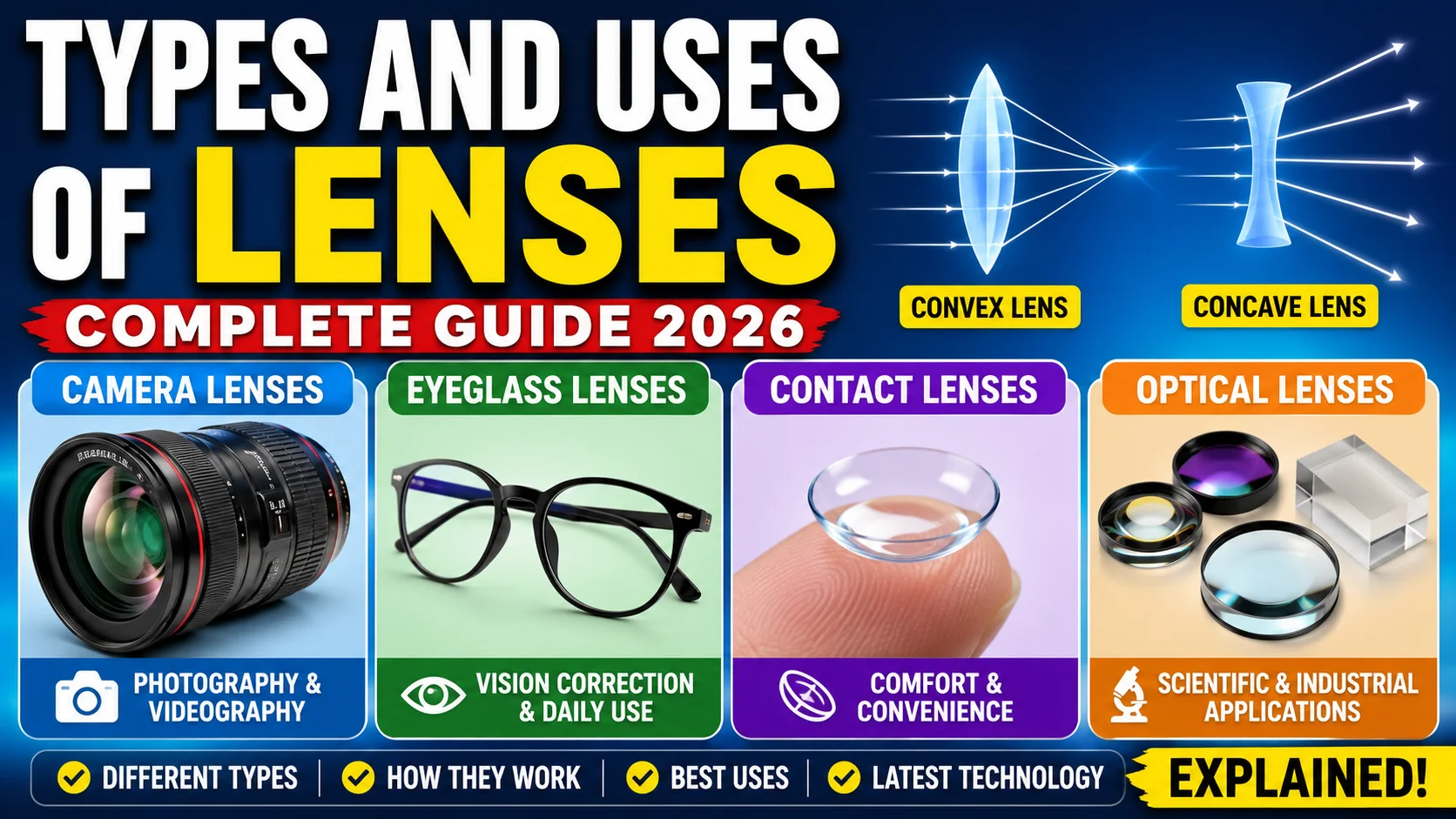
Lenses types and uses
Lenses
Lenses are among the most important optical devices used in everyday life and advanced scientific applications. In 2026, modern lens technology has become more advanced, improving photography, medicine, astronomy, education, and communication systems. A lens is a transparent object made from glass or plastic that bends light rays to form images. The ability of lenses to focus or spread light makes them essential in many industries and devices.
The growing demand for smart devices, high-quality cameras, virtual reality systems, and medical imaging has increased the importance of optical lenses in recent years. Understanding the different types and uses of lenses helps students, photographers, scientists, and technology enthusiasts appreciate how modern optical systems work efficiently in daily life.
What are Lenses?
A lens is an optical component designed to refract light in a controlled way. Lenses are commonly used in eyeglasses, microscopes, telescopes, smartphones, cameras, projectors, and many scientific instruments. The shape of a lens determines how it bends light and forms images. Lenses are divided into two basic categories: convex lenses and concave lenses. Each type has unique properties and practical uses in different fields of science and technology.
Types of Lenses
1. Convex Lens
A convex lens is thicker in the center and thinner at the edges. It is also called a converging lens because it brings light rays together at a focal point.
Uses of Convex Lenses
- Used in magnifying glasses to enlarge objects.
- Found in cameras to focus images clearly.
- Used in microscopes and telescopes.
- Helps correct farsightedness in eyeglasses.
- Commonly used in projectors and optical instruments.
2. Concave Lens
A concave lens is thinner in the center and thicker at the edges. It is known as a diverging lens because it spreads light rays outward.
Uses of Concave Lenses
- Used to correct nearsightedness in eyeglasses.
- Found in laser devices and optical instruments.
- Used in peepholes for doors to provide a wider field of view.
- Helps in scientific experiments involving light divergence.
Modern Lens Technologies in 2026
Optical technology in 2026 has significantly improved lens performance and durability. Modern lenses are now lighter, smarter, and more resistant to scratches and reflections.
- Smart Lenses: Smart lenses are advanced wearable lenses capable of monitoring health data, improving augmented reality experiences, and adjusting focus automatically. Researchers continue developing intelligent contact lenses for medical and technological applications.
- Camera Lenses: Modern smartphone and DSLR lenses now deliver ultra-high image quality with AI-assisted focusing systems and advanced stabilization technology. Professional photographers rely heavily on specialized lenses such as wide-angle lenses, telephoto lenses, and macro lenses.
- Medical Lenses: Medical technology depends on high-precision lenses in devices such as endoscopes, surgical microscopes, and diagnostic imaging systems. Contact lenses in 2026 are also more comfortable and capable of filtering harmful blue light.
Uses of Lenses in Daily Life
Lenses are essential in many daily activities and scientific fields. Their applications continue expanding as technology evolves.
- In education, lenses are used in laboratory microscopes, projectors, and educational tools that help students understand scientific concepts more effectively.
- In Photography: Professional and mobile photography rely heavily on advanced lenses to capture sharp and detailed images under different lighting conditions.
- In Astronomy: Telescopes use powerful lenses to observe stars, planets, and distant galaxies in space exploration programs.
- In Medicine: Doctors use lenses in surgical equipment, diagnostic tools, eyeglasses, and contact lenses to improve vision and healthcare services.
- In Communication Technology: Fiber optic systems and laser technologies use specialized lenses to improve data transmission and communication efficiency.
Advantages of Modern Lenses
- Improved image clarity and sharpness.
- Lightweight and durable materials.
- Better resistance to scratches and reflections.
- Enhanced low-light performance in cameras.
- Smart focusing and AI-powered optical systems.
Disadvantages of Lenses
- Some lenses can be expensive.
- Improper handling may cause scratches or damage.
- Certain lenses require regular cleaning and maintenance.
- High-powered lenses may create optical distortions if poorly designed.
Frequently Asked Questions about lenses
1. What are the main types of lenses?
The two main types of lenses are convex lenses and concave lenses. Convex lenses converge light rays, while concave lenses diverge them.
2. What are lenses used for?
Lenses are used in eyeglasses, cameras, microscopes, telescopes, medical devices, smartphones, and scientific instruments.
3. Why are convex lenses important?
Convex lenses are important because they focus light and help produce magnified or clear images in optical devices.
4. How are lenses used in modern technology?
Modern technology uses lenses in augmented reality devices, smartphone cameras, medical imaging systems, and virtual reality equipment.
5. What materials are used to make lenses?
Lenses are commonly made from glass, plastic, or specialized optical materials designed for durability and high transparency.
6. What Are the New IOL Lenses in 2026?
The new intraocular lenses (IOLs) in 2026 are more advanced than ever, offering patients improved vision quality after cataract surgery. Modern IOL lenses now include smart multifocal lenses, extended depth-of-focus (EDOF) lenses, and AI-assisted adaptive lenses that help patients see clearly at different distances with reduced dependence on glasses. Many ophthalmology clinics are using premium IOL technologies that improve night vision, reduce glare, and enhance color contrast for older adults.
Medical researchers are also developing customizable IOL lenses designed specifically for each patient’s eye structure. These next-generation eye lenses are lighter, more biocompatible, and more resistant to long-term complications. In 2026, advanced laser-assisted cataract surgery combined with modern IOL implants continues to transform eye care and vision correction technology.
7. What Do the New 2026 Glasses Look Like?
The new glasses styles in 2026 combine fashion, comfort, and smart technology. Lightweight titanium frames, transparent crystal designs, oversized retro frames, and minimalist rimless glasses are among the biggest trends this year. Smart glasses with augmented reality features and blue-light protection are also becoming increasingly popular among students, professionals, and gamers.
Eyewear brands are focusing on eco-friendly materials, flexible hinges, and ultra-thin lenses that provide both style and durability. Many modern glasses now include adaptive tint technology, allowing lenses to automatically adjust to sunlight conditions. In 2026, fashionable eyewear is designed to look modern while improving comfort for long daily use.
8. What are the Types of Lenses and Their Uses?
There are several important types of lenses used in science, medicine, photography, and everyday life. The two main optical lens types are convex lenses and concave lenses. Convex lenses are thicker in the center and help focus light rays to produce clear images, while concave lenses spread light rays outward and are commonly used to correct nearsightedness.
Modern lenses are also used in cameras, microscopes, telescopes, smartphones, projectors, and medical devices. Contact lenses help correct vision problems, while specialized camera lenses improve photography and filmmaking. In 2026, optical lens technology continues evolving with lighter materials, AI-assisted focusing systems, and improved image quality across many industries.
8. What Are the New Sony Lenses for 2026?
Sony introduced and expanded several advanced camera lenses in 2026, focusing heavily on professional photography and video production. One of the most talked-about releases is the Sony FE 100-400mm f/4.5 GM OSS, featuring faster autofocus, internal zoom design, and a constant aperture for improved image consistency during video recording.
Sony’s lens ecosystem in 2026 also supports growing demand for cinematic video production and hybrid photography. New developments focus on sharper optics, better stabilization, faster focusing motors, and compact, lightweight designs suitable for mirrorless cameras and professional creators.
Sony Lens Roadmap 2026
The Sony lens roadmap for 2026 shows continued investment in professional full-frame mirrorless lenses and APS-C camera systems. Industry rumors and photography reports suggest Sony is prioritizing high-performance telephoto zooms, compact primes, and advanced video-focused optics for content creators and filmmakers.
Sony is also improving autofocus technology using advanced XD linear motors and AI-powered tracking systems. Many photographers expect additional G Master lenses, lightweight travel lenses, and faster prime lenses to appear throughout 2026.
New Sigma Lenses 2026
Sigma launched several impressive lenses in 2026 for Sony E-mount and other camera systems. The Sigma 15mm F1.4 DC Contemporary lens provides wide-angle performance for APS-C cameras, while the Sigma 35mm F1.4 DG II Art offers improved sharpness, reduced weight, and enhanced autofocus performance.
Sigma also introduced the AF Cine Line 28-105mm T3 FF lens designed for filmmakers, combining professional cinema features with autofocus support. The company continues expanding its Art, Contemporary, and Cine lens families for photographers and video creators.
Sony Lens Rumors 2026
Sony lens rumors in 2026 mainly focus on potential new G Master telephoto lenses, compact cinema lenses, and additional fast prime lenses. Photography communities and online discussions suggest that Sony may continue improving lightweight professional zoom lenses optimized for hybrid photo and video shooting.
Rumors also mention possible updates for APS-C lenses and future video-oriented power zoom lenses that could benefit vloggers and cinematic content creators using Sony Alpha cameras.
Best Sony Lenses for Video
Some of the best Sony lenses for video production in 2026 include the Sony FE 24-70mm GM series, Sony 16-35mm PZ lenses, and Sigma AF Cine Line lenses compatible with Sony E-mount cameras. These lenses provide smooth autofocus, minimal focus breathing, excellent stabilization, and high optical sharpness for professional filmmaking.
Video creators often choose wide-angle lenses for vlogging, telephoto lenses for cinematic compression, and fast prime lenses for low-light shooting and shallow depth-of-field effects. Modern Sony-compatible video lenses are designed specifically for hybrid creators who produce both photos and cinematic videos.
New Tamron Lenses 2026
Tamron continues to release compact and affordable lenses for Sony mirrorless cameras in 2026. Many photographers appreciate Tamron lenses for their lightweight designs, versatile zoom ranges, and excellent value for money. Industry discussions suggest growing interest in updated travel zooms and wide-angle lenses optimized for modern hybrid shooting workflows.
Tamron lenses remain popular among content creators who want portable gear without sacrificing image quality or autofocus performance.
Sony F2 Lenses
Sony F2 lenses are becoming increasingly attractive for photographers and filmmakers who want a balance between brightness, portability, and sharpness. These lenses often provide excellent low-light performance while remaining smaller and lighter than larger F1.2 or F1.4 lenses.
Many Sony F2 lenses are designed for street photography, portraits, travel photography, and cinematic video production. Their compact size makes them ideal for creators using mirrorless camera systems for long shooting sessions.
Sony APS-C Lenses
Sony APS-C lenses are specifically designed for crop-sensor cameras such as the Sony Alpha A6700 series. These lenses are generally smaller, lighter, and more affordable than full-frame lenses while still offering excellent image quality. Popular APS-C lenses include wide-angle zooms, portrait primes, and travel-friendly all-in-one zoom lenses. In 2026, APS-C lens development continues growing due to increasing demand from beginner photographers, vloggers, and YouTube creators looking for compact professional camera systems.
Best Lenses for Eyes
The best lenses for eyes depend on individual vision needs and lifestyle preferences. Prescription eyeglass lenses, contact lenses, blue-light filtering lenses, and multifocal lenses are among the most commonly recommended options by eye specialists.
Modern eye lenses in 2026 now include anti-glare coatings, UV protection, scratch-resistant surfaces, and adaptive photochromic technology that changes according to lighting conditions. High-quality lenses help reduce eye strain, improve visual comfort, and support long hours of screen use in daily life.
Conclusion
Lenses continue to play a vital role in science, medicine, photography, education, and communication technologies in 2026. Advances in optical engineering have improved the quality, precision, and versatility of modern lenses, making them essential components in countless devices and systems. Understanding the types and uses of lenses provides valuable knowledge about how light and vision technologies shape the modern world.
You can subscribe to Science Online on YouTube from this link: Science Online
Types and uses of lenses in our life & special concepts related to the lenses
Uses of the concave mirror and the convex mirror in our daily life
Laws of light reflection, Plane mirrors, Spherical mirrors, Concave mirror & Convex mirror
Spherical mirror use, Properties of Images formed by Concave mirror & Convex mirror