Universe and Big Bang Review 2026: Galaxies, Milky Way, Solar System, and the Origin of the Cosmos
From the formation of galaxies to the expansion of the Universe after the Big Bang, astronomy reveals incredible scientific discoveries that continue changing our understanding of space in 2026. The Milky Way galaxy, our Solar System, and distant cosmic structures provide valuable clues about the origin and future of the Universe.
The Universe
The Universe is an enormous and fascinating space filled with galaxies, stars, planets, black holes, and mysterious cosmic phenomena. Scientists continue exploring the secrets of the cosmos in 2026 using advanced telescopes and space missions. Understanding galaxies, the Solar System, the Milky Way galaxy, and the Big Bang theory helps explain how the Universe formed and evolved over billions of years.
Each galaxy in the universe has a distinctive shape. The difference in the shapes of galaxies forms the universe because each galaxy has a distinctive shape according to the harmony and order of the groups of stars in it. Our galaxy is called the Milky Way galaxy because it appears in the sky at night as a splashing milk or spreading straw.
The vast universe is filled with millions of stars. Everything changes in the universe, where Stars always change. Galaxies get away from each other very fast, so the universe is in a state of continuous expansion. The universe is the wide and extended space that contains all the galaxies, stars, planets, moons, living organisms, and everything. The universe is very vast. The Sun and the Earth are tiny parts of the universe. The universe contains about 100,000 million galaxies.
Galaxies
Galaxies are groups of stars that rotate together in cosmic space due to the effect of gravity. They are the greatest building units that form the universe. Each galaxy has a distinctive shape according to the harmony and order of the groups of stars in it. Galaxies move away from each other as a result of their regular movement.
Galaxies gather in groups called clusters. Galaxy clusters are groups of galaxies that rotate together in cosmic space due to the effect of gravity. The galaxy to which our solar system belongs is the Milky Way galaxy. The Milky Way galaxy is given that name because it appears in the sky at night as a splashing milk or spreading straw.
Solar System
The Milky Way galaxy
It is considered one of the spiral galaxies. It contains all the stars we see at night in the sky. The Sun is a star of millions of stars that rotate around the centre of the Milky Way galaxy in fixed orbits.
In the Milky Way galaxy, the old stars (the older) gather in the centre surrounded by the small stars (the recent) and are located in the spiral arms of the galaxy.
The solar system
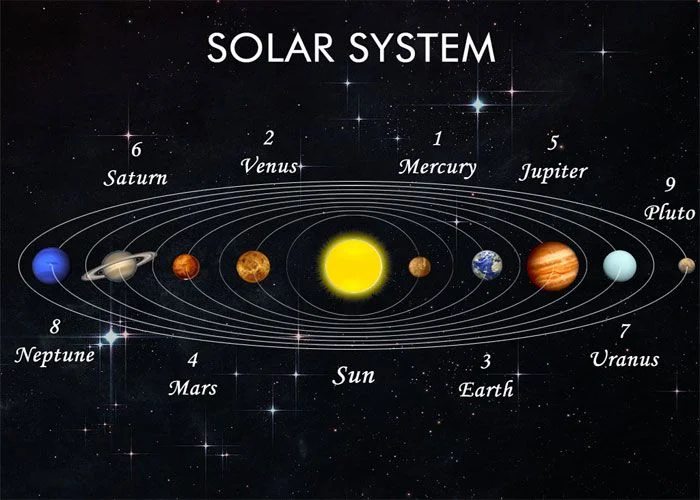
The solar system contains the Sun and eight planets revolving around the Sun. The solar system is located in one of the spiral arms of the Milky Way on the edge of the galaxy. The Sun takes about 220 million years to complete one rotation around the centre of the galaxy. The Earth is one of the planets that rotates around the Sun.
The Earth rotates in a fixed orbit due to the effect of the Sun’s gravity. The force of gravity is responsible for keeping the planets in their orbits around the Sun and the moons in their orbits around the planets, As the distance between the Sun and the planet increases. The Sun’s gravity decreases, and so the planet‘s movement around the Sun becomes slower.
When the gravity between the Sun and the planets vanishes, the planets will leave their orbits and float randomly in space, and therefore, there will be no solar system.
Measuring the distances between the celestial bodies in the universe
The distances between celestial bodies (such as stars) are very large, so the distances in space are not measured in kilometres, but they are measured in a unit called a light year. Astronomers don’t measure the distances between stars in kilometres because the distances between stars are very large.
A light-year is a distance covered with light in one year, and it equals 9.46 × 10¹² km. The speed of light equals 300 000 km/sec., so the distance covered with light in one year = 300 000 x (365 days x 24 hours x 60 min. x 60 sec. )= 9460800 million km = 9.46 x 10¹² km.
When the distance between the Sun and a certain star is three light-years. This means that the distance between the Sun and this star = 3 x 9.46 x 1012 = 28.38 x 10¹² km.
Expansion of the universe
Distances between galaxies increase as time passes, as galaxies move away from each other in the cosmic space. This phenomenon is known as the “Expansion of the universe”. Expansion of the universe is the continuous separation between galaxies in space as a result of their regular movement. The continuous expansion of space (the universe) is due to the movement of galaxies apart.
The origin of the universe
How did the universe originate…?
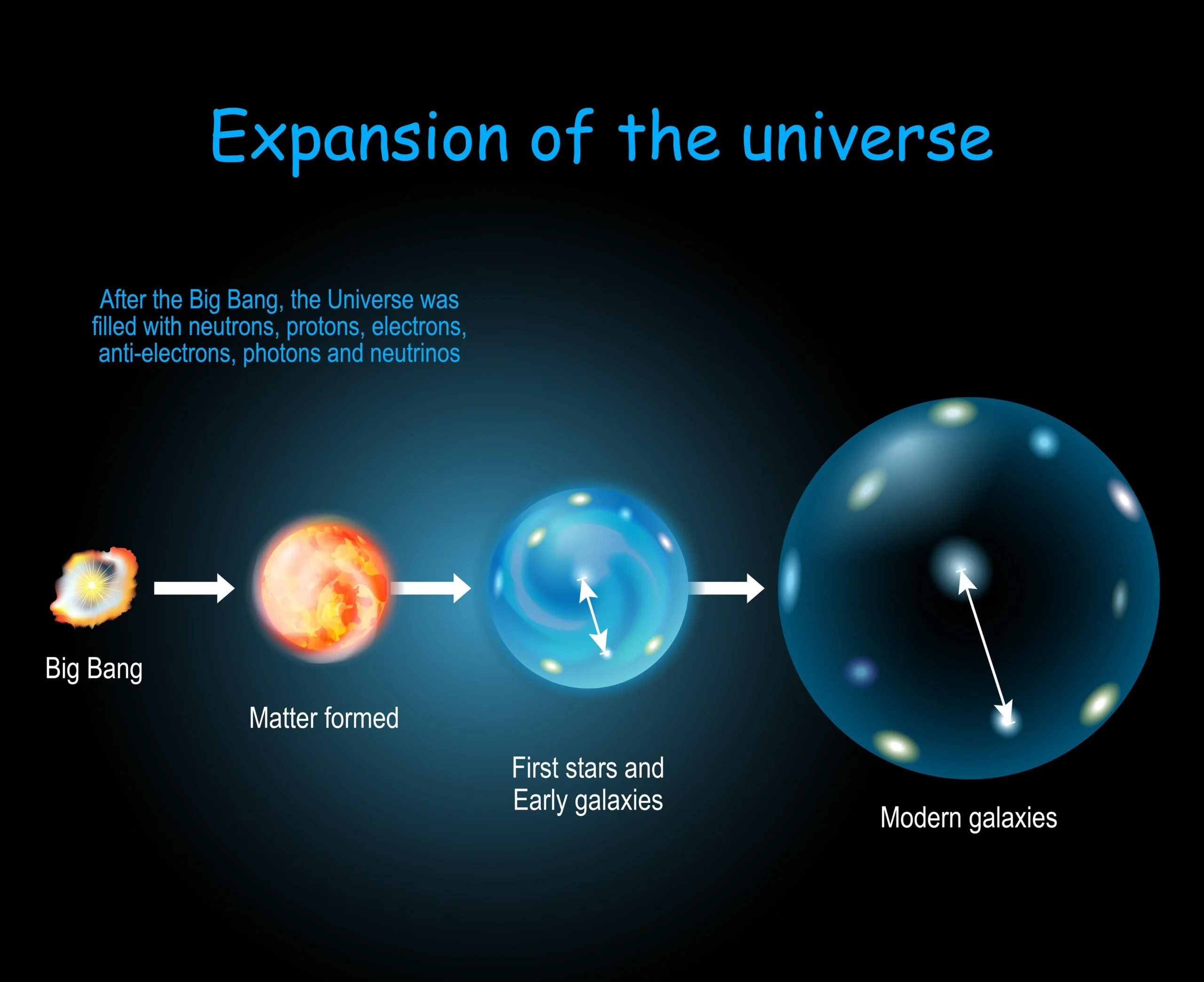
There was no one to relate what happened, but the discoveries in physics and astronomy enabled scientists to trace the history of the universe from the first second fraction of its evolution. Many scientists believe that the universe emerged from a massive explosion called the Big Bang.
Big Bang
The Big Bang Theory [1933]
The Big Bang theory assumed that:
- The beginning of the universe was a gaseous ball of high pressure, high temperature, and small volume.
- A massive explosion occurred in this ball for 15000 million years, and its components were scattered in space, followed by continuous expansion and changing processes till now.
- As a result of this explosion, all forms of matter. energy, space, and time.
Big Bang is a theory that explains the origin of the universe from a massive explosion of 15000 million years and resulted in it all forms of matter, energy, time, and space, followed by continuous expansion and changing processes.
Stages of the origin of the universe since the moment of the Big Bang:
- Through the Big Bang: The gaseous ball from which the universe originated exploded, and the process of expansion and change started.
- Within minutes after the explosion: The temperature becomes about 10000 million degrees. The atomic particles produced from the explosion merged together, producing gaseous clouds of hydrogen and helium with a percentage of 75%: 25%, respectively. These gases produce the galaxies, stars, and universe over millions of years.
- After about 1000 million years, the previously formed matter merged into masses.
- After about 2000- 3000 million years, Gravity helped in gathering more masses, forming Ancestral galaxies, leaving areas of empty space between them.
- After about 3000 million years, Galaxies began to form.
- After about 5000 million years, our galaxy, the Milky Way, took its disc form.
- After about 10000 million years, the Sun was born, then the Earth and planets were created.
- After about 12000 million years, the earliest life forms began to appear on Earth.
- After about 15000 million years, the universe is as it is now.
In 1964, scientists Robert Wilson and Arno Penzias coincidentally discovered radio waves coming from space. They concluded that these waves are a type of echo of the Big Bang, which is still present in the universe. TV sets can receive such signals (waves) on the Earth. These scientists have won the Nobel Prize for physics in recognition of their discovery.
FAQ About the Universe, Galaxies, and the Big Bang
1. What is the Universe?
The Universe includes everything that exists, including galaxies, stars, planets, matter, energy, space, and time.
2. What are galaxies?
Galaxies are massive systems made of stars, gas, dust, planets, and dark matter held together by gravity.
3. What is the Milky Way galaxy?
The Milky Way is the galaxy that contains Earth and the entire Solar System. It is a spiral galaxy with billions of stars.
4. How big is the Milky Way galaxy?
The Milky Way is estimated to be about 100,000 light-years wide.
5. What is the Solar System?
The Solar System consists of the Sun and all objects orbiting around it, including planets, moons, asteroids, and comets.
6. How many planets are in the Solar System?
There are eight major planets in the Solar System: Mercury, Venus, Earth, Mars, Jupiter, Saturn, Uranus, and Neptune.
7. What is the Big Bang theory?
The Big Bang theory explains that the Universe began from an extremely hot and dense state around 13.8 billion years ago and has been expanding ever since.
8. What happened during the Big Bang?
The Universe rapidly expanded, cooled down, and formed particles, atoms, stars, and galaxies over billions of years.
9. What are the stages of the Big Bang?
- Initial Singularity: The Universe existed in an extremely tiny, hot, and dense state.
- Cosmic Inflation: A rapid expansion occurred within a fraction of a second after the Big Bang.
- Formation of Particles: Subatomic particles such as protons and neutrons formed as the Universe cooled.
- Formation of Atoms: Hydrogen and helium atoms formed several hundred thousand years later.
- Formation of Stars and Galaxies: Gravity pulled matter together to form stars, galaxies, and galaxy clusters.
- Expansion of the Modern Universe: The Universe continues expanding today, and scientists study dark matter and dark energy to understand its future.
10. Why is the Universe expanding?
Astronomers discovered that galaxies are moving away from each other due to the expansion of space itself.
11. What is dark matter?
Dark matter is an invisible form of matter believed to make up a large portion of the Universe’s mass.
12. What is dark energy?
Dark energy is a mysterious force thought to accelerate the expansion of the Universe.
13. How do scientists study the Universe?
Scientists use telescopes, satellites, space probes, radio signals, and computer simulations to study space and cosmic evolution.
14. Why is studying space important?
Space research improves scientific understanding, technological development, satellite communication, and future space exploration.
Conclusion
The Universe remains one of the greatest mysteries in science. Research about galaxies, the Milky Way galaxy, the Solar System, and the Big Bang continues helping humanity understand the origins of space, matter, and life itself. In 2026, modern astronomy and advanced technologies are opening new doors for discovering the secrets of the cosmos.
You can subscribe to Science Online on YouTube from this link: Science Online
Nebular theory, Crossing star theory, Modern theory, Solar telescope and Hubble telescope
Stars, Galaxies, Solar system, Planets, Moons, Asteroids, Meteors, Meteorites & Comets
Fundamental Forces in nature, Gravitational forces, Electromagnetic forces & Nuclear forces