Wave motion examples & types of waves, Can waves carry energy?, What determines the speed of a wave?
Wave motion is an example of periodic motion. The wave is a disturbance that propagates and transfers energy in the direction of the propagation. You notice that the concentric circles propagate on the water surface when you throw a stone in the water. This motion represents wave motion.
Wave motion
The wave motion is the motion produced as a result of the vibration of the medium particles at a certain moment, and in a definite direction. The line of the wave propagation is the direction through which the wave propagates.
In the wave motion, the medium particles do not move from their positions. Still, they vibrate only, and the wave propagates carrying the energy in the same direction of its propagation.
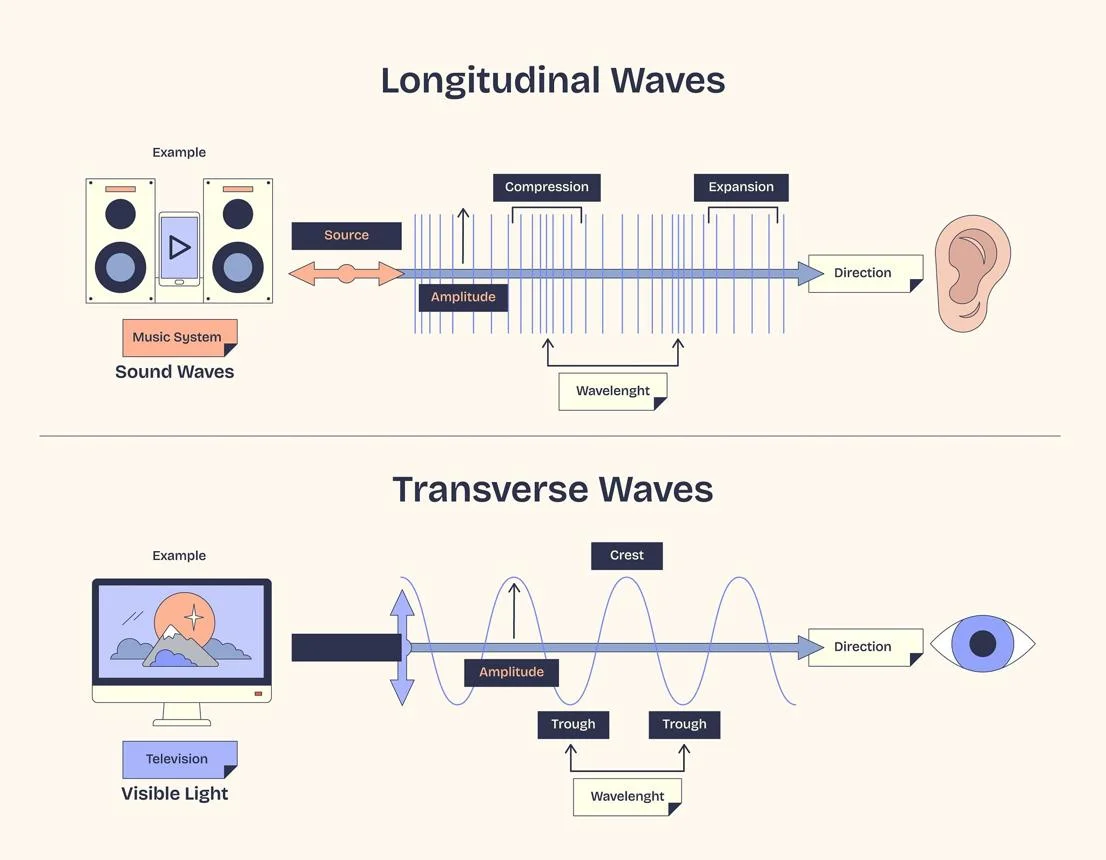
Transverse waves and longitudinal waves
Types of waves
The waves are classified according to the direction of vibration of the medium particles relative to the direction of propagation into transverse waves and longitudinal waves.
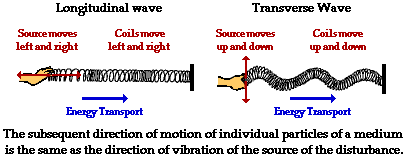
Transverse waves and longitudinal waves
The waves are classified according to their ability to propagate and transfer energy into mechanical waves and electromagnetic waves.
The subsequent direction of the motion of individual particles of the medium is the same as the direction of vibration of the source of the disturbance.
FAQs about Wave Motion
1. What is wave motion?
Wave motion is the transfer of energy from one place to another without the transfer of matter.
2. What are the main characteristics of waves?
Waves are described by:
- Wavelength.
- Frequency.
- Amplitude.
- Wave speed.
3. Does wave motion transfer matter?
No, wave motion transfers energy, not matter. The particles only vibrate around their positions.
Examples of Wave Motion
- Water Waves: Waves moving across the surface of water. Example: ocean waves or ripples in a pond.
- Sound Waves: Waves that travel through air (or other media). Example: human speech and music.
- Light Waves: Electromagnetic waves that can travel through a vacuum. Example: sunlight.
- Seismic Waves: Waves produced by earthquakes. Travel through Earth.
FAQs about Types of Waves
4. What are the main types of waves?
There are two main types:
- Mechanical waves.
- Electromagnetic waves.
Mechanical Waves
5. What are mechanical waves?
Mechanical waves require a medium (solid, liquid, or gas) to travel through.
6. What are examples of mechanical waves?
- Sound waves.
- Water waves.
- Seismic waves.
7. What are the types of mechanical waves?
- Transverse waves: particles move perpendicular to the wave direction.
- Longitudinal waves: particles move parallel to the wave direction.
Electromagnetic Waves
8. What are electromagnetic waves?
They are waves that do not need a medium and can travel through space.
9. What are examples of electromagnetic waves?
- Radio waves.
- Microwaves.
- Visible light.
- X-rays.
10. What is the difference between mechanical and electromagnetic waves?
Mechanical waves require a material medium (solid, liquid, or gas) to travel and cannot move through space. In contrast, electromagnetic waves do not need a medium and can travel through a vacuum, such as light from the Sun reaching Earth.
11. What is a transverse wave?
A wave in which particles move perpendicular to the direction of propagation (e.g., light waves).
12. What is a longitudinal wave?
A wave in which particles move parallel to the direction of propagation (e.g., sound waves).
13. What determines the speed of a wave?
Wave speed depends on the type of wave and the properties of the medium.
14. Can waves carry energy?
Yes, all waves carry energy from one place to another.
You can subscribe to Science Online on YouTube from this link: Science Online
Properties of Mechanical waves and Electromagnetic waves
Properties of electromagnetic waves and Light reflection
X-rays properties, uses and method of obtaining X-rays by using Coolidge tube
Mechanical waves and some technological applications of sound mechanical waves