
Nebular theory, Crossing star theory, Modern theory, Solar telescope and Hubble telescope
The continuous expansion of cosmic space is due to the movement of galaxies apart, Planets revolving around the Sun in fixed orbits, and the stability of the Earth rotation in an orbit around the Sun due to the Sun gravity, There are many scientific and philosophical theories about the evolution of the solar system, They are about twenty theories, and they are still unproved & subjected to change.
The Nebular theory: [Laplace 1796]
In 1796, the French scientist Pierre Simon Laplace published research entitled World Order. This research included a perception of Laplace about the evolution of the solar system, This perception has been affected by two observations, which are:
- There are clouds or nebula in space.
- Space contains many cloudy rings surrounding some planets, such as the rings of the Saturn planet.
Assumptions of Nebular Theory
It assumed that the origin of the solar system was the nebula, and the three phases of nebular theory:
- The contraction of the nebula (gaseous sphere): The solar system originated from a glowing gaseous sphere revolving around itself, this sphere is called a nebula. Over time, the nebula lost its heat gradually, so its size contracted and its revolving speed around itself (its axis) increased.
- Formation of the gaseous rings: The centrifugal force arising from the rotation of the nebula around its axis led to the nebula losing its spherical shape and became in a form of a flat rotating disk, and the separation of parts of the nebula in the form of gaseous rings, that also rotate around the remaining flaming mass and in the same direction.
- Formation of the solar system: The gaseous rings cooled down and froze forming the planets of the solar system, while the flaming mass that remained in the centre formed the “Sun“.
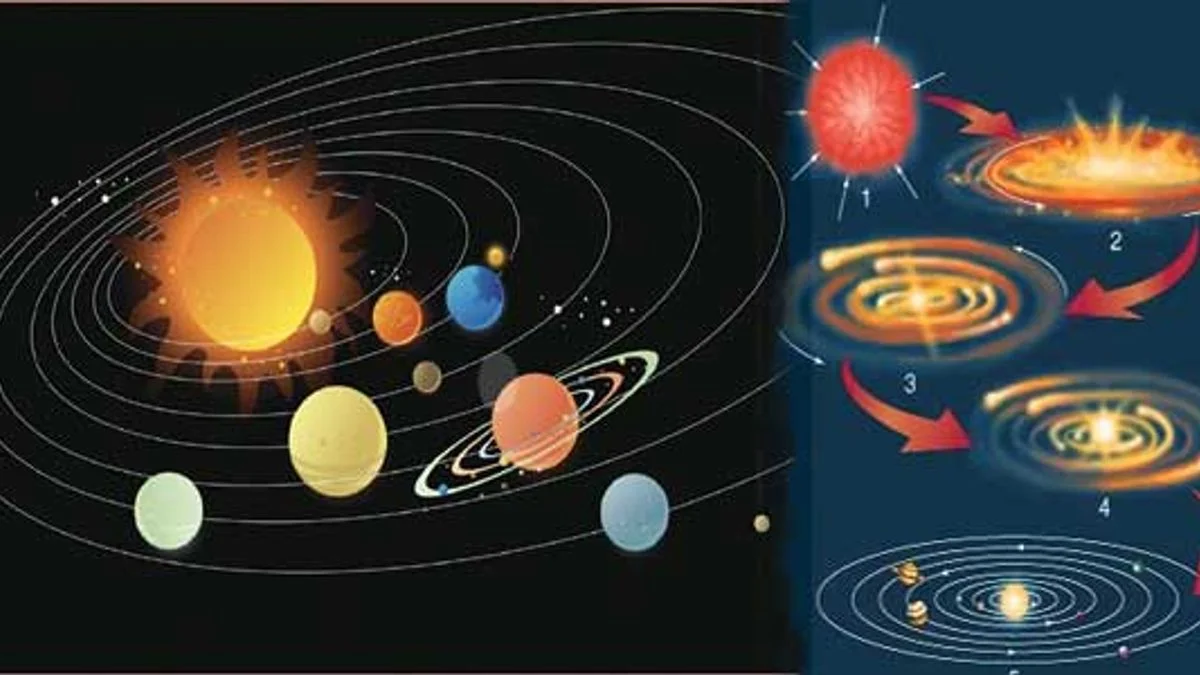
Nebular Theory
Nebula is a glowing gaseous sphere revolving around itself, from which the solar system originated. The nebula lost its sphere form and became in a form of a flat rotating disk due to the effect of centrifugal force that resulted from the rotation of the nebula around itself.
The Crossing Star Theory: [Chamberlain and Moulton 1905)
Assumptions of the crossing star theory: It assumed that the origin of the solar system was a big star which is the Sun.
- Another huge star (crossing stars) approached the Sun, and the star attracted the Sun to it, leading to a great expansion in the part of the Sun-facing it.
- The expanded part from the Sun was exploded leading to: The Sun escaped from the gravity of that star, A gaseous line was formed of a great length from the Sun until the last planets (which will be formed later), the gaseous line started to condense due to the attraction force, then it cooled forming the planets.
The Sun escaped from the gravity of the huge star in the crossing star theory due to the explosion in the expanded part of the Sun that faces the huge star.
Modern theory of the world: [ Fred Hoyle 1944]
Fred Hoyle builds his theory on the origin of the solar system on the basis of a well-known astronomical phenomenon known as the Stars explosion phenomenon.
Stars explosion phenomenon
Glowing a star for a short time to become one of the most shining stars in the sky, then its glowing disappears gradually to return as it was. The interpretation of this phenomenon is not known specifically until now, the following is an attempt to interpret this phenomenon:
- Sudden violent nuclear reactions occur within the star which led to its explosion.
- The star bombs huge amounts of gaseous materials as a result of this explosion which led to increasing its size and its shining.
- When the bombed gases are cooled, the shining of the star returned as it was.
Assumptions of modern theory (Fred Hoyle)
It assumed that the origin of the solar system was a star rather than the Sun.
- A star was rotating near the Sun, and the star exploded due to huge nuclear reactions, The force of the explosion led to the bombing of the star’s nucleus away from the gravity of the Sun, and a gaseous cloud from this star remained around the Sun.
- The gaseous cloud is subjected to cooling and contraction processes forming the matter of planets, then the attraction force of the Sun controlled the orbits of planets around it.
The explosion of some stars suddenly due to the occurrence of sudden and violent nuclear reactions.
Important instruments to study outer space
The solar telescope
Astronomers use special equipment centered on the Earth as the solar telescope to study the Sun, or carried into space as Hubble telescope.
Importance of solar telescope: It forms a complete picture of the Sun.
How does the solar telescope work…?
- It works on reflecting the Sun rays downward to a concave mirror in a tunnel under the Earth’s surface. The sunlight is gathered, then separated into a solar spectrum by the spectrometer (this shows the different light wavelengths emitted by the Sun).
- A complete picture of the Sun is formed in a monitoring room where astronomers can study its light, Astronomers got most of their information about the Sun from the study of its spectra.
The Hubble telescope
The Hubble telescope was launched in April in 1990, and it rotates around the Earth at a height of 500 km.
Importance of Hubble telescope
It collects photos of the universe that give us details about its state since millions of years, these photos allow astronomers to study the evolution of the universe after the Big Bang.
FAQ About Nebular Theory, Crossing Star Theory, Modern Theory
Nebular Theory (Kant–Laplace Hypothesis)
What is the Nebular Theory?
The Nebular Theory says the Sun and planets formed from a huge rotating cloud of gas and dust (a nebula) that collapsed under gravity. The center became the Sun; the surrounding disk formed planets.
Who proposed the Nebular Theory?
Immanuel Kant and Pierre-Simon Laplace (18th century).
What does the Nebular Theory explain well?
- Flat, disk-like layout of the solar system
- Planets orbiting in nearly the same plane and direction
What are its limitations?
Early versions couldn’t fully explain how planets gained their angular momentum or how some irregular moons formed.
Crossing Star Theory (Passing/Encounter Theory)
What is the Crossing Star Theory?
It suggests a star passed close to the Sun, pulling out hot solar material that later cooled and condensed into planets.
Who proposed it?
Sir James Jeans and Harold Jeffreys (early 20th century).
Why is this theory mostly rejected today?
- Close stellar encounters are extremely rare.
- Hot gas would likely disperse instead of forming planets.
- Doesn’t match observed planet formation around other stars.
Modern Theory (Modern Nebular / Protoplanetary Disk Model)
What is the Modern Theory of the solar system’s formation?
The Modern Theory updates the nebular idea using physics and observations: a collapsing solar nebula formed the Sun, while a protoplanetary disk formed planets by accretion (small particles sticking together).
Why is the Modern Theory widely accepted?
- We observe protoplanetary disks around young stars.
- Computer models match planet formation.
- Explains orderly orbits and disk shape.
Are there open questions?
Yes—details of gas-giant formation speed, planet migration, and irregular moons are active research areas.
Solar Telescope (Observing the Sun)
What is a solar telescope?
A solar telescope is specially designed to observe the Sun safely using filters that block harmful radiation.
What can solar telescopes study?
- Sunspots.
- Solar flares.
- Prominences.
- Surface features in H-alpha or other wavelengths.
Why are special filters necessary?
Direct sunlight can damage eyes and instruments. Solar filters reduce intensity and isolate safe wavelengths.
Why are solar telescopes important?
They help scientists monitor space weather, which affects satellites, GPS, radio communication, and power grids on Earth.
Hubble Space Telescope (Deep Space Observatory)
What is the Hubble Space Telescope?
Hubble is a space telescope orbiting Earth above the atmosphere, giving ultra-clear views of distant galaxies, nebulae, and stars.
Why is Hubble important?
- Measured the expansion rate of the universe.
- Revealed details of galaxies, nebulae, and exoplanet atmospheres.
- Provided iconic deep-field images.
How is Hubble different from ground telescopes?
No atmospheric blur → sharper images and access to wavelengths absorbed by Earth’s atmosphere.
Is Hubble still useful today?
Yes—alongside newer telescopes, Hubble continues to deliver valuable science and long-term observations.
Nebular vs Crossing Star vs Modern Theory — what’s the difference?
- Nebular (classical): Early idea of formation from a rotating nebula.
- Crossing Star: Planets formed from material pulled from the Sun by a passing star (largely rejected).
- Modern Theory: Evidence-based nebular model with protoplanetary disks and accretion (widely accepted).
Solar Telescope vs Hubble Telescope — key difference?
- Solar Telescope: Studies the Sun in detail (with special filters).
- Hubble: Studies deep space (galaxies, nebulae, stars) from orbit.
You can subscribe to Science Online on YouTube from this link: Science Online
Universe, Galaxies, Milky Way galaxy, Solar System, Origin of Universe & Stages of Big Bang
Stars, Galaxies, Solar system, Planets, Moons, Asteroids, Meteors, Meteorites & Comets
Fundamental Forces in nature, Gravitational forces, Electromagnetic forces & Nuclear forces