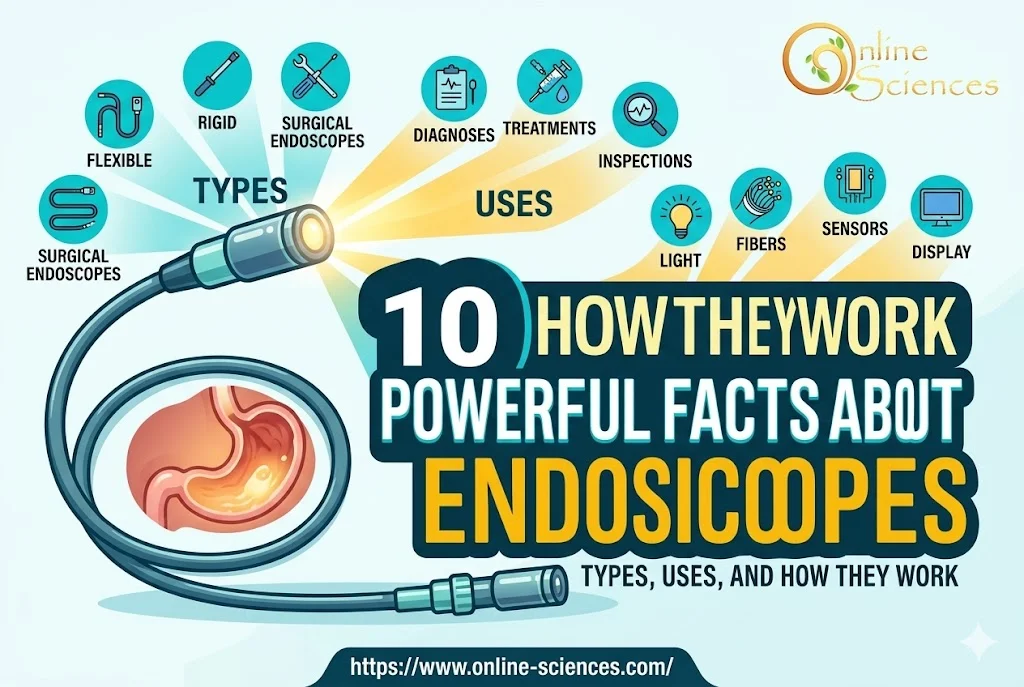
10 Shocking Facts About Endoscopes: Types, Uses, and How They Work
Endoscopes are advanced medical devices that allow doctors to visualize internal organs and body cavities with high precision. While an endoscope is an instrument equipped with a camera and light, endoscopy is the procedure performed with that device. Together, they play a crucial role in diagnosing diseases, obtaining biopsies, and performing minimally invasive treatments with greater safety and accuracy.
Endoscopes
What are Endoscopes?
Endoscopes are specialized medical instruments used to examine the inside of the human body without the need for large surgical incisions. They consist of a long, flexible or rigid tube equipped with a light source and a camera that transmits images to a monitor. Physicians use endoscopes to diagnose diseases, investigate symptoms, and perform minimally invasive treatments.
Modern endoscopes have revolutionized healthcare by allowing doctors to view internal organs with exceptional clarity while reducing patient discomfort, recovery time, and surgical risks. They are widely used in gastroenterology, pulmonology, urology, gynecology, and many other medical specialties.
What is an Endoscope Used For?
An endoscope is used for a variety of diagnostic and therapeutic procedures, including:
- Examining the digestive tract.
- Detecting ulcers and inflammation.
- Diagnosing cancers and tumors.
- Investigating unexplained bleeding.
- Taking tissue biopsies.
- Removing polyps.
- Treating blockages.
- Examining the respiratory system.
- Evaluating joint conditions.
- Performing minimally invasive surgeries.
Because endoscopes provide direct visualization of internal structures, they often help doctors make faster and more accurate diagnoses.
What is Endoscopy Used For?
Endoscopy is the medical procedure performed using an endoscope. It enables healthcare providers to inspect organs and body cavities in real time.
Common reasons for endoscopy include:
Diagnostic Purposes
- Persistent abdominal pain.
- Chronic heartburn.
- Difficulty swallowing.
- Gastrointestinal bleeding.
- Chronic cough.
- Suspicion of cancer.
Therapeutic Purposes
- Removal of foreign objects.
- Treatment of bleeding ulcers.
- Removal of polyps.
- Placement of stents.
- Surgical interventions through natural body openings.
Endoscopy often eliminates the need for more invasive exploratory surgeries.
Endoscope Definition in Medical Terms
In medicine, an endoscope is a medical imaging instrument consisting of a tube, optical system, illumination source, and camera designed to visualize internal organs, tissues, and body cavities for diagnostic or therapeutic purposes.
How Endoscopes Work
Understanding how endoscopes work helps explain why they have become essential tools in modern medicine.
Components of an Endoscope
- Insertion Tube: The tube is inserted into the body through natural openings or small incisions.
- Light Source: A powerful LED or fiber-optic light illuminates internal tissues.
- Camera System: A miniature high-definition camera captures images and videos.
- Control Handle: Allows physicians to maneuver the tip of the endoscope.
- Working Channels: Special channels permit the insertion of instruments for biopsy, cutting, suction, or treatment.
Working Principle
The camera at the tip captures images from inside the body. These images travel electronically to a monitor where doctors can view structures in real time. Advanced systems can zoom, magnify, and record procedures for future analysis.
Endoscope Camera Technology
The endoscope camera is one of the most important parts of modern endoscopic systems.
Recent advances include:
- High-definition imaging.
- 4K video technology.
- Narrow-band imaging.
- Digital magnification.
- Fluorescence imaging.
- AI-assisted lesion detection.
These innovations help physicians identify abnormalities that may be difficult to detect with conventional imaging methods.
Types of Endoscope
There are numerous types of endoscopes designed for specific body regions.
- A gastroscope is used to examine the esophagus, Stomach, and upper small intestine. It is commonly used during upper gastrointestinal endoscopy.
- A colonoscope is used to inspect the colon and rectum. It is often used for colorectal cancer screening.
- A bronchoscope is used to evaluate the trachea, Bronchi, and Airways. It helps diagnose lung diseases and respiratory infections.
- A cystoscope is used for examining the bladder and urethra. It is frequently employed in urology.
- An arthroscope is used for inspecting knee joints, shoulder joints, and other joints. It allows minimally invasive orthopedic surgery.
- A laparoscope is inserted through small abdominal incisions to examine the liver, gallbladder, appendix, and reproductive organs. It is widely used in minimally invasive surgery.
What are the Three Main Types of Endoscopy?
Although many specialized procedures exist, three commonly performed types include:
- Upper Endoscopy (EGD): Examines the esophagus, stomach, and duodenum.
- Colonoscopy: Examines the large intestine and rectum.
- Bronchoscopy: Examines the respiratory tract and lungs.
These procedures represent some of the most frequently performed endoscopic examinations worldwide.
Endoscope Instrument Components
A complete endoscope instrument system typically includes:
- Camera: Captures images.
- Light Source: Illuminates tissues.
- Fiber Optics: Transmits light.
- Display Monitor: Shows images.
- Control Unit: Operates the scope.
- Biopsy Forceps: Collects tissue samples.
- Suction Channel: Removes fluids.
- Irrigation System: Cleans viewing area.
Endoscope Medical Applications
Endoscopes are used in many medical specialties:
Gastroenterology
- Ulcer diagnosis.
- Colon cancer screening.
- Polyp removal.
Pulmonology
- Lung examination.
- Airway obstruction assessment.
Urology
- Bladder evaluation.
- Stone treatment.
Gynecology
- Uterine examinations.
- Fertility investigations.
Orthopedics
- Joint surgeries.
- Ligament repair.
General Surgery
Minimally invasive procedures.
What is an Endoscope in Physics?
In physics and optical engineering, an endoscope is an imaging device that uses lenses, fiber optics, and illumination systems to transmit visual information from inaccessible locations to an observer.
The technology relies on:
- Optical reflection.
- Fiber-optic transmission.
- Digital image sensors.
- Light propagation principles.
These physical principles enable clear imaging inside the human body and industrial systems.
Advantages of Endoscopes
Modern endoscopes provide several benefits:
- Improved Diagnosis: Doctors can directly observe internal structures.
- Minimally Invasive: Smaller incisions mean less trauma.
- Faster Recovery: Patients typically recover more quickly.
- Reduced Risk: Lower infection and complication rates.
- Greater Accuracy: High-definition imaging improves diagnostic precision.
Risks and Limitations
Although generally safe, endoscopy may involve:
- Bleeding.
- Infection.
- Perforation of organs.
- Reactions to sedation.
- Temporary discomfort.
Serious complications are relatively rare when performed by trained specialists.
Endoscope vs Endoscopy: What’s the Difference?
Many people use the terms endoscope and endoscopy interchangeably, but they actually refer to two different things. An endoscope is the medical instrument itself—a flexible or rigid tube equipped with a light source and a camera that allows doctors to see inside the body. An endoscopy, on the other hand, is the medical procedure performed using that instrument to examine, diagnose, or treat various conditions.
For example, during a colonoscopy, the doctor uses a specialized endoscope called a colonoscope to inspect the large intestine. In simple terms, the endoscope is the tool, while endoscopy is the process of using that tool. Understanding this distinction helps patients better comprehend medical procedures and the technology involved in modern minimally invasive healthcare.
Simply put, the endoscope is the tool, while endoscopy is the procedure performed using that tool.
Future of Endoscope Technology
Emerging technologies are transforming endoscopy:
- Artificial intelligence-assisted diagnosis.
- Capsule endoscopy.
- Robotic endoscopes.
- Ultra-thin flexible scopes.
- 3D imaging systems.
- Wireless imaging devices.
These innovations are expected to improve accuracy, comfort, and treatment outcomes.
Conclusion
Endoscopes have become indispensable tools in modern medicine, enabling physicians to diagnose and treat diseases with remarkable precision and minimal invasiveness. From gastrointestinal examinations and lung inspections to joint surgeries and bladder evaluations, endoscopic technology continues to improve patient care. As innovations such as AI-assisted imaging, robotic systems, and capsule endoscopy advance, endoscopes will play an even greater role in the future of healthcare.
Frequently Asked Questions (FAQ) about Endoscopes
1. What is an endoscope used for?
An endoscope is used to examine internal organs, diagnose diseases, collect biopsies, remove polyps, and perform minimally invasive treatments.
2. What is endoscopy used for?
Endoscopy is used to investigate symptoms, diagnose conditions, monitor diseases, and perform therapeutic procedures without major surgery.
3. What are the three types of endoscopy?
The most common types are upper endoscopy (EGD), colonoscopy, and bronchoscopy.
4. What’s the difference between endoscopy and endoscope?
An endoscope is the instrument used for viewing internal organs, while endoscopy is the procedure performed using that instrument.
5. Are endoscopic procedures painful?
Most endoscopic procedures involve sedation and cause little to no pain, although mild discomfort may occur.
6. What is an endoscope camera?
An endoscope camera is a miniature imaging device attached to the endoscope that captures real-time images from inside the body.
7. How does an endoscope work?
It uses a light source and camera to transmit images from inside the body to a monitor, allowing physicians to visualize internal structures.
8. What are the major types of endoscopes?
Major types include gastroscopes, colonoscopes, bronchoscopes, cystoscopes, arthroscopes, and laparoscopes.
Shocking Facts About Endoscopes
Endoscopes are essential medical instruments that have revolutionized the diagnosis and treatment of many diseases by allowing doctors to see inside the body without making large surgical incisions. They provide clear, real-time images of internal organs such as the stomach, intestines, lungs, bladder, and joints, helping physicians detect ulcers, tumors, inflammation, bleeding, and infections at an early stage. Early diagnosis improves treatment success, reduces complications, and can save lives by identifying serious conditions before they become more advanced.
The importance of endoscopes extends beyond diagnosis, as they are also used in many minimally invasive medical procedures. Doctors can remove polyps, stop internal bleeding, collect tissue samples, perform biopsies, remove foreign objects, and even perform certain surgeries using an endoscope. These procedures usually result in smaller wounds, less pain, faster recovery, shorter hospital stays, and a lower risk of infection compared with traditional open surgery. As endoscopic technology continues to advance with high-definition imaging and AI-assisted systems, endoscopes are becoming even more accurate and effective in improving patient care.
Endoscopes are one of the most important medical inventions, allowing doctors to examine the inside of the human body without major surgery. Using a tiny camera and a flexible or rigid tube, endoscopes help diagnose and treat conditions affecting the digestive system, respiratory tract, urinary system, joints, and more. Endoscopes have transformed modern healthcare by making procedures safer, faster, and less invasive.
You can subscribe to Science Online on YouTube from this link: Science Online
Common procedures of Interventional Radiology and the best Interventional Radiologists
Interventional radiology types, Robotic endovascular systems advantages and disadvantages
Cone beam CT vs. Fan beam CT, CBCT advantages, disadvantages and uses
Magnetic Resonance Imaging (MRI) uses, advantages and disadvantages
Computed Tomography (CT) types, uses, advantages and disadvantages
Artificial intelligence in radiology decision support systems, Medical Imaging and Healthcare
Enlarged prostate symptoms, Prostatic artery embolization (PAE) importance and risks
Hepatic Artery Embolization, Importance and risks of Embolization therapy for Liver cancer
Thyroid nodules, Thyroid Fine Needle Aspiration Biopsy importance and risks
Uterine fibroid embolization risks, importance and Minimally invasive procedure specialists
Advantages and Disadvantages of Using Interventional Radiology in Pain Management