Matter, Mixture Types, Properties, Formation and Separation: Amazing Guide to Matter 2026
Atmospheric air is a mixture of different gases such as oxygen, nitrogen, carbon dioxide, and water vapour. A solution is a special type of mixtures. where its components are mixed and interfere till you can not distinguish between its particles.
Types of matter
Matter can be classified into pure substances and mixtures. A pure substance is a substance that is made of only one type of identical particles, such as distilled (pure) water, sugar, and baking soda.
A mixture is a substance that consists of more than one type of particles, such as concrete, tomato sauce, and mineral water (a mixture of water and some useful minerals such as calcium and magnesium).
Both sugar and distilled water are considered pure substances because each of them is composed of only one type of identical particles. Both milk and concrete are considered mixtures because each of them consists of more than one type of particles.
Types of mixtures
Types of mixtures
There are many different types of mixtures, such as Solid-solid mixture, Liquid-liquid mixture, Solid-liquid mixture, Gaseous-Gaseous mixture, and Gaseous-liquid mixture.
- A solid-solid mixture consists of two or more different solid matter such as fruit salad and vegetable salad.
- The liquid-liquid mixture consists of two or more different liquids, such as a mixture of vinegar and water, a mixture of oil and water, and a mixture of oil and vinegar (dressing of salad).
- The solid-liquid mixture consists of solid and liquid matter, such as a mixture of sand and water, a mixture of salt and water.
- The gaseous-gaseous mixture consists of different gases, such as atmospheric air, which is a mixture of oxygen gas, nitrogen gas, carbon dioxide gas, and water vapour.
- The gaseous-liquid mixture consists of gaseous and liquid matter, such as a mixture of soda water that is produced from dissolving carbon dioxide gas in sugar solution.
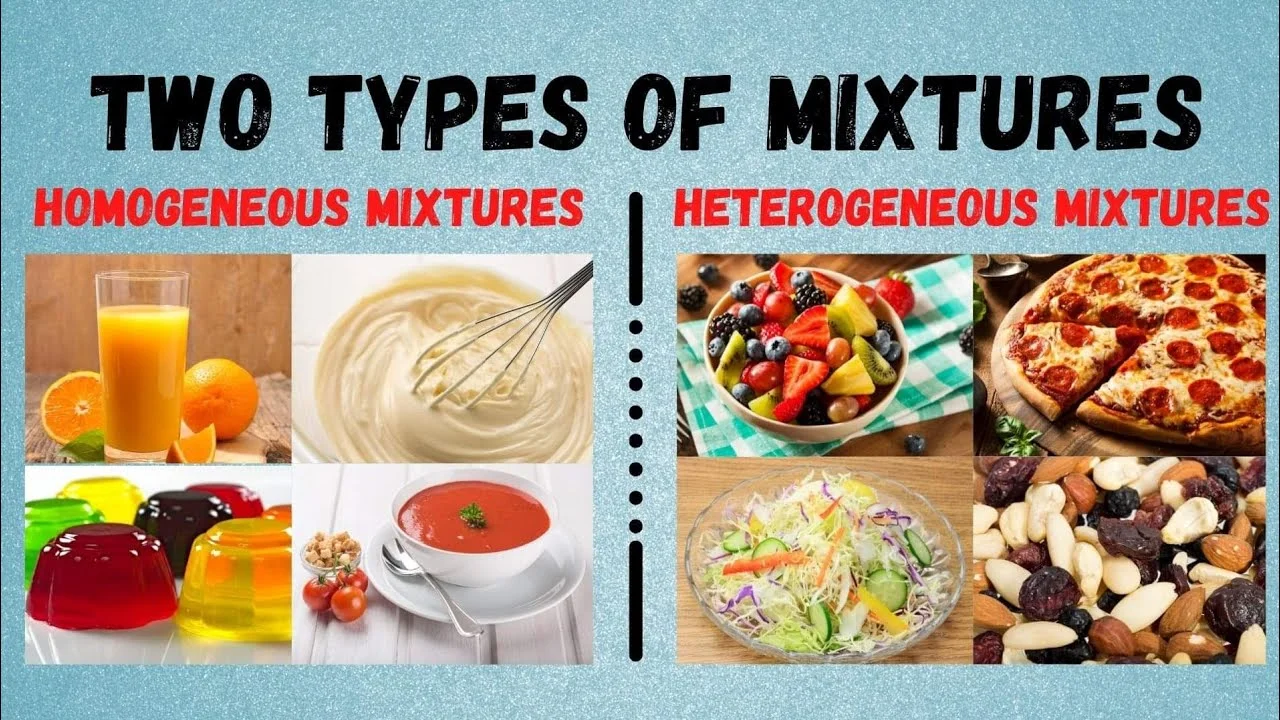
Mixtures can be separated by physical methods, such as filtration, distillation, or evaporation, without changing the chemical nature of the components. There are two main types of mixtures, which are:
1. Homogeneous Mixtures
The individual components cannot be seen separately. They are distributed throughout the mixture.
Examples: Saltwater, sugar dissolved in water, air, alloys (like bronze), and vinegar.
2. Heterogeneous Mixtures
The individual components can be seen separately. They are not evenly distributed.
Examples: Oil and water, sand and water, pizza, trail mix, and granite.
Subtypes of Mixtures
- Solutions: A homogeneous mixture where one substance (solute) is dissolved in another (solvent), such as salt water, sugar water, and carbonated drinks.
- Colloids: A homogeneous mixture where particles are dispersed evenly but are larger than those in a solution. Examples: Milk, fog, and jelly.
- Suspensions: A heterogeneous mixture where particles are suspended in a liquid but settle over time. Examples: Muddy water, chalk in water, and orange juice with pulp.
Properties of mixtures
You can separate the tomato from the salad easily and eat it separately. The strawberry in the fruit salad keeps its taste and colour before and after mixing. You can add or remove the desired amount of vegetables in your vegetable soup. So, the properties of the mixture are:
- The components of the mixture do not join (react) together and can be separated easily.
- Each component in a mixture keeps its properties, so the properties of a mixture are the same as the properties of its components.
- The components of the mixture can be mixed at any ratio.
A mixture of sand and iron filings can be separated easily because the components of the mixture do not react together.
Formation of mixtures
A mixture can be formed by different methods such as shaking, stirring, and grinding. A mixture can be formed by mixing two or more different matters.
Where solid and liquid materials can be mixed by shaking or stirring, such as a mixture of salt and water. Liquid materials can be mixed by shaking or stirring, such as a mixture of strawberry juice and banana juice. Solid materials can be mixed by shaking or grinding, such as a mixture of salt and pepper.
Separation of mixtures
The components of the mixture do not react together, so they can be separated easily by simple methods such as :
- A magnet (Magnetic attraction) is used to separate the solid mixture that contains magnetic substances, such as a mixture of sand and iron filings.
- The filtration process is used to separate solid materials that are insoluble in water, such as a mixture of sand (or mud) and water.
- The evaporation process is used to separate solid materials that are soluble in water, such as a mixture of salty solutions.
- A separation funnel is used to separate liquid mixtures whose components do not mix together, such as a mixture of oil and water.
A magnet can be used to separate iron filings from sand because the magnet attracts the iron filings only and separates them from the mixture. The filtration process is used to separate sand from a sugary solution because the filtration process is used to separate the solid materials, such as sand, that are insoluble in water.
FAQ about matter and mixtures
1. What is matter?
Matter is anything that has mass and occupies space. Solids, liquids, and gases are common states of matter.
2. What are the main types of mixtures?
The two main types are homogeneous mixtures and heterogeneous mixtures. Homogeneous mixtures have a uniform composition, while heterogeneous mixtures have visibly different components.
3. What is a homogeneous mixture?
A homogeneous mixture has the same composition throughout. Salt water and air are common examples.
4. What is a heterogeneous mixture?
A heterogeneous mixture does not have a uniform composition. Examples include sand and water, oil and water, and a salad.
5. How are mixtures formed?
Mixtures form when two or more substances are physically combined without creating a new substance through a chemical reaction.
6. What are the properties of mixtures?
The properties of a mixture depend on its components and their proportions. Its components generally retain their individual properties.
7. How can mixtures be separated?
Mixtures can be separated using physical methods such as filtration, evaporation, distillation, decantation, chromatography, and magnetic separation.
8. What is the difference between a mixture and a pure substance?
A pure substance has a fixed composition and specific properties, while a mixture contains two or more substances that can generally be separated by physical methods.
9. Can mixtures be separated without chemical reactions?
Yes. Many mixtures can be separated using physical processes because their components are not chemically bonded together.
10. What is the difference between a mixture and a solution?
A solution is a type of homogeneous mixture in which one substance is uniformly dissolved in another. Salt dissolved in water is a common example.
You can follow Science Online on YouTube at this link: Science Online
🔥 Google Gemini Live: Amazing AI Voice Assistant, Camera & Screen Sharing – Complete Guide 2026 🚀
🔥 Using Gemini for Multimodal Retail Recommendations: GSP1230 Gen AI 🚀
Gemini Takes Over: The End of Google Assistant in 2026! 🚀
Matter, Properties & Kinds of molecules, Melting process and Vaporization process
Formation of the solution & factors affecting the solubility process