Powerful Function of the Spinal Cord: 7 Essential Roles in the Central Nervous System (2026)
The function of the spinal cord in the central nervous system is essential for transmitting nerve signals, controlling reflexes, and coordinating body movements, making it a critical structure for human survival and daily activity.
Spinal cord
The central nervous system is composed of the spinal cord and the brain. The spinal cord is a cylindrical cord from which the spinal nerves extend. The spinal cord is 40 to 50 cm long and 1 cm to 1.5 cm in diameter. The spinal cord extends in a channel within a series of vertebrae in the backbone (the vertebral column) for protection, and it is the most important structure between the body and the brain.
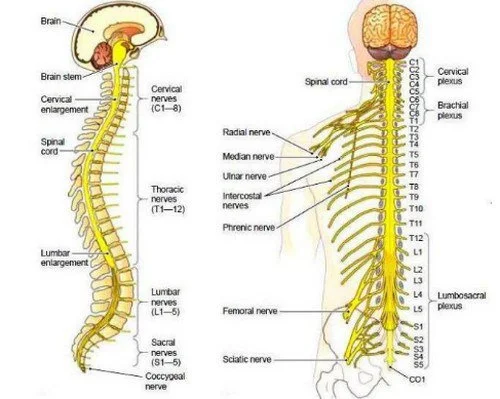
Spinal cord
The spinal cord is divided into four regions: the cervical, thoracic, lumbar, and sacral. The spinal cord consists of the internal gray matter, which has the shape of the letter H, and is surrounded by external white matter. The structure of the spinal cord is opposite to that of the two cerebral hemispheres. The spinal cord is the main pathway for information connecting the brain and the peripheral nervous system.
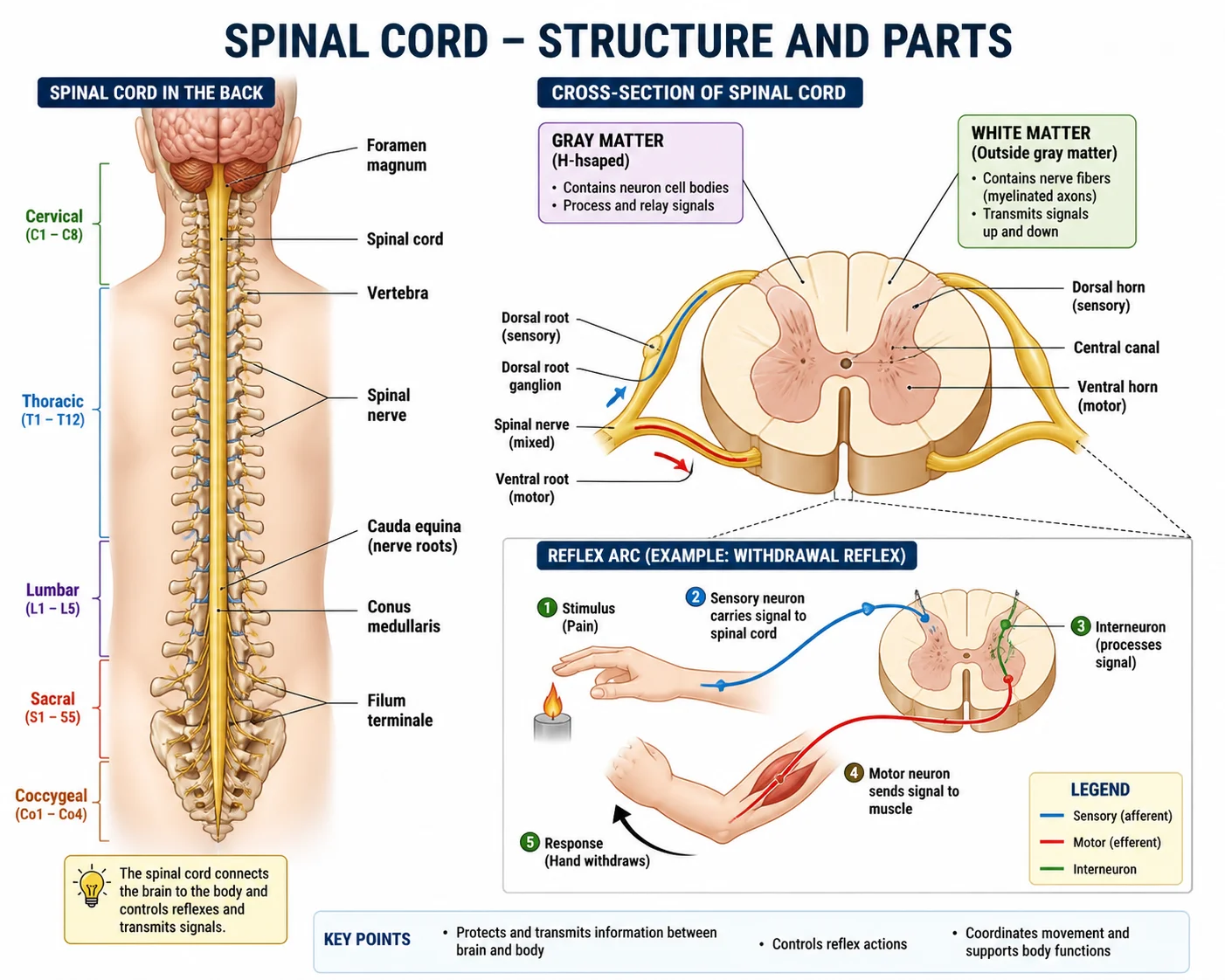
Spinal cord parts
Function of the Spinal Cord
The spinal cord delivers nerve messages from the body organs to the brain and vice versa. The spinal cord is responsible for reflexes (groups of reflex actions), such as quickly withdrawing the hand from a hot surface.
The Spinal Cord is a vital part of the Central Nervous System, acting as the main communication pathway between the brain and the rest of the body. It is responsible for transmitting nerve signals, controlling reflexes, and coordinating body movements.
The spinal cord plays a critical role in transmitting nerve impulses between the brain and different parts of the body. Sensory information, such as pain, temperature, and touch, travels from body receptors through the spinal cord to the brain for interpretation. At the same time, motor commands from the brain are sent through the spinal cord to muscles and glands, allowing movement and response to the environment.
Another essential function of the spinal cord is its role in reflex actions, which are rapid and automatic responses to stimuli. These reflexes, such as withdrawing your hand from a hot object, occur without direct involvement of the brain, making them faster and protective. The spinal cord processes these reflexes independently to ensure immediate reactions that help prevent injury.
In addition, the spinal cord is responsible for coordinating complex movements and maintaining balance. It works closely with the brain to regulate posture and muscle activity, ensuring smooth and controlled body movements. This coordination is essential for daily activities like walking, running, and maintaining body stability.
FAQ About the Function of the Spinal Cord
1. What is the main function of the spinal cord?
The main function is to transmit signals between the brain and the body and control reflex actions.
2. How does the spinal cord help in movement?
It carries motor signals from the brain to muscles, enabling voluntary movements.
3. What are reflex actions?
Reflex actions are quick, automatic responses controlled by the spinal cord without brain involvement.
4. Is the spinal cord part of the central nervous system?
Yes, it is a major component of the central nervous system along with the brain.
5. What happens if the spinal cord is damaged?
Damage can lead to loss of movement, sensation, or both, depending on the severity.
6. Does the spinal cord control balance?
Yes, it helps coordinate muscle activity and maintain posture and balance.
7. How does the spinal cord transmit signals?
It uses nerve fibers (neurons) to carry electrical impulses between the brain and body.
You can subscribe to Science Online on YouTube from this link: Science Online
Autonomic nervous system, Reflex action types & Autonomic ganglia function
Functions of Sympathetic nervous system & Role of the sympathetic in emergencies
Nervous system in man, Nerve cells types & Nature of nerve impulse
Nervous system (Central nervous system, Peripheral nervous system & Autonomic nervous system)
Human Transport System, Structure of human circulatory system (heart, blood vessels and blood)