
Nanotechnology in Electronics: 10 Amazing Benefits and Uses
Nanotechnology in electronics is transforming modern technology by enabling smaller, faster, lighter, and more energy-efficient electronic devices. By manipulating materials at the nanoscale, scientists and engineers can develop advanced computer chips, high-performance batteries, flexible displays, sensitive sensors, and innovative communication systems. These developments are helping improve smartphones, computers, medical devices, and many other electronic products.
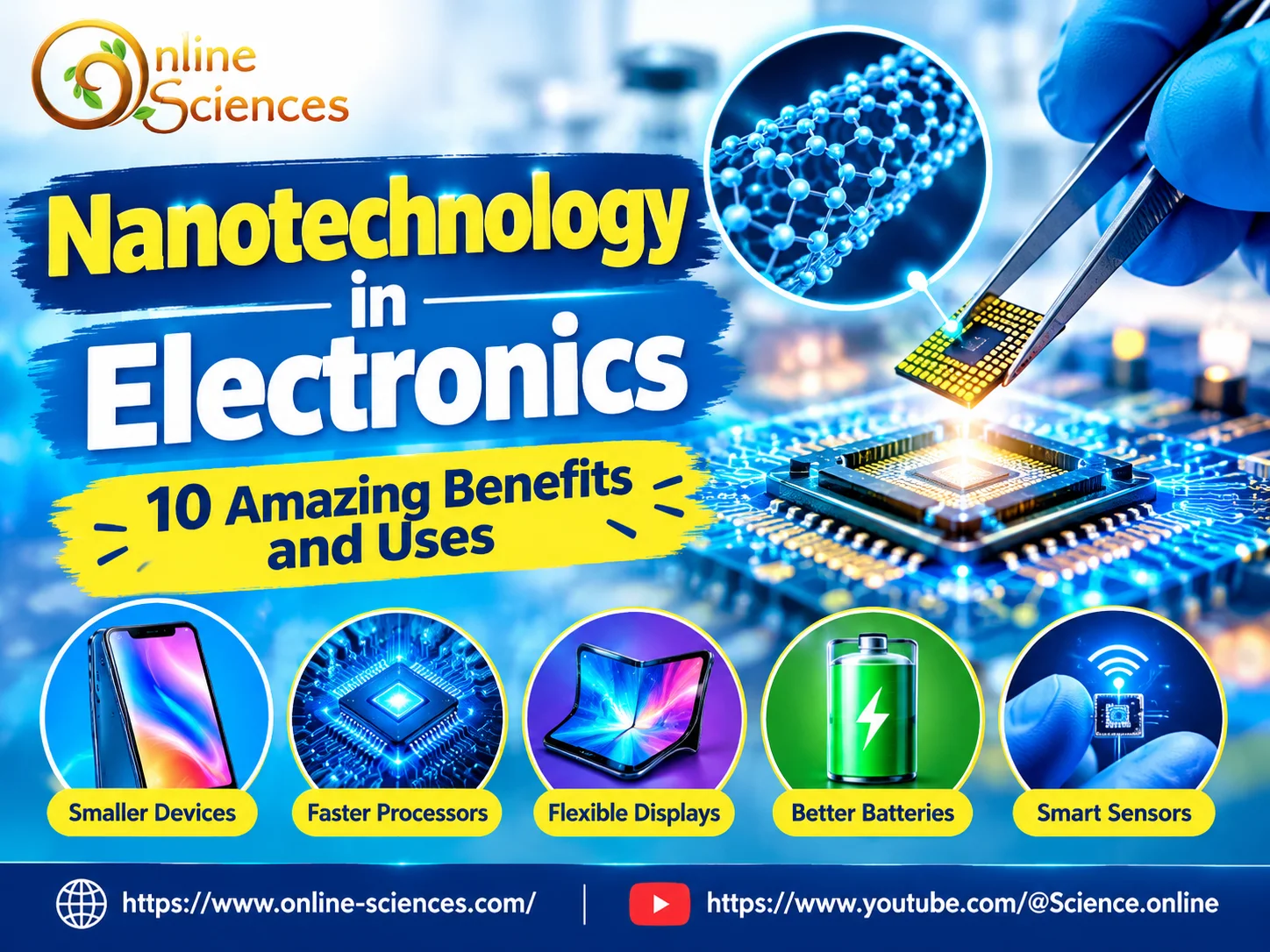
Nanotechnology in Electronics
Nanotechnology
Nanotechnology is used in many communications, computing, and electronic applications. It provides faster, smaller, and more portable systems. These systems can manage and store ever-larger amounts of information.
Nanotechnology in Electronics
Nanoelectronics means using nanotechnology in electronic components. There are many applications such as computing and electronic products, including flash memory chips for iPod Nanos, antimicrobial and antibacterial coatings on the mouse, the keyboard, and the cell phone casings.
Nanoelectronics aims to process, transmit, and store information by taking advantage of properties of matter that are distinctly different from macroscopic properties.
Nanotechnology is used for printed electronics for RFID, smart cards, and smart packaging. It is used for more life-like video games and flexible displays for e-book readers.
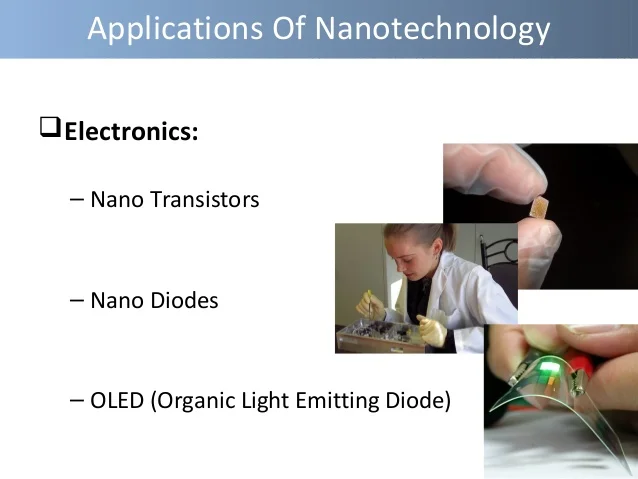
Application of nanoparticles in electronics
Nanotechnology is used for nanoscale transistors that are faster, more powerful, and increasingly energy-efficient. You will see soon that your computer’s entire memory may be stored on a single tiny chip.
Nanotechnology is used in many new TVs, laptop computers, digital cameras, and cell phones, and it is used in many devices to incorporate nanostructured polymer films known as organic light-emitting diodes or OLEDs, where OLED screens offer brighter consumption and longer lifetimes.
Nanotechnology is used for magnetic random access memory (MRAM) enabled by nanometer‐scale magnetic tunnel junctions that can quickly and effectively save even encrypted data during a system shutdown or crash. So, It enables resume‐play features.
Nanotechnology in electronics provides faster, smaller, and enhanced handheld devices. It provides advanced display technologies with conductive nanomaterials, data storage, quantum computing, printable and flexible electronics, and magnetic nanoparticles for data storage.
Nanotechnology can actually revolutionize a lot of electronic products, procedures, and applications; electronic products include nano transistors, nano diodes, OLEDs, plasma displays, and quantum computers.
Nanotechnology in electronics increases the capabilities of electronic devices while reducing their weight and power consumption. It increases the density of memory chips, and it reduces the size of transistors that are used in integrated circuits.
Nanotechnology improves display screens on electronic devices, so the power consumption will be reduced, and the weight and thickness of the screens will decrease.
Application of nanoparticles in electronics
Nanoparticles have a significant impact on electronics, enabling advancements in miniaturization, performance, and energy efficiency.
- Transistors and Semiconductors: Nanoparticles, such as silicon and carbon-based nanomaterials (e.g., carbon nanotubes, graphene), help create smaller, faster, and more energy-efficient transistors. Quantum dots and nanowires are used to improve charge transport in semiconductors.
- Memory Storage Devices: Nanoparticles, including metallic and magnetic nanoparticles, are used in Flash memory and magnetic storage (e.g., hard drives) to increase data storage density. Resistive RAM (ReRAM) utilizes metal oxide nanoparticles for high-speed, non-volatile memory.
- Display Technologies: Quantum dots are used in QLED displays, improving color accuracy and brightness in TVs, monitors, and mobile screens. Nanoparticles enhance OLED (Organic LED) displays, making them thinner, flexible, and more energy-efficient.
- Nanoelectronics & Flexible Electronics: Silver, gold, and carbon nanotube-based nanoparticles help create wearable electronics and bendable circuits. Nanoparticles are used in printed electronics to produce ultra-thin, flexible circuits for smart textiles and medical sensors.
- Electromagnetic Shielding: Nanoparticles such as carbon nanotubes and graphene help develop EMI shielding materials for electronic devices, protecting them from electromagnetic interference.
- Batteries and Supercapacitors: Nanoparticles in lithium-ion batteries (e.g., silicon nanoparticles in anodes) increase battery life and charge efficiency. Graphene-based supercapacitors offer fast charging and longer durability compared to conventional capacitors.
- Nano-Sensors: Nanoparticle-based sensors are used in electronics for detecting gases, humidity, temperature, and biomolecules. They improve the sensitivity and response time of environmental and biomedical sensors.
- Photodetectors and Solar Cells: Nanoparticles improve the efficiency of photodetectors in cameras and security devices. Quantum dots and perovskite nanoparticles enhance solar cell efficiency by better capturing sunlight.
Benefits and Uses of Nanotechnology in Electronics
Nanotechnology is one of the most important technologies shaping the future of electronics. It involves designing, producing, and manipulating materials at extremely small dimensions, typically between 1 and 100 nanometers. At this scale, materials can exhibit unique electrical, optical, magnetic, and mechanical properties that differ from their behavior in larger forms.
In electronics, nanotechnology helps engineers create smaller components while improving their performance, reducing power consumption, and introducing new functions. From advanced semiconductor chips to wearable electronics, its applications are expanding across many industries.
1. Smaller and More Powerful Electronic Devices
One of the main benefits of nanotechnology in electronics is the ability to manufacture extremely small electronic components. Nanoscale transistors and other semiconductor structures allow manufacturers to integrate more components into a limited area.
This development supports compact smartphones, lightweight laptops, miniature cameras, and portable medical devices. Smaller components can also help manufacturers develop sophisticated electronic systems without significantly increasing device size.
However, shrinking components requires advanced manufacturing techniques and careful management of heat, leakage current, and other physical limitations.
2. Faster Computer Processors
Nanotechnology contributes to the development of powerful processors used in computers, smartphones, servers, and artificial intelligence systems.
Advanced semiconductor manufacturing uses nanoscale structures to improve transistor density and performance. These improvements can support faster data processing and more efficient computing, although actual performance also depends on chip architecture, cooling, and software.
Carbon nanotubes and other emerging nanomaterials are also being investigated as possible alternatives or complements to conventional semiconductor materials for future electronic components.
3. Improved Energy Efficiency
Energy efficiency is another important advantage of nanotechnology in electronics. Carefully engineered nanoscale materials and structures can help reduce energy losses in certain electronic components.
More efficient transistors, advanced memory technologies, and improved power-management circuits can help electronic devices perform tasks while consuming less electricity.
These developments are particularly valuable for smartphones, laptops, data centers, and Internet of Things (IoT) devices, where reducing power consumption can extend battery life and lower operating costs. The overall energy savings depend on the device design and the technology used.
4. Advanced Batteries and Energy Storage
Nanotechnology is helping researchers develop improved battery materials for portable electronics and electric vehicles. Nanostructured electrodes can provide greater surface area for electrochemical reactions and may improve charging speed, energy storage, and battery performance. Researchers are investigating nanomaterials such as silicon nanostructures, graphene, and carbon nanotubes for different battery applications.
These materials may help overcome some limitations of conventional batteries, including charging time and energy density. Nevertheless, durability, safety, manufacturing costs, and large-scale production remain important challenges.
5. Better Displays and Flexible Electronics
Nanotechnology is contributing to the development of advanced displays with improved brightness, color performance, and energy efficiency. Quantum dots, which are semiconductor nanocrystals, can emit specific colors when stimulated by light or electricity. They are used in certain display technologies to produce vivid colors and improve color accuracy.
Nanomaterials are also being researched for flexible electronic circuits, bendable screens, wearable devices, and lightweight electronic components. These technologies could support foldable phones, smart clothing, and electronic systems integrated into curved surfaces.
6. Highly Sensitive Nanosensors
Nanosensors use nanoscale materials or structures to detect small changes in their surroundings. They can be designed to respond to chemicals, gases, temperature, pressure, light, or biological substances. Their potential applications include environmental monitoring, industrial safety, healthcare diagnostics, and smart electronic systems.
For example, nanosensor technology may help detect certain pollutants at low concentrations or monitor changes in biological samples. However, sensitivity, selectivity, calibration, and reliability must be evaluated for each application.
7. Improved Data Storage and Memory
Nanotechnology supports research into smaller, denser, and potentially more efficient data-storage systems. Nanoscale magnetic structures, advanced semiconductor memory, and emerging memory technologies may allow electronic devices to store larger quantities of information in compact spaces.
These developments benefit smartphones, cloud computing, artificial intelligence, and high-performance computers, all of which require efficient access to large amounts of data. The practical benefits depend on factors such as storage speed, endurance, cost, and manufacturing complexity.
8. Better Communication Systems
Modern communication technologies rely on advanced electronic and optical components. Nanotechnology can contribute to faster and more efficient communication systems through improved semiconductor devices, nanoscale optical structures, and advanced materials.
Potential applications include high-frequency communication circuits, optical communication components, and technologies supporting future wireless networks. By improving selected components, nanotechnology may help reduce signal losses, improve device performance, and support increasingly demanding data transmission requirements.
9. More Advanced Medical and Wearable Electronics
Nanotechnology is creating new opportunities for compact medical electronics and wearable monitoring devices.
Small sensors integrated into electronic systems can measure physiological signals or detect selected chemical markers. Wearable devices may use these technologies to monitor movement, temperature, or other health-related indicators.
Nanomaterials can also support the development of flexible electrodes and miniature diagnostic systems. Medical applications require careful testing to establish accuracy, biocompatibility, safety, and clinical usefulness before devices can be used for diagnosis or treatment.
10. Challenges and the Future of Nanoelectronics
Despite its many advantages, nanotechnology in electronics faces several challenges. Manufacturing nanoscale structures requires sophisticated equipment, precise control, and substantial investment. Other concerns include heat generation, material stability, electronic defects, environmental effects, and the safe handling and disposal of certain nanomaterials.
Researchers are working to improve production methods, reduce manufacturing costs, and develop safer materials. Advances in semiconductor engineering, quantum-dot displays, nanosensors, and emerging memory technologies are likely to create additional opportunities.
In the future, nanotechnology may contribute to more capable artificial intelligence hardware, energy-efficient computing, flexible electronics, and increasingly compact communication devices.
Conclusion
Nanotechnology in electronics offers important benefits, including smaller devices, improved processing capabilities, greater energy efficiency, advanced batteries, high-quality displays, and highly sensitive sensors.
Although manufacturing costs, reliability, and environmental safety remain important considerations, ongoing research is expanding the possibilities of nanoelectronics. As these technologies mature, they are expected to play an increasingly important role in the development of future electronic devices and systems.
Frequently Asked Questions (FAQ)
1. What is nanotechnology in electronics?
Nanotechnology in electronics involves using nanoscale materials and structures to develop or improve electronic components, including transistors, sensors, memory devices, and displays.
2. What are the main benefits of nanotechnology in electronics?
The main benefits include smaller components, improved processing performance, potentially lower power consumption, advanced data storage, better displays, and more sensitive sensors.
3. How is nanotechnology used in computer chips?
It supports the fabrication of nanoscale transistors and other semiconductor structures, allowing manufacturers to integrate more components into modern processors and memory chips.
4. Can nanotechnology improve battery performance?
Yes. Some nanostructured electrode materials may improve charging rates, energy storage, or battery performance, although results depend on the material, battery design, and manufacturing process.
5. How does nanotechnology improve electronic displays?
Quantum dots and other nanomaterials can improve color performance and support the development of advanced display technologies.
6. What are nanosensors used for?
Nanosensors can detect selected physical, chemical, or biological changes. Applications include environmental monitoring, industrial safety, healthcare research, and smart devices.
7. What are the disadvantages of nanotechnology in electronics?
Challenges include high research and manufacturing costs, production complexity, reliability concerns, and possible environmental or health risks associated with particular nanomaterials.
8. What is the future of nanotechnology in electronics?
Future applications may include more efficient processors, advanced memory, flexible electronics, improved sensors, and new materials for high-performance communication systems.
You can subscribe to Science Online on YouTube using this link: Science Online