
7 Powerful Facts About the Importance of Adaptation in Desert Plants and Their Survival Secrets
Desert plants survive in some of the harshest environments on Earth, where water is scarce, temperatures are extremely high, and rainfall is very low. The importance of adaptation in desert plants lies in their ability to develop special structures and behaviors that help them conserve water, tolerate heat, and continue growing under difficult environmental conditions. These remarkable survival mechanisms make desert plants one of the best examples of biological adaptation in nature.
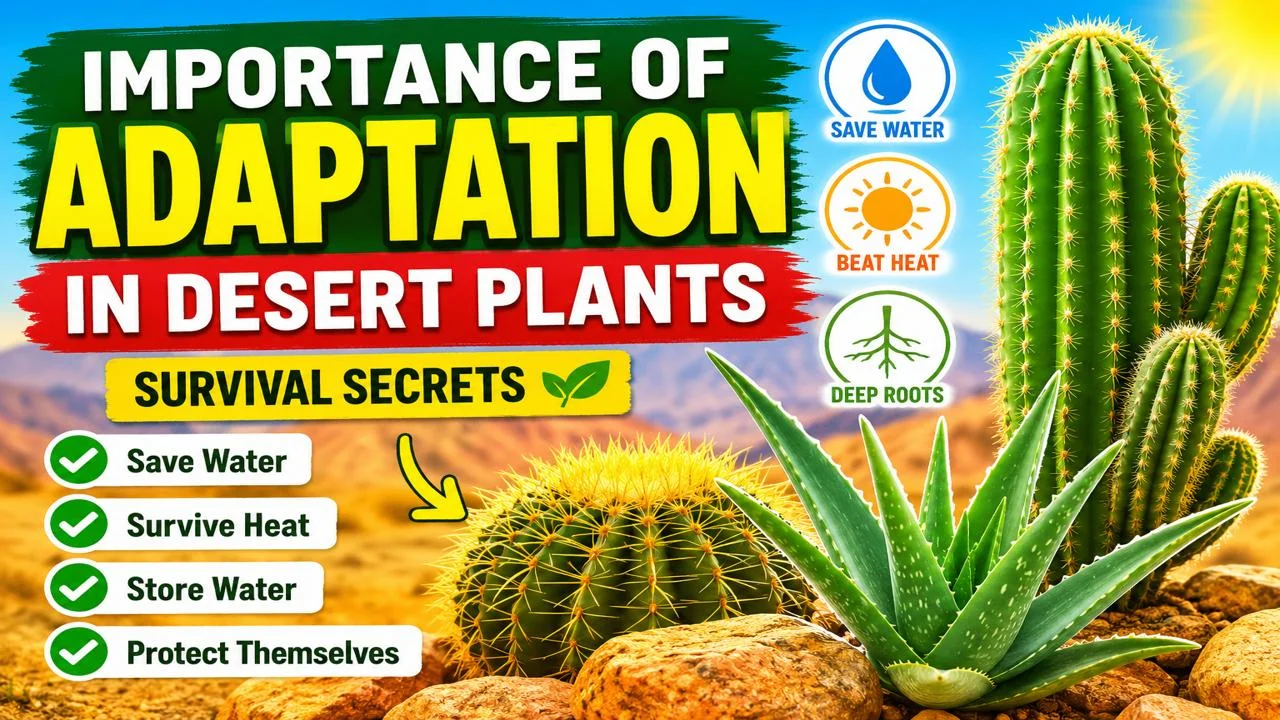
Importance of Adaptation in Desert Plants
Desert plants
Desert plants are generally small compared to plants that grow in environments with water. The desert plants face a shortage of water and rain, strong winds, and an extreme rise in temperature during the day.
Understanding how desert plants adapt to their environmental conditions helps scientists improve agriculture, conserve biodiversity, and develop crops that can survive climate change and drought. From thick stems to deep roots and tiny leaves, every feature of desert plants has a special role in helping them survive.
Desert plant adaptations are among the most fascinating examples of survival in nature. Learn more about the importance of biodiversity, climate adaptation, and plant survival mechanisms to better understand how ecosystems remain balanced even in extreme desert environments.
What is Adaptation in Desert Plants?
Adaptation is the process through which plants develop special features that help them survive in their habitat. Desert plants, also called xerophytes, possess physical and physiological adaptations that allow them to live with limited water and intense sunlight. These adaptations may include storing water, reducing water loss, or protecting the plant from extreme heat.
Importance of Adaptation in Desert Plants
The importance of adaptation in desert plants can be seen in several ways:
- Water Conservation: Desert plants have special adaptations that reduce water loss through transpiration. This helps them survive long periods without rain.
- Survival in Extreme Heat: Adaptations such as waxy coatings and small leaves protect plants from excessive heat and sunlight.
- Efficient Water Storage: Many desert plants store water in thick stems, leaves, or roots, allowing them to survive drought conditions.
- Protection from Animals: Spines and thorns protect desert plants from animals searching for water-rich food.
- Successful Reproduction: Some desert plants produce seeds that remain dormant until rainfall occurs, ensuring successful germination.
- Soil Stabilization: Desert vegetation helps prevent soil erosion and supports desert ecosystems.
- Ecological Balance: Adapted desert plants provide food and shelter for insects, birds, and desert animals.
Adaptation in Desert Plants Examples
- Cactus: The cactus is one of the most famous desert plants. It has thick green stems that store water, while its spines reduce water loss and protect it from animals.
- Date Palm: Date palms have deep roots that absorb underground water efficiently. Their narrow leaves reduce evaporation.
- Acacia Tree: Acacia trees develop long root systems that reach deep water sources beneath dry soil.
- Aloe Vera: Aloe vera stores water inside its fleshy leaves and survives in dry climates for long periods.
- Prickly Pear: This desert plant uses flattened stems to store water and carry out photosynthesis instead of leaves.
How are Desert Plants Adapted to Their Environmental Conditions?
Desert plants use several remarkable survival strategies:
- Thick Waxy Cuticle: A waxy layer covers leaves and stems to reduce water evaporation.
- Reduced Leaves or Spines: Small leaves minimize surface area and reduce transpiration.
- Deep Root Systems: Roots may extend deep underground to reach hidden water supplies.
- Water Storage Tissues: Succulent stems and leaves store water for future use.
- CAM Photosynthesis: Many desert plants open their stomata at night instead of daytime to reduce water loss.
- Dormant Seeds: Seeds remain inactive during drought and grow quickly after rainfall.
Adaptation of the desert plants
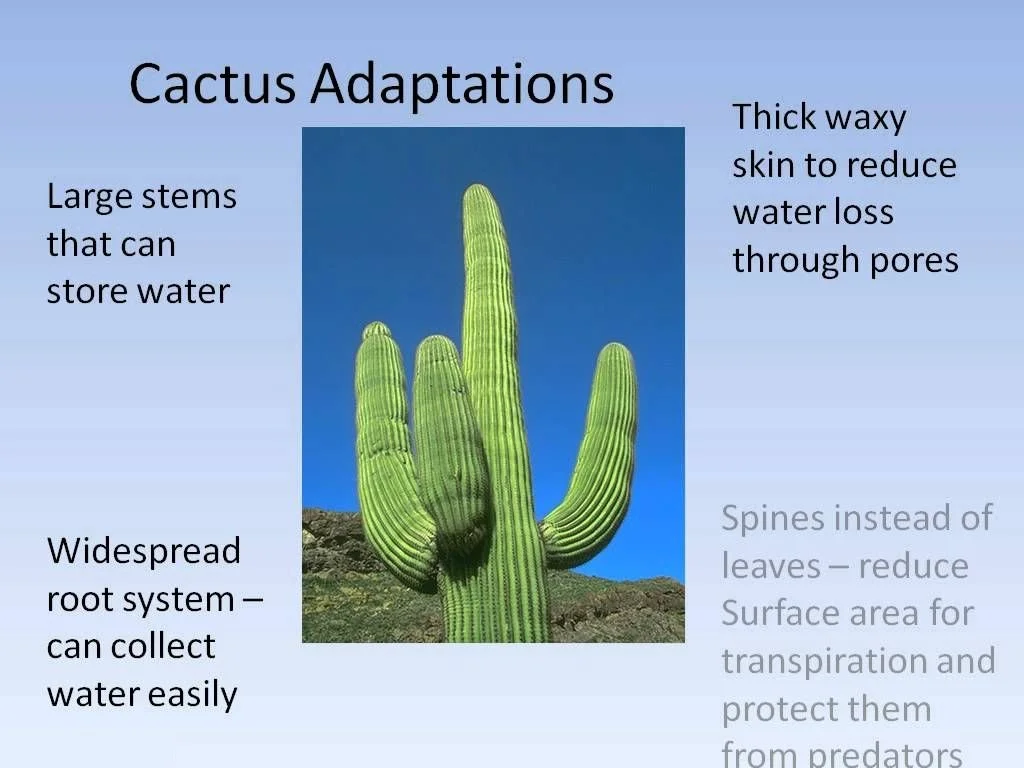
The roots of desert plants extend vertically into the soil for great depths to reach the humid layers of the soil (to absorb the groundwater), such as the Calamagrostis plant.
The roots of desert plants spread horizontally to absorb a large amount of the rainwater or dew, and store it in the stems, as in the opuntia plant, or succulent (juicy) leaves, as in the cactus plant.
Cactus Adaptations
The leaves of the desert plants are small. They may be ribbon-like and spiralled. There are a number of stomata that lie deeply to reduce the loss of water by transpiration, like the Calamagrostis plant.
The leaves of the desert plants are used to store water, as in the cactus. A waxy layer surrounds the leaves of the desert plants to prevent water loss by transpiration, as in the cactus.
The leaves of the desert plants are modified (reduced) into spines to reduce the loss of water during the transpiration process, as in the opuntia plant.
The stems of the desert plants are short to avoid the strong winds, as in the cactus plant. They may be rich in the chloroplasts to perform the photosynthesis process, as in the opuntia plant.
The roots of the Calamagrostis plant are branched and extend vertically deep in the soil to absorb the groundwater to overcome the water shortage.
Adaptation in desert plants examples
There are many adaptations that desert plants have developed to survive in their harsh environment. By conserving water, reducing sun exposure, and taking advantage of the cooler night hours, these plants can thrive in one of the most challenging habitats on Earth.
Water storage: Many desert plants are succulents, which means they have thick, fleshy leaves or stems that store water. Cacti are the most famous example of this, but other succulents include aloe vera, jade plants, and sedums.
Reduced Surface Area: Desert plants often have small leaves or spines to reduce the amount of surface area exposed to the sun. This helps to minimize water loss through transpiration, the process by which plants release water vapor into the atmosphere. Some plants, like cacti, have modified leaves that are spines. Others, like creosote bush, have small, waxy leaves that help to trap moisture.
Deep Root Systems: Many desert plants have deep taproots that can reach down to groundwater reserves far below the surface. This allows them to access water even during long droughts. Other desert plants have shallow, spreading root systems that can quickly absorb any rainwater that falls. Mesquite trees, for example, can have roots that extend hundreds of feet into the ground.
Night blooming: Some desert plants, such as cacti, bloom at night. This helps them to avoid the heat of the day and to attract night-pollinating animals, such as bats and moths.
Waxy Coatings: Many desert plants have a waxy coating on their leaves or stems. This helps to reduce water loss by preventing evaporation. The waxy coating can also help to reflect sunlight, keeping the plant cooler.
CAM Photosynthesis: Many desert plants use a special type of photosynthesis called crassulacean acid metabolism (CAM). This allows them to take in carbon dioxide at night when the stomata (pores) in their leaves are closed, and there is less water loss. The carbon dioxide is then stored as a molecule and used for photosynthesis during the day.
FAQ about Adaptation in Desert Plants
1. What is adaptation in desert plants?
Adaptation in desert plants refers to the special structural and physiological features that help plants survive in hot, dry environments with very little water.
2. Why do desert plants need special adaptations?
Deserts have:
- Extremely low rainfall.
- High temperatures during the day.
- Rapid water evaporation.
So, plants must conserve water and survive long drought periods.
3. What are some common examples of desert plants?
Examples include:
- Cactus.
- Date Palm.
- Acacia.
- Aloe Vera.
4. How are desert plants adapted to reduce water loss?
They use several strategies:
- Thick waxy cuticle to reduce evaporation.
- Reduced leaves or spines (like cactus) to minimize water loss.
- Sunken stomata to limit transpiration.
5. How do desert plants store water?
Many desert plants (like cactus):
- Have thick, fleshy stems or leaves.
- Store water in specialized tissues.
This allows them to survive long dry periods.
6. How do roots help desert plants survive?
Desert plants have special root systems:
- Deep roots to reach underground water.
- Wide, shallow roots to quickly absorb rainwater.
7. Why do some desert plants have spines instead of leaves?
Spines:
- Reduce water loss.
- Protect plants from animals.
- Provide shade to reduce temperature.
8. How do desert plants perform photosynthesis without leaves?
In plants like cactus, the green stem carries out photosynthesis instead of leaves.
9. What is CAM adaptation in desert plants?
CAM (Crassulacean Acid Metabolism) is a special process where:
- Stomata open at night to take in carbon dioxide.
- Stay closed during the day to reduce water loss.
10. How do desert plants survive extreme heat?
They:
- Have light-colored surfaces to reflect sunlight.
- Grow slowly to conserve energy.
- Remain dormant during extreme drought.
11. Can desert plants grow quickly?
Yes, some desert plants:
- Grow rapidly after rainfall.
- Complete their life cycle quickly before the water disappears.
12. What is the importance of desert plant adaptations?
These adaptations help plants:
- Survive in extreme environments.
- Maintain ecological balance.
- Provide food and shelter for desert animals.
13. What is the importance of adaptation in desert plants?
Adaptation helps desert plants conserve water, survive high temperatures, protect themselves from predators, and reproduce successfully in dry environments.
14. What are examples of desert plant adaptations?
Examples include spines instead of leaves, thick water-storing stems, deep roots, waxy coatings, and CAM photosynthesis.
15. Why do cactus plants have spines?
Spines reduce water loss and protect cactus plants from animals.
16. How do desert plants get water?
Some desert plants absorb underground water through deep roots, while others store rainwater in their tissues.
17. What is CAM photosynthesis?
It is a process where plants open their stomata at night to reduce water loss during hot daytime conditions.
18. Why are desert plants important to ecosystems?
They prevent soil erosion, provide food and shelter for animals, and help maintain ecological balance.
Conclusion
The importance of adaptation in desert plants is essential for survival in harsh desert environments. Through unique structural and physiological features, desert plants efficiently conserve water, resist extreme temperatures, and maintain ecological stability. Understanding these adaptations provides valuable insights into nature, environmental science, and the future of sustainable agriculture in a changing climate.
You can subscribe to Science Online on YouTube from this link: Science Online
Adaptation in insectivorous & birds, Hibernation, Aestivation, Birds migration and Camouflage
Adaptation reasons, types, diversity of living organisms and motion in mammals
Transportation in plant, Structure and role of the plant stem in the process of transportation
Autotrophic Nutrition in green plants, Mechanism of water and minerals absorption