12 Powerful Facts About Role of Muscles in Performing Movement – Complete Guide
The role of muscles in performing movement is fundamental to every action the human body performs, from walking and running to breathing and maintaining posture. Muscles work together with bones, joints, tendons, and the nervous system to produce smooth, controlled movements. Understanding how muscles generate force and coordinate body movements is essential for learning anatomy, physiology, sports science, and human health.
Role of Muscles in Performing Movement
Muscular system
The muscular system is the engine that moves our body, where the muscles generate the mechanical energy and the movement of the body due to the ability of the muscular cells to contract and relax.
The muscles are fixed to the bones by the long strips called tendons, so, when the muscles contract and relax, they move the bones.
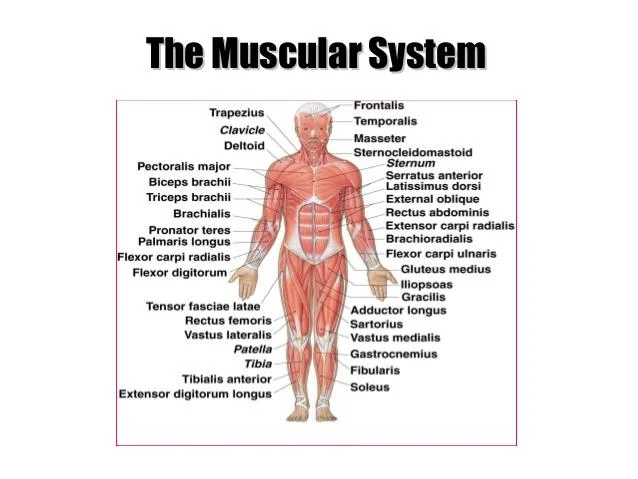
The muscular system is responsible for the movement of the human body. It is attached to the bones of the skeletal system, which are about 650 named muscles that make up roughly half of a person’s body weight.
Human muscular system
The human body contains 650 muscles. The biggest muscle in size is at the bottom of the body, while the smallest muscle is in the ear, The human use 200 muscles during walking.
Types of muscles
Types of muscles cells
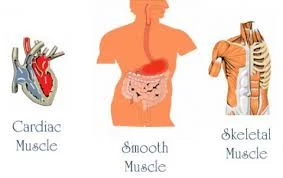
There are two types of muscles, which are the voluntary muscles and the involuntary muscles. The voluntary muscles are the muscles that can move willingly, and you can control their movement. The voluntary muscles include the limb muscles, the trunk muscles, the face muscles, and the abdominal wall muscles.
The involuntary muscles are the muscles that can move automatically, and you can not control or are even aware of their movement. The involuntary muscles include the gastrointestinal tract, the blood vessels, and the bladder muscles.
Role of muscles in the movement of the forearms
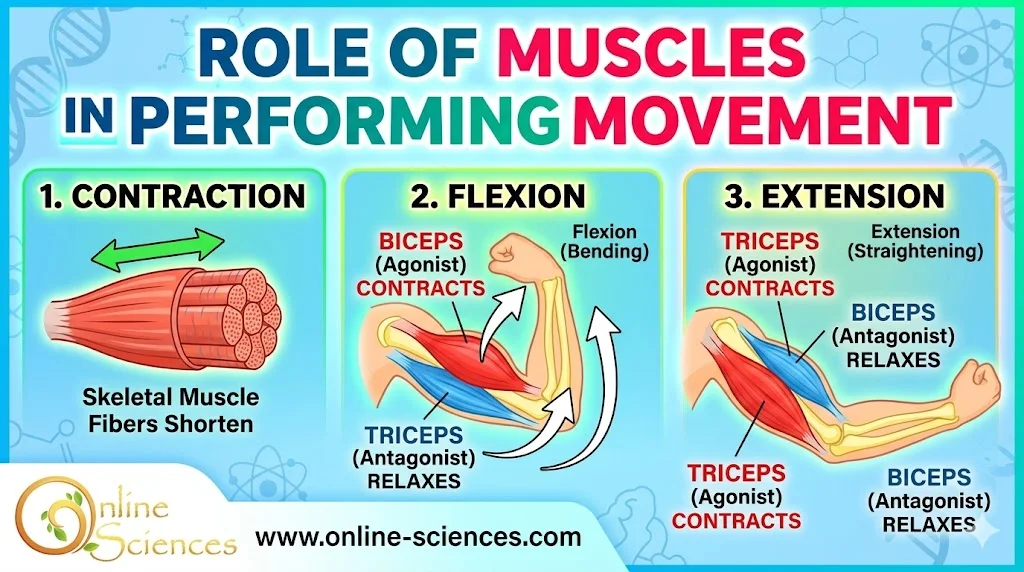
The front muscle contracts and the back muscle relaxes, which causes the bending (moving up) of the arm with the help of the elbow joint.
The front muscle relaxes and the back muscle contracts, which causes extension (move down) of the arm with the help of the elbow joint.
The effect of the contraction or the relaxation of the muscles is transferred to the elbow joint bones by the tendons that link between the muscles and the bones.
Facts About the Role of Muscles in Performing Movement
- Muscles are responsible for all body movements, from simple actions like blinking and smiling to complex activities such as running and lifting heavy objects.
- Skeletal muscles work by contracting and relaxing. They generate force by shortening, which pulls on bones to move the joints.
- Muscles cannot push bones. Instead, they only pull, so they work in opposing pairs called antagonistic muscles to move body parts in opposite directions.
- Tendons connect muscles to bones, transmitting the force generated during muscle contraction to create movement.
- The brain and nervous system control muscle movement by sending electrical impulses through motor neurons to muscle fibers.
- Most voluntary movements require several muscles to work together. Agonist, antagonist, synergist, and stabilizer muscles coordinate to produce smooth and efficient motion.
- Muscles help maintain posture by making continuous, low-level contractions that keep the body balanced while standing or sitting.
- Muscles stabilize joints, reducing excessive movement and lowering the risk of dislocations and injuries during physical activities.
- There are three main types of muscle contractions: concentric (muscle shortens), eccentric (muscle lengthens while under tension), and isometric (muscle length remains the same while generating force).
- Skeletal muscles account for about 40–50% of an adult’s body weight, making them one of the largest organ systems in the human body.
- The human body contains more than 600 skeletal muscles, each specialized for specific movements and functions.
- Muscles require energy to contract. They obtain this energy from adenosine triphosphate (ATP), which is produced from nutrients such as carbohydrates and fats.
- Regular exercise strengthens muscles, improving power, endurance, flexibility, coordination, and overall physical performance.
- Muscles also produce heat during contraction, helping maintain a stable body temperature, especially in cold environments.
- Smooth and coordinated movement depends on healthy muscles, bones, joints, tendons, ligaments, and the nervous system working together.
- Without muscle contractions, the skeleton cannot move, as bones act as levers that are pulled by muscles across joints.
- Muscle strength and flexibility contribute to better balance, reducing the likelihood of falls and improving mobility throughout life.
- Resistance training stimulates muscle growth, increasing muscle size and strength by causing muscle fibers to adapt to greater workloads.
- Adequate protein, hydration, and rest are essential for muscle repair and growth, especially after physical activity.
- Healthy muscles improve overall quality of life by supporting everyday activities, protecting joints, enhancing athletic performance, and promoting long-term mobility and independence.
FAQ About the Role of the Muscles in Performing Movement
1. What is the role of muscles in performing movement?
Muscles move by contracting and relaxing. When a muscle contracts, it pulls on the bones through tendons, causing the bones to move at the joints. This coordinated action enables activities such as walking, lifting, writing, and speaking.
2. How do muscles work with bones to create movement?
Muscles are attached to bones by strong connective tissues called tendons. Since muscles can only pull—not push—they work in pairs. When one muscle contracts, the opposing muscle relaxes, allowing smooth and controlled movement.
3. Why can’t muscles push bones?
Muscle fibers generate force only by shortening during contraction. Because they cannot actively lengthen to create force, an opposing muscle must contract to move the bone back in the opposite direction.
4. What are antagonistic muscle pairs?
Antagonistic muscles are pairs of muscles that perform opposite actions. When one muscle contracts, the other relaxes. For example, the biceps and triceps work together to bend and straighten the elbow.
5. What is the function of tendons in movement?
Tendons connect muscles to bones and transmit the force generated by muscle contractions. They are strong, flexible tissues that help produce efficient movement while stabilizing joints.
6. How does the nervous system control muscle movement?
The brain and spinal cord send electrical signals through motor neurons to muscle fibers. These signals trigger muscle contractions, allowing voluntary movements to occur with precision and coordination.
7. What are the different types of muscle contractions?
There are three main types:
- Concentric contraction: The muscle shortens while producing force.
- Eccentric contraction: The muscle lengthens while controlling movement.
- Isometric contraction: The muscle produces force without changing length.
Each type is essential for daily activities and exercise.
8. Why are muscles important for maintaining posture?
Muscles continuously make small contractions to keep the body upright and balanced. These contractions help stabilize the spine, support joints, and prevent falls.
9. How do muscles help protect joints?
Strong muscles support and stabilize joints during movement. They absorb impact, reduce stress on bones and ligaments, and lower the risk of injuries.
10. What factors affect muscle performance?
Muscle performance depends on several factors, including:
- Regular exercise.
- Proper nutrition.
- Hydration.
- Adequate rest.
- Age.
- Overall health.
- Nervous system function.
Maintaining these factors helps improve strength, endurance, and coordination.
11. Why is regular exercise important for healthy muscles?
Exercise strengthens muscles, improves flexibility, enhances coordination, increases endurance, and supports healthy bones and joints. It also reduces the risk of muscle weakness and injury.
12. What happens if muscles do not function properly?
Poor muscle function can lead to weakness, reduced mobility, joint instability, difficulty performing everyday tasks, and an increased risk of falls or injuries. Severe muscle disorders may significantly affect a person’s quality of life.
You can subscribe to Science Online on YouTube from this link: Science Online
Muscular system, Structure of skeletal muscle, Muscle properties & functions
Skeletal system, Axial skeleton (vertebral column, Skull & thoracic cage)
Skeletal system, Appendicular skeleton structure and importance
Mechanism of muscle contraction, motor unit, muscle fatigue & Huxley’s theory of sliding filaments