15 Powerful Facts About the Importance and Structure of the Appendicular Skeleton (Complete Guide 2026)
The importance and structure of the appendicular skeleton are essential topics in human anatomy because this part of the skeletal system is responsible for movement, support, and interaction with the environment. The appendicular skeleton consists of the bones of the upper and lower limbs, as well as the pectoral and pelvic girdles that attach these limbs to the axial skeleton. Understanding its structure and functions helps explain how the body performs everyday activities such as walking, running, lifting, and maintaining balance.
Importance and Structure of the Appendicular Skeleton
Skeletal system
The skeletal system consists of 206 named bones that make up the skeleton. It is divided into main divisions, which are the axial skeleton and the appendicular skeleton. It gives shape to the body, and it supports the body’s weight; without the bones, you can not stand or sit erect.
The bones in our body connect and form the skeleton, which gives our body its shape. It supports our body and protects the important organs in our body.
The skeletal system protects the organs such as the heart, the lungs, and the brain. The backbone supports our body, the ribcage protects our lungs and the heart. The skull protects our brain and the eyes.
Skeletal system
Appendicular skeleton
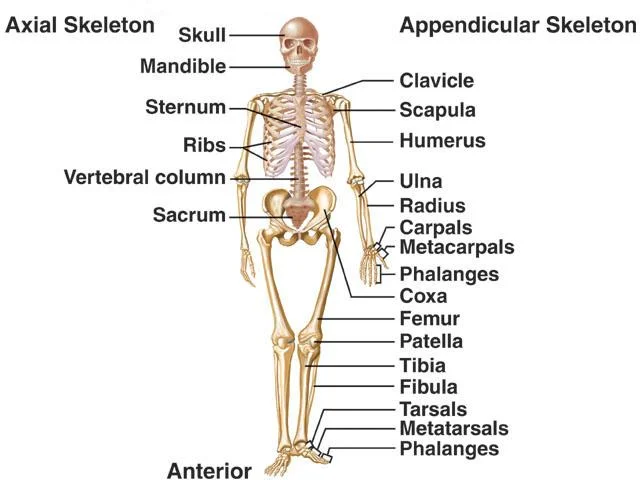
The appendicular skeleton consists of the bones of the upper limbs, the bones of the lower limbs, and their girdles and bones.
The bones of the upper limbs consist of 3 parts, which are the humerus bone, the forearm bones, the hand bones, and it is connected to the shoulder bones. The bones of the upper limbs allow eating, drinking, and holding things.
The bones of the lower limbs consist of 3 parts, which are the femur bone, the shaft bones, and the foot bones, and it is connected to the pelvic bones. The bones of the lower limbs allow walking, running, standing, and carrying the rest of the body.
What is the Appendicular Skeleton?
The appendicular skeleton is the portion of the human skeleton that includes the bones of the arms, legs, shoulders, and hips. It contains 126 bones, which account for more than half of the total bones in the adult human body. The appendicular skeleton is connected to the axial skeleton through the pectoral girdle and pelvic girdle, allowing the limbs to move efficiently and perform a wide range of actions.
Structure of the Appendicular Skeleton
The appendicular skeleton is divided into four major parts:
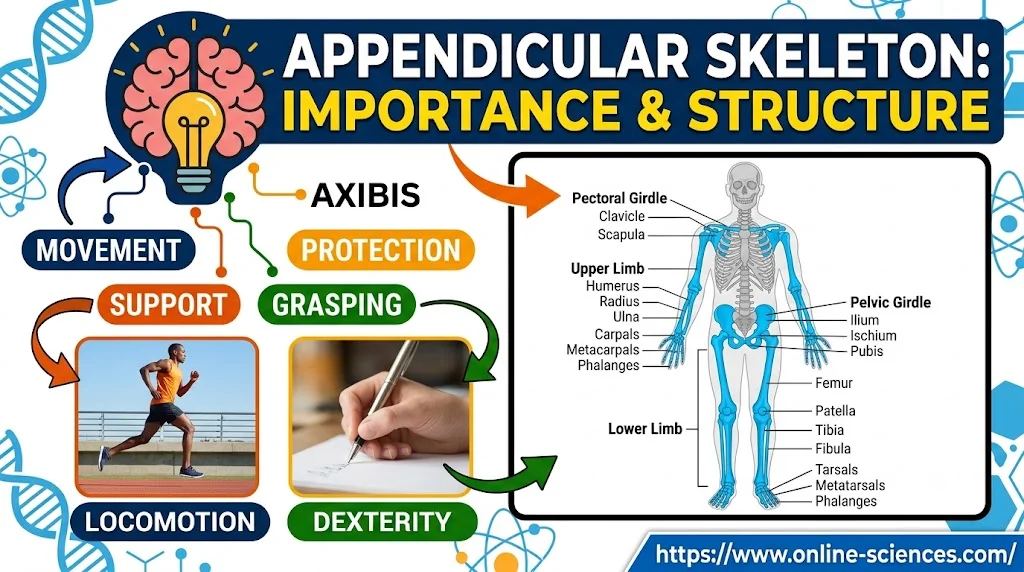
1. Pectoral (Shoulder) Girdle: The pectoral girdle attaches the upper limbs to the axial skeleton and consists of:
- Two clavicles (collarbones).
- Two scapulae (shoulder blades).
Functions:
- Supports the arms.
- Provides attachment sites for muscles.
- Allows a wide range of shoulder movements.
2. Upper Limbs: Each upper limb contains:
- Humerus.
- Radius.
- Ulna.
- Carpals.
- Metacarpals.
- Phalanges.
Functions:
- Grasping objects.
- Writing and fine motor skills.
- Lifting and carrying.
3. Pelvic (Hip) Girdle: The pelvic girdle consists of two hip bones formed by the fusion of:
- Ilium.
- Ischium.
- Pubis.
Functions:
- Supports body weight.
- Protects pelvic organs.
- Connects lower limbs to the trunk.
4. Lower Limbs: Each lower limb contains:
- Femur.
- Patella.
- Tibia.
- Fibula.
- Tarsals.
- Metatarsals.
- Phalanges.
Functions:
- Standing.
- Walking.
- Running.
- Jumping.
- Maintaining balance.
Importance of the Appendicular Skeleton
The appendicular skeleton performs several vital functions:
- Enables Movement: It works with muscles and joints to produce body movements.
- Supports Body Weight: The lower limbs and pelvic girdle bear and distribute body weight.
- Provides Stability and Balance: The appendicular skeleton helps maintain posture and coordination.
- Protects Certain Internal Organs: The pelvic girdle protects organs such as the urinary bladder and reproductive organs.
- Facilitates Daily Activities: Actions such as walking, writing, lifting, and sports depend on the appendicular skeleton.
- Provides Muscle Attachment Sites: Many muscles attach to appendicular bones, enabling movement and strength.
- Stores Minerals: Like all bones, appendicular bones store calcium and phosphorus.
- Produces Blood Cells: Bone marrow inside many appendicular bones contributes to blood cell formation.
FAQ about the appendicular skeleton
1. What is the appendicular skeleton?
The appendicular skeleton is the part of the skeleton that includes the bones of the limbs and the girdles that attach them to the axial skeleton.
2. How many bones are in the appendicular skeleton?
The adult appendicular skeleton contains 126 bones.
3. What are the main parts of the appendicular skeleton?
The pectoral girdle, upper limbs, pelvic girdle, and lower limbs.
4. What is the function of the pectoral girdle?
It attaches the upper limbs to the body and allows extensive shoulder movement.
5. What is the function of the pelvic girdle?
It supports body weight, protects pelvic organs, and connects the lower limbs to the trunk.
6. Which bone is the longest in the appendicular skeleton?
The femur is the longest and strongest bone in the human body.
7. Why is the appendicular skeleton important?
It enables movement, supports body weight, provides balance, and protects certain organs.
8. How does the appendicular skeleton help in movement?
Bones act as levers, while muscles pull on them to produce motion at joints.
9. What bones make up the upper limbs?
The humerus, radius, ulna, carpals, metacarpals, and phalanges.
10. What bones make up the lower limbs?
The femur, patella, tibia, fibula, tarsals, metatarsals, and phalanges.
11. Does the appendicular skeleton protect organs?
Yes. The pelvic girdle protects several organs located in the pelvic cavity.
12. What is the difference between the axial and appendicular skeleton?
The axial skeleton forms the body’s central axis, while the appendicular skeleton consists of the limbs and girdles responsible for movement.
13. How does the appendicular skeleton contribute to blood cell production?
Bone marrow within many appendicular bones produces red blood cells, white blood cells, and platelets.
14. What minerals are stored in appendicular bones?
Mainly calcium and phosphorus.
15. Why is studying the appendicular skeleton important?
It helps students understand human movement, anatomy, physiology, sports medicine, and orthopedic health.
Conclusion
The importance and structure of the appendicular skeleton lie in its critical role in movement, support, balance, and protection. Composed of 126 bones organized into the pectoral girdle, upper limbs, pelvic girdle, and lower limbs, the appendicular skeleton allows humans to perform countless daily activities while supporting overall body function and health. Understanding this part of the skeletal system is fundamental for anyone studying biology, anatomy, or medicine.
You can follow science online on YouTube from this link: Science online
Skeletal system, Axial skeleton (vertebral column, Skull & thoracic cage)
Skeletal system, Appendicular skeleton structure and importance
Skeletal system, Importance of Cartilages, Joints, Ligaments & Tendons