Atomic Structure of Matter Explained 2026: The Ultimate Guide to Atoms, Protons, Neutrons & Electrons
The atomic structure of matter is the foundation of chemistry and physics, explaining how everything in the universe is built from tiny particles called atoms. Understanding the arrangement of protons, neutrons, and electrons helps us explain the properties of elements, chemical reactions, electricity, and modern technologies. Whether you’re a student or simply curious about science, learning atomic structure provides the key to understanding the physical world around us.
Atomic Structure of Matter
The atom
The atom is the fundamental building unit of matter, and it is the smallest individual unit of matter that can participate in chemical reactions. Boyle, Thomas, Rutherford, and Bohr are among the scientists who contributed to the discovery of the construction of the atom.
The atomic radius of an atom is measured by a unit called Angstrom, and one Angstrom equals a part of ten thousands million parts of one metre, The radius of a hydrogen atom equals 0.3 Angstrom, and this indicates how small the atom is.
The atom
Atomic construction
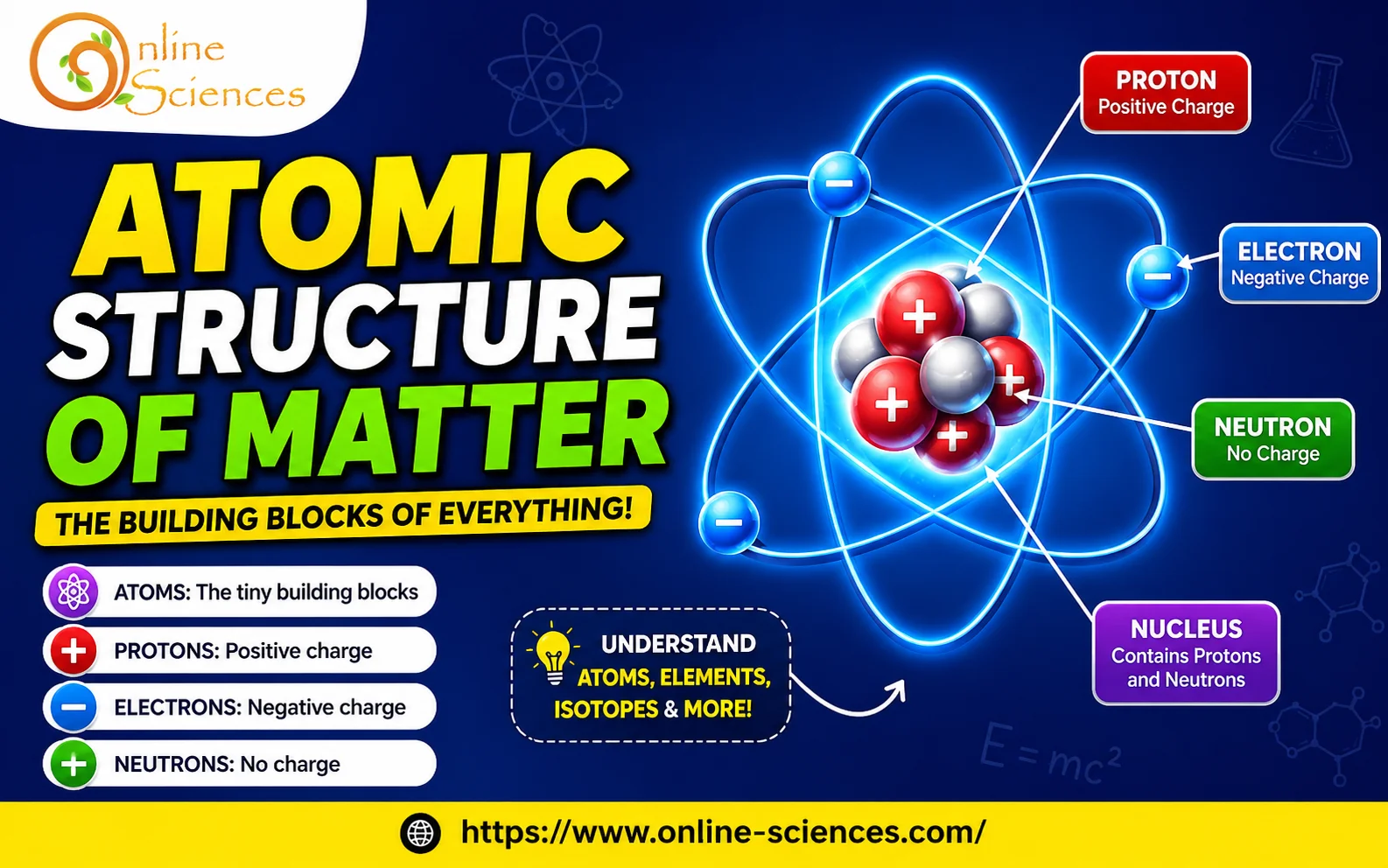
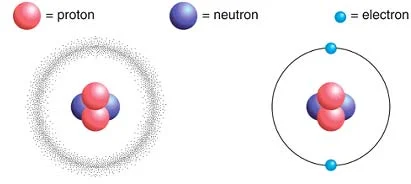
The atom consists of the nucleus and the electrons, and it is electrically neutral in its ordinary state. The nucleus is the central core of the atom, where the mass of the atom is concentrated.
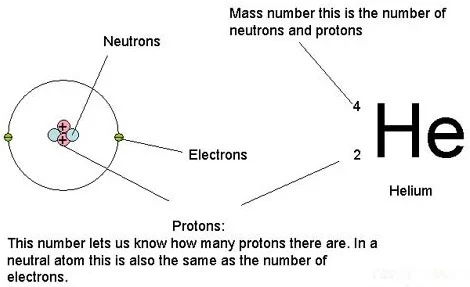
The nucleus is positively charged as it contains the protons (positively charged particles) and the neutrons (electrically neutral particles). The atomic number and the mass number to express the atom of any element.
The atomic number is the number of protons in the nucleus of an atom, and it is written below the symbol on the left. The mass number is the sum of the numbers of protons and neutrons in the nucleus of an atom, and it is written above the symbol on the left side.
The electrons are negatively charged particles; they revolve around the nucleus at a very high speed. The electrons have a negligible mass relative to that of the protons or the neutrons, so the mass of the atom is concentrated in the nucleus.
The number of the negative electrons which revolve around the nucleus is equal to the number of the positive protons in the nucleus, so the atom is electrically neutral in its ordinary state.
The atomic number and mass number of the atom
10 Interesting Facts About the Atomic Structure of Matter
Everything is made of atoms. Every solid, liquid, gas, and even living organism is composed of tiny particles called atoms, making them the fundamental building blocks of matter.
Atoms are mostly empty space. Although atoms contain a nucleus and electrons, most of their volume is empty space between these particles.
The nucleus contains almost all the atom’s mass. The tiny nucleus contains protons and neutrons, which account for more than 99.9% of an atom‘s total mass.
Electrons determine chemical behavior. Electrons orbit the nucleus in energy levels, and their arrangement determines how atoms bond and react with other atoms.
Each element has a unique atomic number. The number of protons in an atom’s nucleus defines its atomic number and identifies the element.
Atoms can exist as different isotopes. Isotopes are atoms of the same element with the same number of protons but different numbers of neutrons, resulting in different masses.
Atoms are incredibly small. A single atom is typically about 0.1 nanometers (1 × 10⁻¹⁰ meters) in diameter, meaning millions of atoms could fit across the width of a human hair.
Atoms are constantly moving. Even in solids, atoms vibrate continuously. In liquids and gases, they move more freely, with higher temperatures causing faster motion.
The modern atomic model evolved over centuries. Scientists such as John Dalton, J. J. Thomson, Ernest Rutherford, Niels Bohr, and Erwin Schrödinger each contributed to our current understanding of atomic structure.
Atomic structure powers modern technology. Knowledge of atoms has led to breakthroughs in electronics, nuclear energy, medicine, nanotechnology, semiconductor manufacturing, and quantum computing, making it one of the most important concepts in modern science.
Frequently Asked Questions (FAQ) about the atomic structure of matter
1. What is the atomic structure of matter?
The atomic structure of matter refers to the arrangement of subatomic particles—protons, neutrons, and electrons—within an atom. It explains how atoms form all substances in the universe.
2. What are the three main particles of an atom?
The three primary subatomic particles are:
- Protons – Positively charged particles found in the nucleus.
- Neutrons – Neutral particles located in the nucleus.
- Electrons – Negatively charged particles that move around the nucleus.
3. What is the atomic number?
The atomic number is the number of protons in the nucleus of an atom. It uniquely identifies each chemical element.
4. What is the mass number?
The mass number is the total number of protons and neutrons present in an atom’s nucleus.
5. Why are electrons important?
Electrons determine an atom’s chemical properties and participate in chemical bonding and electrical conductivity.
6. What is the nucleus of an atom?
The nucleus is the dense central part of an atom containing protons and neutrons. It holds nearly all of the atom’s mass.
7. What are isotopes?
Isotopes are atoms of the same element that have the same number of protons but different numbers of neutrons, resulting in different mass numbers.
8. Why is studying atomic structure important?
Understanding atomic structure helps explain chemical reactions, material properties, electricity, nuclear energy, medicine, and many modern technologies.
9. What is the difference between an atom and a molecule?
An atom is the smallest unit of an element, while a molecule consists of two or more atoms chemically bonded together.
10. Who discovered the atomic structure?
The modern understanding of atomic structure developed through the work of scientists such as John Dalton, J. J. Thomson, Ernest Rutherford, Niels Bohr, and Erwin Schrödinger.
You can follow science online on YouTube from this link: Science online
Evolution concept of the atomic structure, Atomic theory & Properties of cathode rays
Atoms components, Rutherford and Bohr’s Atomic Models
Chemical combination, Types of bonds (Chemical bonds & Physical bonds)
Theories explaining the covalent bond, Octet rule & Overlapped orbitals concept