Boiling Point and Separation of Petroleum Oil: 10 Essential Facts About Fractional Distillation of Crude Oil
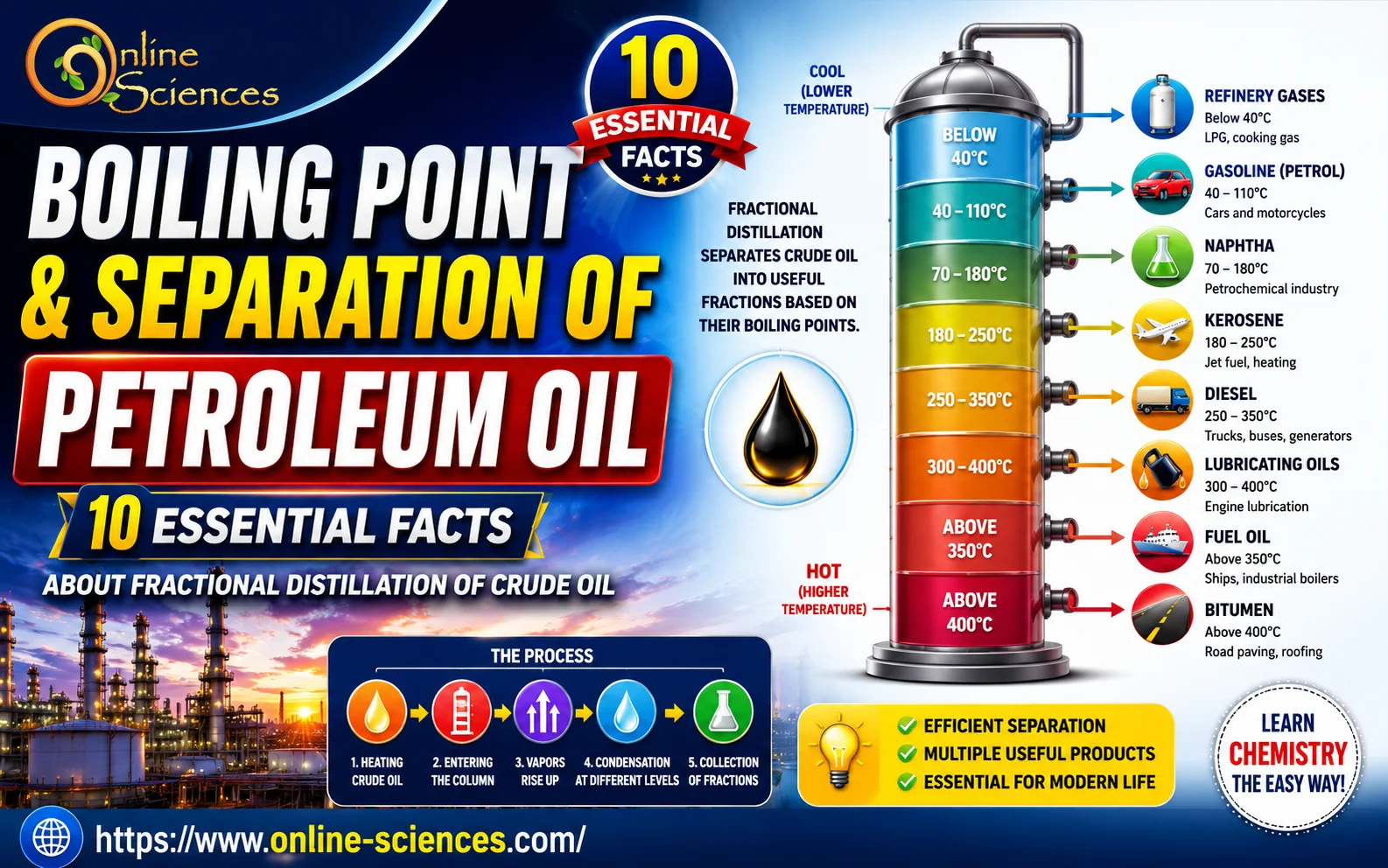
Boiling Point and Separation of Petroleum Oil play a vital role in producing the fuels and petrochemical products used every day. Crude oil is a complex mixture of hydrocarbons, and each component has a different boiling point. Through fractional distillation, crude oil is separated into useful fractions such as gasoline, kerosene, diesel, lubricating oil, and bitumen, making it one of the most important industrial processes in the world.
Boiling Point and Separation of Petroleum Oil
Boiling point
The boiling point is the temperature at which a matter begins to change from a liquid state to a gaseous state. The change of matter from the liquid state to the gaseous state is known as boiling, and the temperature at which the matter begins to boil is called the boiling point.
The boiling point of the water is 100° Celsius, and this means that the water begins to boil and change into water vapor (gas).
The pressure affects the boiling points, and the boiling points of the liquids vary widely at normal atmospheric pressure. Because of this variation in the boiling points, two or more liquids can often be separated by a process called fractional distillation.
At the boiling point, the atoms or the molecules of the liquid gain enough energy to change the liquid into water vapor, and then the liquid rapidly evaporates.
Life application of the boiling process
The separation of petroleum oil depends on the difference between them in their boiling points. The separation of the components of the oil can be done by heating the crude oil and then separating each substance at its boiling point.
Separation of the petroleum oil
The boiling point is the temperature at which the vapour pressure of the substance is equal to the atmospheric pressure. The boiling point depends on the pressure; as the pressure increases, the boiling point increases. The pressure pans are used for fast cooking as they raise the pressure, so the boiling point increases and the food is cooked faster.
Separation of the petroleum oil
The separation of petroleum oil is also known as crude oil refining. It is a process that involves breaking down crude oil into its useful components. This process is primarily carried out through fractional distillation and other refining techniques to produce fuels and other products.
1. Desalting
Crude oil is often contaminated with water, salts, and sediments. The first step in refining is desalting, where these impurities are removed by washing the crude oil with water. This helps prevent corrosion in the refining equipment.
2. Fractional Distillation
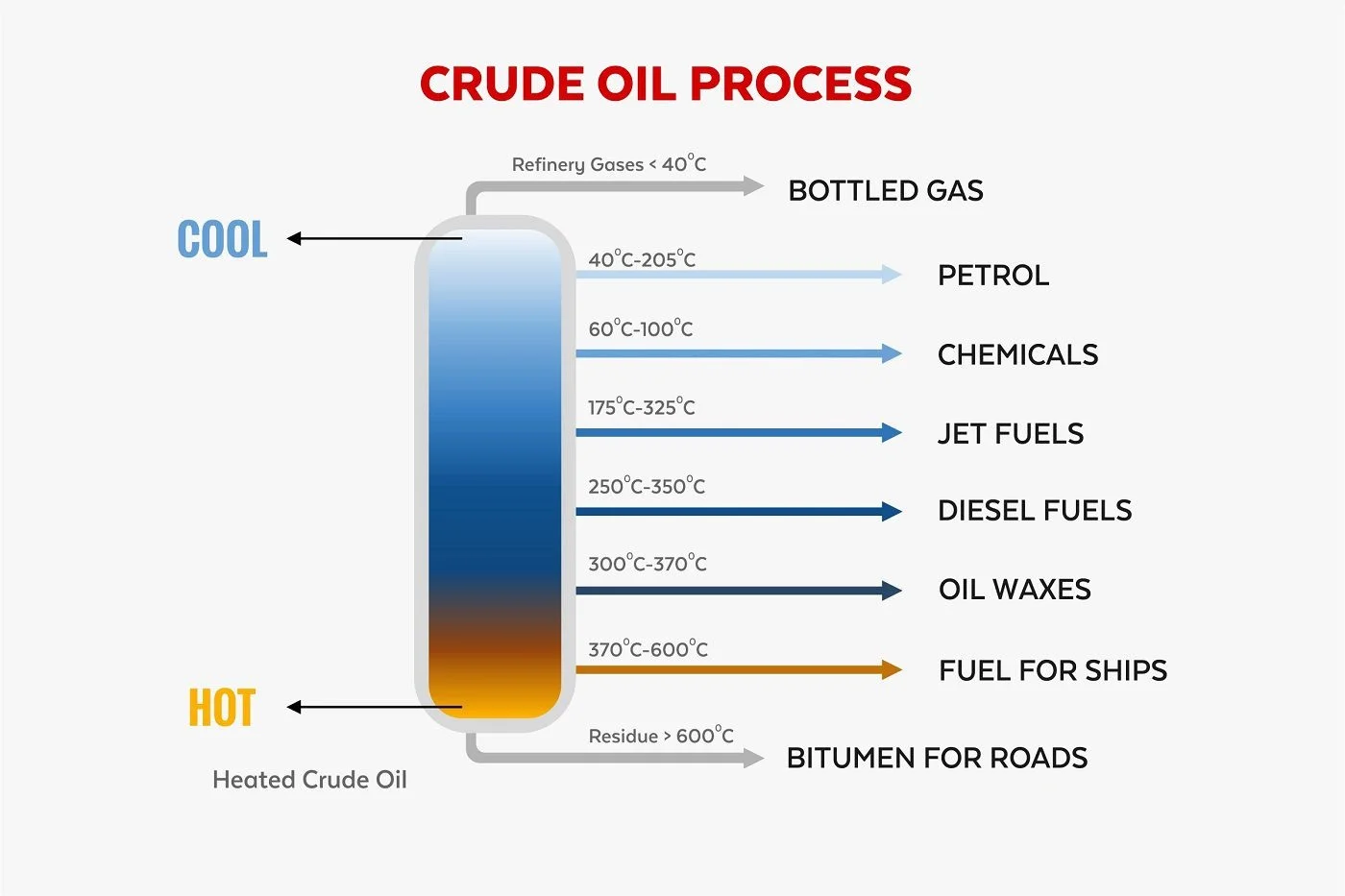
This is the primary method used to separate crude oil into different fractions based on boiling points. Crude oil is heated to about 350-400°C (662-752°F), causing it to vaporize. The vapor enters a fractionating column, where it rises through trays or packing material.
As the vapor cools, different hydrocarbons condense at various levels of the column, depending on their boiling points. Lighter fractions condense at the top, and heavier ones condense at the bottom.
Some common fractions include:
- Petroleum gases (propane, butane) – top of the column, around 20-100°C.
- Naphtha (used for gasoline production) – 70-200°C.
- Kerosene (jet fuel) – 150-300°C.
- Diesel – 250-350°C.
- Heavy gas oils (lubricating oils, fuel oils) – 300-400°C.
- Residuum (asphalt, bitumen) – bottom of the column, remains as the heaviest fraction.
3. Conversion Processes
Some fractions, like heavy oils, may not be useful as-is. Refineries use conversion processes to break these heavy fractions into lighter, more valuable products. These processes include:
- Cracking: Large hydrocarbons are broken into smaller molecules. Types include thermal cracking (using heat) and catalytic cracking (using catalysts).
- Hydrocracking: Uses hydrogen and catalysts to break down heavier fractions into lighter, cleaner products like gasoline and diesel.
4. Treating and Reforming
- Treating removes impurities like sulfur, nitrogen, and metals from the fractions. This process uses techniques like hydrotreating or sweetening to make the products more environmentally friendly.
- Reforming converts the low-octane naphtha into high-octane gasoline by rearranging hydrocarbon molecules. It produces valuable byproducts like hydrogen.
5. Blending
The final products are blended to meet market specifications for fuels such as gasoline, diesel, and jet fuel. Additives may be mixed in to improve performance or reduce environmental impact.
6. Additional Processing Units
Coking: Used to process the heaviest residual oils, yielding lighter products and petroleum coke (used in industrial applications).
Isomerization and Alkylation: Produce higher-octane gasoline components by altering molecular structures.
Final Products
- Fuels such as Gasoline, diesel, kerosene, jet fuel, and fuel oil.
- Lubricants: Motor oils, greases.
- Petrochemicals are used to make plastics, synthetic rubber, and chemicals.
- Other byproducts: Asphalt, paraffin wax, sulfur.
This entire refining process transforms crude oil into usable products by separating it into various hydrocarbon chains with specific applications.
FAQ About Boiling Point and Separation of Petroleum Oil
What is crude oil?
Crude oil (petroleum) is a natural mixture of hydrocarbons formed from ancient plants and animals. It must be separated into useful fuels and products before use.
What is the boiling point?
The boiling point is the temperature at which a liquid changes into a gas. Different hydrocarbons in crude oil have different boiling points.
Why is the boiling point important in separating petroleum?
Fractional distillation separates crude oil because each fraction has a different boiling range. Components with lower boiling points vaporize and condense higher in the column; higher boiling point components condense lower down.
What is fractional distillation?
Fractional distillation is a process that separates crude oil into fractions (groups of hydrocarbons) based on differences in boiling points using a tall fractionating column with a temperature gradient.
Steps of Fractional Distillation of Crude Oil
What are the main steps in fractional distillation?
- Step 1: Heating the crude oil. Crude oil is heated in a furnace to about 350–400°C, turning most of it into vapor.
- Step 2: Entering the fractionating column. The hot vapors rise up the column, which is hot at the bottom and cooler at the top.
- Step 3: Condensation at different levels. As vapors rise, they cool and condense at different trays according to their boiling points.
- Step 4: Collection of fractions. Each fraction is collected separately (gases at the top, heavier oils near the bottom).
- Step 5: Further processing (optional). Some fractions are refined further by cracking, reforming, or treating to improve quality.
Main Fractions & Their Uses
What are the main fractions obtained from crude oil?
Common fractions include:
- Refinery gases (LPG) – cooking gas, heating.
- Petrol (Gasoline) – car fuel.
- Naphtha – petrochemicals, plastics.
- Kerosene – jet fuel.
- Diesel (Gas oil) – trucks, buses.
- Lubricating oil – engine oil.
- Fuel oil – ships, power stations.
- Bitumen (Residue) – roads, roofing.
Which fractions have low and high boiling points?
- Low boiling point fractions: gases, petrol (lighter molecules, more volatile).
- High boiling point fractions: fuel oil, bitumen (heavier molecules, less volatile).
Why do lighter fractions rise higher in the column?
Lighter hydrocarbons have lower boiling points, so they stay as vapor longer and rise higher before condensing in cooler regions.
Why is a temperature gradient important?
The temperature gradient allows each fraction to condense at a specific height, improving separation efficiency.
Is fractional distillation a physical or chemical process?
It is a physical separation process because no new substances are formed; components are separated based on boiling points.
Is fractional distillation harmful to the environment?
Refining can cause pollution if not controlled. Modern refineries use filters, scrubbers, and safety systems to reduce emissions and waste.
Why is petroleum separation important in daily life?
Because it provides essential fuels and materials for:
- Transportation.
- Electricity generation.
- Plastics and chemicals.
- Roads and construction.
Why can’t crude oil be used directly?
Crude oil is a mixture; it must be separated into useful fractions with specific properties.
What determines where a fraction condenses in the column?
Its boiling range and the temperature at that level of the column.
What happens to the residue at the bottom of the column?
The residue (bitumen) is collected at the bottom and used for roads, roofing, or further processing.
Boiling Point and Separation of Petroleum Oil
Petroleum (crude oil) is a naturally occurring fossil fuel formed from the remains of ancient marine organisms over millions of years. Since crude oil contains hundreds of different hydrocarbons, it cannot be used directly. Instead, it must be separated into valuable products according to the boiling points of its components.
This separation is carried out using fractional distillation, where hydrocarbons with lower boiling points evaporate first, while those with higher boiling points remain as liquids until higher temperatures are reached.
What is the Boiling Point?
The boiling point is the temperature at which a liquid changes into a gas when its vapor pressure equals the surrounding atmospheric pressure. Each hydrocarbon in crude oil has a unique boiling point because of differences in molecular size and structure.
- Small hydrocarbon molecules have low boiling points.
- Large hydrocarbon molecules have high boiling points.
This difference allows crude oil to be separated efficiently.
What is Fractional Distillation?
Fractional distillation is a physical separation process that divides crude oil into different fractions based on their boiling points. Each fraction contains hydrocarbons with similar boiling temperature ranges and similar molecular sizes.
Fractional Distillation of Crude Oil Steps
- Heating the Crude Oil: Crude oil is first heated in a furnace to temperatures of approximately 350–400°C. At this temperature, most hydrocarbons vaporize; heavy residues remain liquid.
- Entering the Fractionating Column: The hot mixture of vapors and liquids enters the bottom of a tall fractionating column. The column is: hot at the bottom, and cooler toward the top. This temperature gradient is essential for separation.
- Rising of Hydrocarbon Vapors: The vaporized hydrocarbons rise upward through the column. As they move upward, the temperature decreases. Different hydrocarbons condense at different levels.
- Condensation at Different Levels: Each hydrocarbon condenses when the surrounding temperature becomes lower than its boiling point. This creates separate fractions collected at different trays inside the column.
- Collection of Petroleum Fractions: The separated fractions are removed from the column through side outlets. These fractions include gases, gasoline, naphtha, kerosene, diesel, lubricating oil, fuel oil, and bitumen.
Fractions Obtained from Crude Oil
- Refinery gases: below 40°C, which are used in LPG and cooking gas.
- Gasoline (Petrol): 40–110°C, it is used in cars and motorcycles.
- Naphtha: 70–180°C, it is used in the Petrochemical industry.
- Kerosene: 180–250°C, it is used in Jet fuel and heating.
- Diesel: 250–350°C, it is used in Trucks, buses, and generators.
- Lubricating oils: 300–400°C, it is used in Engine lubrication.
- Fuel oil: Above 350°C, it is used in ships and industrial boilers.
- Bitumen: Above 400°C, it is used in road paving and roofing.
Importance of Fractional Distillation
Fractional distillation is important because it:
- Produces transportation fuels.
- Supplies raw materials for plastics.
- Provides lubricants for machinery.
- Produces asphalt for roads.
- Supports chemical industries.
- Maximizes the value of crude oil.
Factors Affecting Petroleum Separation
Several factors influence the efficiency of fractional distillation:
- Temperature inside the column.
- Pressure.
- Boiling point differences.
- Molecular size.
- Number of trays in the fractionating tower.
- Heat transfer efficiency.
Advantages of Fractional Distillation
- Efficient separation process.
- Large-scale industrial production.
- Produces multiple valuable products.
- High recovery of petroleum fractions.
- Supports modern transportation and manufacturing.
Limitations
- Requires high temperatures.
- Consumes large amounts of energy.
- Produces greenhouse gas emissions.
- Requires expensive refinery equipment.
- Heavy fractions need additional processing.
Amazing Facts About Boiling Point and Separation of Petroleum Oil
- Crude oil contains hundreds of different hydrocarbons.
- Fractional distillation separates oil without changing its chemical composition.
- The fractionating column is hottest at the bottom and coolest at the top.
- Smaller hydrocarbon molecules have lower boiling points.
- Bitumen has the highest boiling point among petroleum fractions.
- Petrol evaporates much faster than diesel because of its lower boiling point.
- Modern oil refineries process millions of barrels of crude oil every day.
- Naphtha is an important raw material for making plastics.
- Jet fuel is mainly produced from the kerosene fraction.
- Fractional distillation is one of the most important processes in the global energy industry.
FAQs about Boiling Point and Separation of Petroleum Oil
1. What is the boiling point in petroleum separation?
It is the temperature at which a hydrocarbon changes from a liquid into a vapor, allowing it to be separated from other hydrocarbons.
2. Why is crude oil separated by fractional distillation?
Because crude oil is a mixture of hydrocarbons with different boiling points that can be separated into useful products.
3. Why is the fractionating column hot at the bottom?
The lower part receives the heated crude oil, while the upper part remains cooler to allow vapors to condense at different heights.
4. Which petroleum fraction has the lowest boiling point?
Refinery gases have the lowest boiling points.
5. Which fraction has the highest boiling point?
Bitumen has the highest boiling point and remains at the bottom of the column.
6. What is the main purpose of fractional distillation?
To separate crude oil into useful fuels and industrial raw materials.
Conclusion
The boiling point and separation of petroleum oil are fundamental concepts in chemistry and petroleum engineering. By using fractional distillation, crude oil is transformed into valuable products such as gasoline, diesel, kerosene, lubricants, and bitumen. Understanding how boiling points determine where each fraction condenses helps explain one of the most efficient and economically important industrial processes in the world.
You can subscribe to Science Online on YouTube from this link: Science Online
Offshore Drilling advantages and disadvantages
Properties of fluids, Factors affecting density and pressure
Applications on the pressure at a point (Connected vessels, U-shaped tube & Mercuric barometer)